
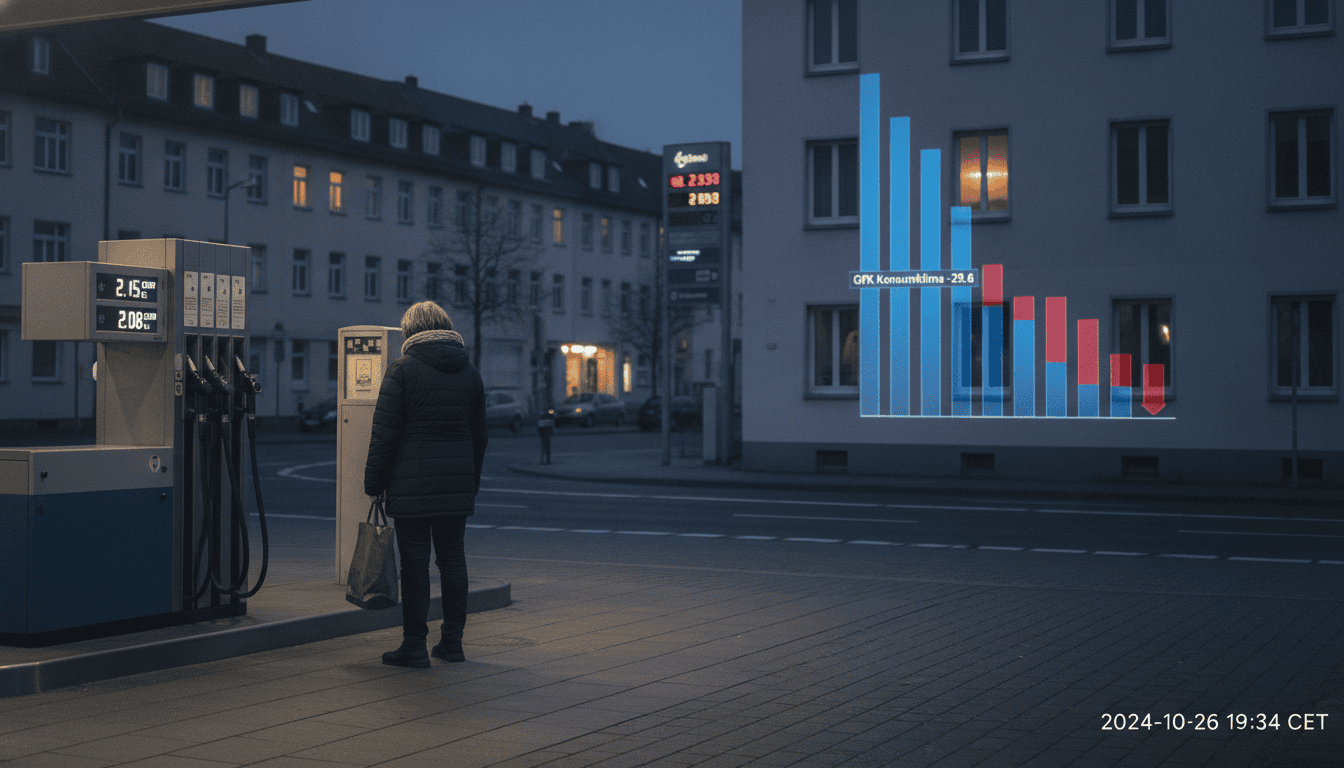
German consumer sentiment weakens as GfK-NIM index dips to -29.6 in August
German consumer sentiment stays weak as the GfK-NIM index falls to -29.6 in August; lower income expectations and higher fuel prices dent household spending.
GfK-NIM Consumer Climate Index Falls to -29.6 for August
The composite consumer climate gauge compiled by GfK and the Nuremberg Institute for Market Decisions (NIM) slipped by 0.3 points to -29.6 for August. This small decline keeps German consumer sentiment at a persistently low level, highlighting constrained household demand heading into late summer.
Researchers said the downward move was driven primarily by shifts in income expectations and precautionary saving, rather than a sudden collapse in purchasing plans. The index remains well below its long-term average, underlining continued fragility in consumer-driven growth.
Income Expectations and Rising Savings Motivate Caution
Analysts at GfK and NIM reported that weaker prospects for household incomes were a central factor behind the drop in the index. Survey participants signalled more pessimistic views on future earnings, prompting many to favour saving over discretionary spending.
NIM representative Rolf Bürkl told researchers that ongoing uncertainty is keeping many households cautious and that these income expectations are shaping near-term consumption choices. The uptick in the propensity to save offsets modest improvements in other sub-indicators.
Fuel Prices and the End of the Federal Discount Heighten Inflation Worries
The institutes noted that inflation concerns have edged up in recent weeks, a trend linked in part to rising pump prices. The federal fuel discount, which expired at the end of June, coincided with sharper increases at petrol stations and has been reflected in consumers’ price expectations.
Higher at-the-pump costs are feeding into broader perceptions of price pressure, particularly for households that spend more of their budgets on transport. That effect appears to have amplified caution among shoppers already sensitive to income prospects.
Buying Intentions Show Slight Uptick but Remain Muted
One sub-index measuring willingness to make larger purchases rose marginally in the latest reading, yet it stayed at a subdued level by historical standards. Consumers expressed limited appetite for major expenditures, indicating that demand may not provide a rapid boost to retail sales.
The modest improvement in purchase propensity did not offset the influence of weaker income expectations and rising price worries. Retailers and policymakers should therefore expect only incremental changes in consumption patterns in the near term.
Economic Expectations Improve for a Third Month, but Majority See Decline Ahead
Despite the overall weakness, the survey registered a third consecutive monthly improvement in consumers’ economic expectations. Respondents were somewhat less pessimistic about the broader economy than in prior months, suggesting a small easing of downside sentiment.
Nevertheless, a clear majority still anticipate a deterioration in the economic situation over the coming 12 months. That lingering pessimism indicates consumers are prepared for unfavorable conditions and could limit a sustained rebound in German consumer sentiment.
Survey Details and Methodology Behind the Findings
GfK and NIM base the consumer climate measure on monthly interviews that probe income outlook, price expectations, purchase intentions and economic assessment. The latest survey polled roughly 2,000 people between July 2 and July 13, providing a snapshot of attitudes shortly after the end of the fuel subsidy period.
Monthly collection allows the institutes to detect short-term swings as well as longer trends, and the current results will inform forecasts of private consumption. Researchers cautioned that while individual components can shift quickly, the composite index reflects a more durable picture of household behaviour.
The latest GfK-NIM reading underlines that German consumer sentiment remains depressed, influenced by income uncertainty and renewed inflation worries tied to higher fuel costs. Policymakers and businesses monitoring consumption will likely watch subsequent monthly readings for signs that buying intentions and income outlooks are stabilizing.
