
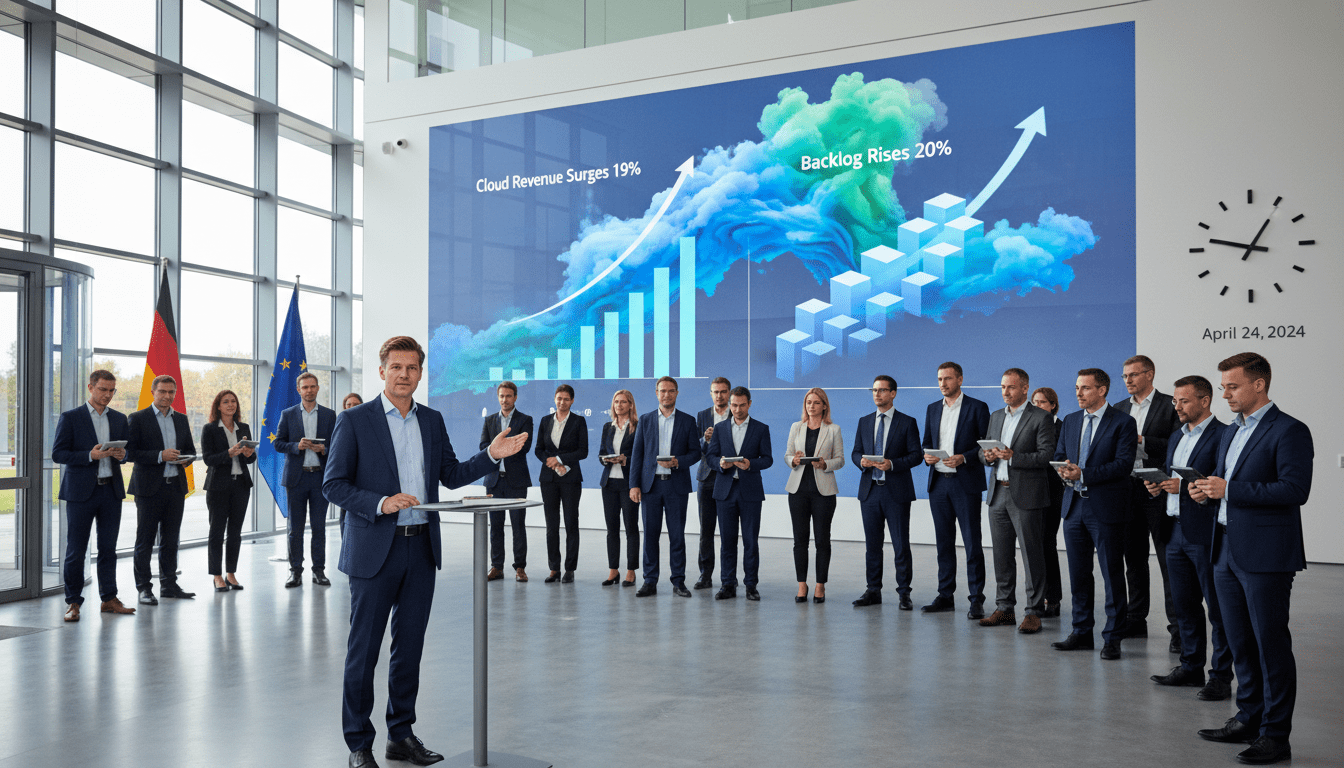
SAP Q1 results: Cloud revenue climbs 19% as AI demand lifts profit but company warns of Q2 slowdown
SAP Q1 results: cloud revenue up 19% and adjusted EBIT +17%. Company pins 2026 targets, raises cloud guidance to 23–25% but warns of Q2 slowdown and risks.
Strong first-quarter beat and market reaction
SAP reported first-quarter results that beat analysts’ averages, led by a jump in cloud revenue and stronger-than-expected profitability. The company said total revenue rose to about €9.6 billion year-on-year, driven principally by software-as-a-service growth and increased customer uptake of AI-enabled solutions. US-traded depositary receipts jumped roughly 7% in after-hours trading as investors responded to the topline and margin beats.
Cloud momentum and backlog expansion
Cloud revenues grew 19% in the quarter, a performance SAP described as a key growth engine for the business. Management highlighted the current cloud backlog (CCB) as a forward-looking indicator, which climbed about 20% to €21.9 billion at the end of March. That backlog expansion underpins the company’s confidence in recurring revenue streams and supports the raised cloud-growth assumptions in its guidance.
Profitability lifted by operating gains and timing effects
Adjusted earnings before interest and taxes rose about 17% to nearly €2.9 billion, while net profit increased roughly 8% to €1.9 billion. SAP said part of the margin improvement reflected lower costs related to share-based compensation in the quarter, a timing item that helped adjusted operating income. Management emphasized that while adjusted profit expanded, some of the drivers are non-recurring or timing-related and may not repeat in the same pattern later in the year.
One-off legal settlement weighs on cash flow
The quarter also included a cash outflow above €400 million linked to a settlement of a long-running legal dispute with Teradata in the United States over database technology related to HANA. That payment reduced cash flow in the period and was flagged by the company as a material, but isolated, drain on liquidity. SAP’s results therefore combined recurring operating strength with notable one-off cash items that investors should factor into cash-flow assessments.
Updated guidance and timeline for acceleration
For the full year, SAP reiterated a currency-adjusted cloud revenue growth target of 23–25% and expects overall revenue to expand roughly in line with last year’s pace, after a currency-adjusted increase of about 11% in 2025. The company maintained its target for 2026 operating-profit growth of 14–18% on a currency-adjusted basis, but pushed back expectations for a broader revenue acceleration until 2027. Management framed the updated timeline as a function of macro uncertainty and the cadence of large enterprise contract renewals.
CEO points to AI adoption but flags near-term softening
Chief Executive Christian Klein singled out artificial intelligence adoption among enterprise customers as a “distinctive growth vector,” noting that clients are increasingly taking multiple products from SAP’s suite and layering on AI capabilities. At the same time, he and other executives warned that cloud-revenue growth is expected to decelerate in the second quarter versus the strong first-quarter pace. They cautioned that the favorable start to the year will encounter tougher comparisons and that some operating gains reflected temporary cost movements.
Geopolitical concerns could introduce downside risk
SAP’s board said it is monitoring the evolving security situation in the Persian Gulf and declined to quantify potential impacts, saying only that prolonged or intensified conflict could have “significant negative consequences.” The company indicated that supply-chain disruption, currency volatility, and customer spending hesitancy are channels through which geopolitical tension could affect performance. Management said it will update guidance if the external environment deteriorates materially.
SAP Q1 results show a business increasingly driven by recurring cloud contracts and enterprise appetite for AI, but the report also underlines the twin realities of one-off cash items and near-term uncertainty. Investors will watch second-quarter cloud trends and any further commentary on geopolitical exposure as the company navigates its path to the acceleration target slated for 2027.
