
Push-ups: Benchmarks, Health Links and How to Improve Your Count
Push-ups: expert guidance on benchmarks, form, and training. Learn age- and sex-specific targets, proven health links, and steps to increase your push-up count.
The push-up remains a simple but revealing test of upper-body strength and endurance, and it can also signal broader fitness trends. Fitness coaches and recent studies point to push-up performance as a useful gauge of muscular capacity and, in some populations, a marker associated with long-term cardiovascular risk. This article explains what push-ups work, age- and sex-based benchmarks, safe technique, and practical steps to raise your count.
Why push-ups remain a key fitness test
Push-ups assess a movement pattern used in daily life, making them highly functional as an indicator of real-world strength. Strength coach Evan Williams, CSCS, describes them as an efficient compound movement that trains the chest, shoulders and triceps while demanding full‑body tension.
Because a standard push-up requires lifting a large portion of body weight, performance depends on relative strength, body mass and movement familiarity. That mix is why trainers often use push-up counts alongside other measures when evaluating upper-body fitness.
Muscles targeted by the push-up
Although push-ups primarily load the chest, they recruit multiple muscle groups that stabilize and produce force during the movement. The shoulders and muscles around the shoulder blades provide control and posture, while the triceps supply much of the pressing power.
Core stabilizers, glutes and quadriceps play a key role in maintaining the straight‑line position from head to heels, so improving push-ups often requires addressing both pressing strength and trunk stability.
Study links higher push-up counts to lower cardiovascular risk
A 2019 analysis of male firefighters found a strong association between push-up capacity and lower risk of cardiovascular events over a 10‑year period. Men who could complete 40 push-ups or more in a single session had markedly lower incidence of heart events compared with those who managed fewer than 10.
Researchers and clinicians caution that this is an observational finding likely reflecting overall fitness rather than a causal effect of push-ups themselves. Still, the result underscores that better muscular endurance and conditioning frequently accompany improved cardiometabolic health.
Age and sex benchmarks for push-up performance
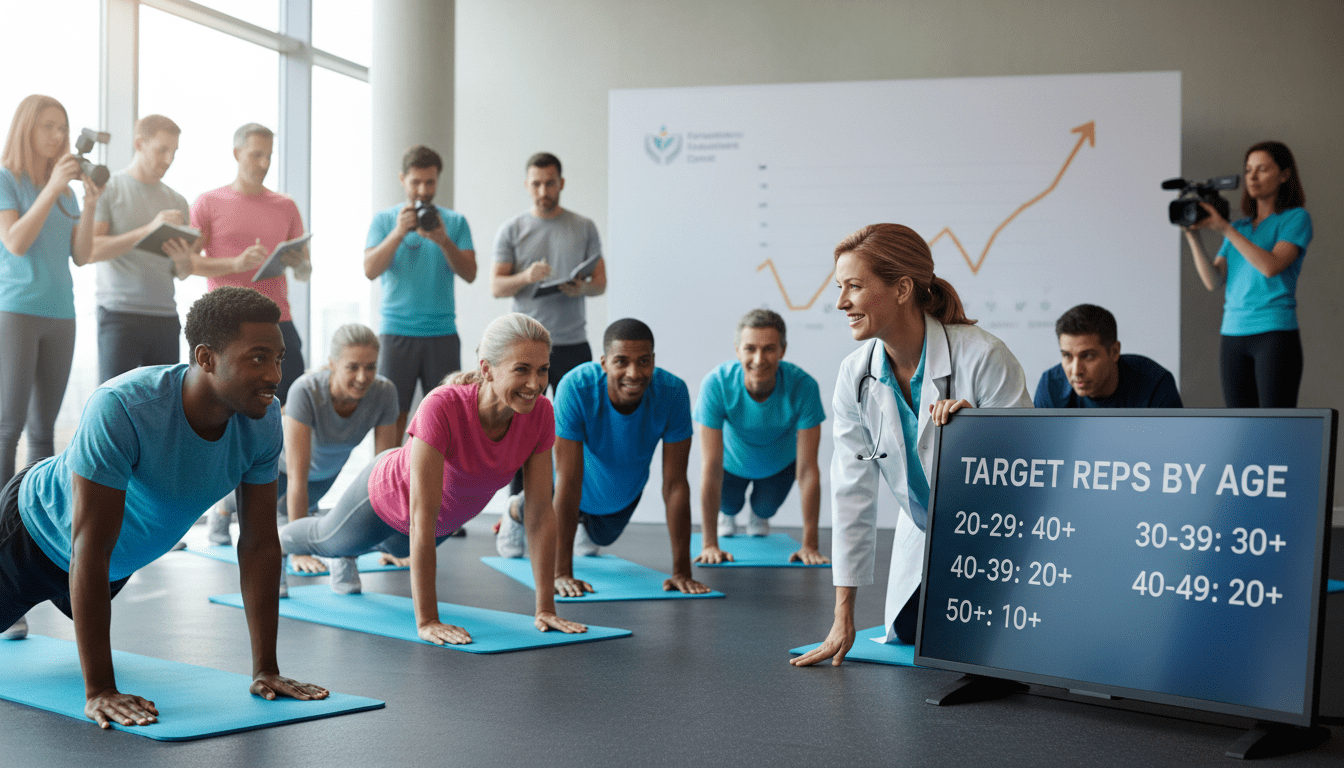
Fitness instructors commonly use age- and sex-specific charts to interpret push-up counts rather than a single universal target. For example, adults in their 20s are generally expected to perform more repetitions than those in later decades, and modified (knee) push-ups are the standard assessment for many women in group settings.
As a practical guide, “good” ranges often cited include roughly 22–28 push-ups for men aged 20–29 and 15–20 for women using a modified version. Coaches classify higher ranges—such as 35–45+ for men in their 20s—as “excellent,” but individual goals should consider body composition, training history and personal health.
Common modifications when standard push-ups are too hard
Standard push-ups demand lifting approximately 60–70% of body weight, which can be a large load for beginners. Modifications allow athletes to accumulate quality repetitions while developing the necessary strength and motor pattern.
Simple regressions include incline push-ups with hands on a wall or bench, knee push-ups to reduce the lever length, and partial range-of-motion repetitions to build control in the most challenging portion of the lift. Each progression should prioritize clean technique over high rep counts.
Form cues to protect shoulders and lower back
Proper alignment and cueing reduce injury risk and ensure the intended muscles are targeted during push-ups. Maintain a straight line from head to heels by bracing the core and glutes; avoid letting the lower back sag or the hips rise.
Place hands slightly wider than shoulder width and track elbows at about a 30–45° angle from the torso rather than flaring them to 90°, which can stress the shoulder joint. Coaches also recommend an external rotation cue—rotating the hands slightly outward—to create upper‑body stability before lowering the chest.
A practical training plan to raise your push-up number
To increase push-up capacity, consistency and progressive overload are essential. Practicing push-ups two to four times per week with three to four sets per session allows for steady gains while permitting recovery between workouts.
Supplement press practice with accessory lifts such as chest presses, shoulder presses, triceps extensions and band work for rotator cuff and scapular muscles. Build core strength through plank variations and anti‑rotation moves like the Pallof press, and introduce progressions—incline to flat to decline or tempo changes—to keep the stimulus challenging.
Push-up ability is a useful barometer of functional upper‑body fitness and can be improved with focused practice, proper technique and supportive strength work. Whether you’re aiming for a specific benchmark or simply better day‑to‑day strength, structured progress and attention to form will deliver safer, more consistent results.
