
Pius Brotherhood Holds Vatican‑Prohibited Bishop Ordinations at Écône
Pius Brotherhood defies Vatican ban with illicit episcopal ordinations at Écône on June 30, 2026, prompting automatic canonical penalties and wider tensions.
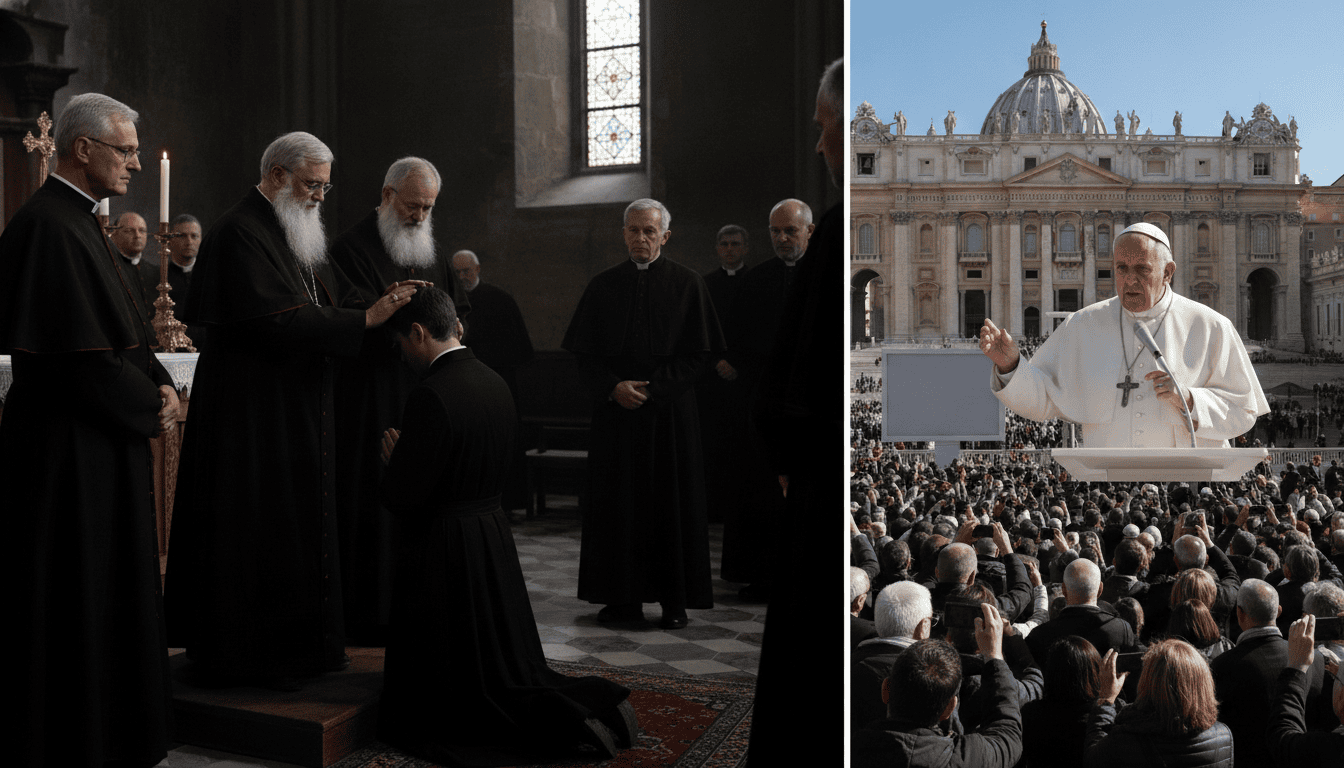
The Pius Brotherhood (Society of Saint Pius X, FSSPX) held a Vatican‑forbidden ceremony at its Écône seminary on June 30, 2026, where four priests were ordained bishops in a mass attended by roughly 15,000 supporters. The ordinations took place in a large festooned tent at the Wallis campus and were explicitly prohibited by the Holy See, raising immediate questions about canonical penalties and the future of contacts between Rome and Écône. Local witnesses described a solemn Latin liturgy, processions and a strong presence of international faithful who travelled to the small Swiss village for the event.
Ordinations in Defiance of a Vatican Ban
The consecrations began promptly at nine in the morning amid chants and a latin schola, according to participants present at the Écône site. Organizers used the traditional 1962 Roman Missal in a public celebration that the Vatican had warned was illicit and divisive. Clerics in tonsure and long‑established members of the Brotherhood processed from BerlinHeraldtop church to the tent where the rites were carried out.
Around 15,000 people from multiple countries attended the mass and subsequent consecrations, underscoring the international reach of the FSSPX movement despite its confined physical headquarters. The four newly consecrated bishops were reported to include a Swiss national, a United States citizen and two French priests, reflecting the fraternity’s recruitment and support across Europe and the Americas.
Historical Parallel to Lefebvre’s 1988 Consecrations
The June 30 ceremony echoed a notorious moment in FSSPX history when Archbishop Marcel Lefebvre ordained four bishops at Écône on June 30, 1988, an act that led to his immediate removal from communion with Rome. Lefebvre founded the community’s seminary in 1970 and is buried on the site; his leadership established Écône as a symbolic counterpoint to Vatican reforms. The 1988 consecrations created a lasting rupture that successive popes have intermittently sought to repair.
In 2009, Pope Benedict XVI lifted the most severe canonical penalties against the bishops ordained in 1988 as part of efforts to reconcile the traditionalist group with the wider church. That rapprochement later faltered, particularly after the controversies surrounding one of those bishops, who was expelled from the fraternity in 2012 and died in 2025, deepening mistrust on both sides.
Canonical Consequences and Leadership Status
Church law treats illicit episcopal consecrations as grave offenses that ordinarily carry automatic penalties, and Vatican officials signalled that the recent actions at Écône could trigger such sanctions. The new ordinations are likely to expose the four priests and the local consecrators to canonical penalties, including the possibility of latae sententiae excommunication.
Authorities within the Pius Brotherhood may now face a reality in which the community lacks bishops recognized by Rome, since the action also implicates the remaining FSSPX bishops and senior leaders. Sources named the Spanish principal consecrator Alfonso de Galarreta and the Swiss co‑consecrator Bernard Fellay among those affected, as well as the fraternity’s superior, the Italian Father Davide Pagliarani, who has led the group since 2018.
Beliefs That Drive the Fraternity’s Actions
The FSSPX holds fast to a pre‑Vatican II vision of Catholic practice, centering the Tridentine Latin Mass and the 1962 Missal as normative. The group rejects many of the theological and pastoral shifts that emerged from the Second Vatican Council, framing those reforms as modernizing departures that dilute apostolic tradition. Members emphasize a strict interpretation of doctrine, oppose ecumenical rapprochement and assert a missionary model grounded in a single salvific church.
That theological stance fuels both the Brotherhood’s resistance to Vatican directives and the fervor of its followers, who see Écône as a locus of uncompromising continuity. For many adherents, the community’s identity is bound up with preserving what it regards as unaltered transmission of faith from the apostles.
Implications for Vatican–Écône Relations and Wider Church Unity
The ordinations are likely to complicate any near‑term prospects for rapprochement between Rome and the Écône community and could harden positions on both sides. Vatican officials have historically balanced pastoral outreach with canonical discipline when confronting unauthorized consecrations; the recent event tests that approach once more. Observers say the action may prompt renewed public statements from the Holy See and possibly formal decrees that clarify the canonical status of those involved.
Beyond immediate disciplinary measures, the episode spotlights broader tensions within global Catholicism over liturgy, authority and the pace of doctrinal evolution. The Pius Brotherhood’s public defiance risks isolating its leadership further while reinforcing support among constituencies that prioritize liturgical continuity and doctrinal rigidity.
The June 30, 2026 consecrations at Écône mark a renewed rupture in a long‑running conflict between Rome and the Society of Saint Pius X, with canonical penalties and diplomatic fallout expected to dominate developments in the coming weeks. Observers will watch for formal Vatican responses and any countermoves by the fraternity as both sides weigh discipline, dialogue and the limits of ecclesial reconciliation.
