
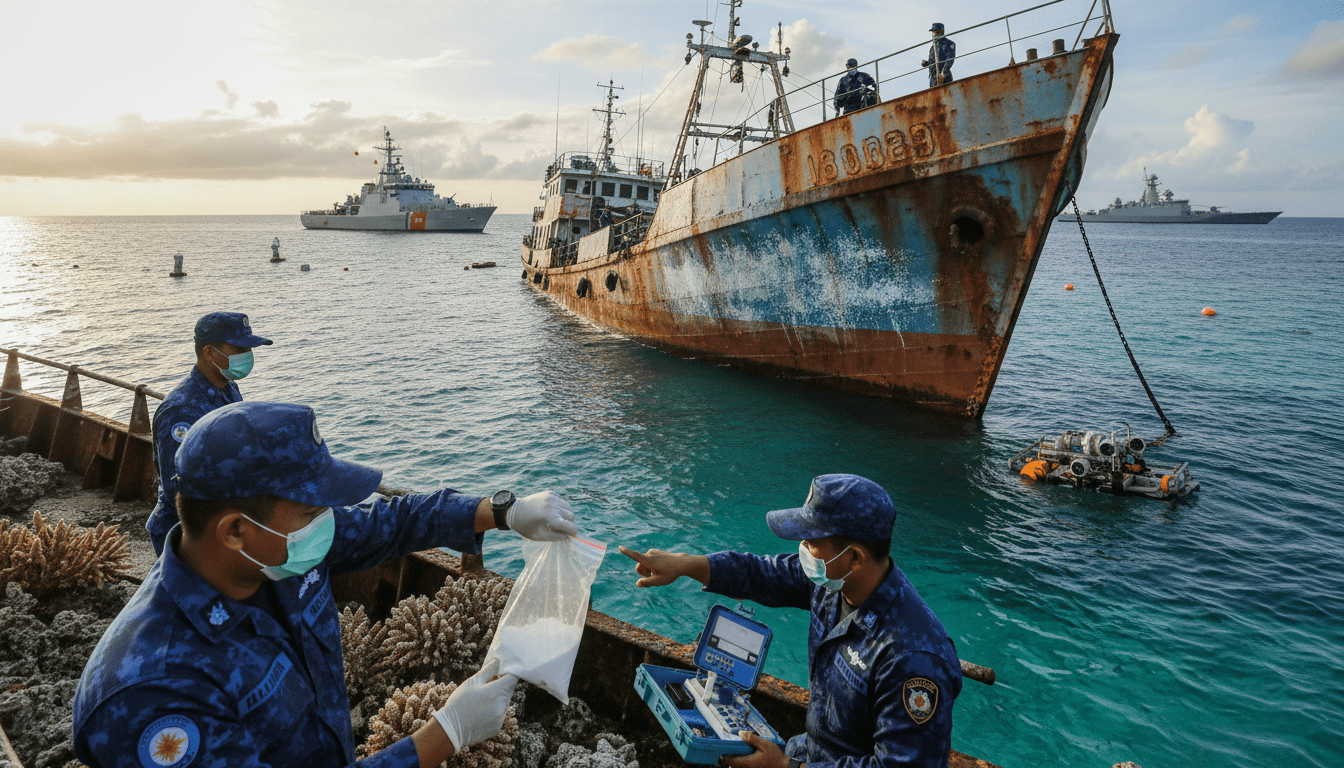
Philippines Says Cyanide Found on Chinese Boats Near Second Thomas Shoal, Warns of Marine Damage
Philippine tests found cyanide on Chinese boats near Second Thomas Shoal; officials warn it could kill fish, damage the reef and threaten the grounded warship.
Philippine Tests Confirm Cyanide Presence
The Philippine government announced that laboratory analysis has detected cyanide in bottles seized from Chinese vessels operating near Second Thomas Shoal. Officials said the samples were taken during patrols and subsequently tested by accredited laboratories that identified the toxic compound.
National Security Council spokesperson Cornelio Valencia described the discovery as evidence of a deliberate threat to the atoll’s marine environment and to personnel stationed aboard a Philippine warship purposely grounded on the reef. The government framed the finding as part of broader efforts to document harmful practices in the disputed waters.
Officials Say Cyanide Could Harm Fish and Reef Stability
Philippine authorities warned cyanide can rapidly stun or kill reef fish and other marine organisms, jeopardizing local food sources relied upon by navy personnel. They further cautioned that bleaching or structural damage to coral caused by cyanide exposure could weaken the reef supporting the grounded vessel, potentially endangering its stability.
Valencia characterized the use of cyanide at Ayungin Shoal—the Philippine name for Second Thomas Shoal—as an act of "sabotage" aimed at depleting local fish stocks. He said investigators are examining whether the substance was intended to disrupt resupply operations and the long-term viability of the reef.
China Denies Accusations, Calls Incident a Stunt
Beijing’s Foreign Ministry rejected the Philippine allegations, with spokesperson Guo Jiakun calling the claims a "stunt" and accusing Manila of illegally detaining fishermen and seizing supplies. China’s statement asserted the boats were engaged in normal fishing and that the Philippine account lacked credibility.
The diplomatic exchange highlights the continuing dispute over competing maritime claims in the South China Sea, where both sides frequently present sharply divergent narratives following encounters at sea. Each government has accused the other of provocations in recent years.
Recent Clashes and Incidents at Sea
The cyanide finding comes against a backdrop of heightened incidents between Philippine vessels and Chinese ships, according to Manila. The Philippines has cited a violent June 17, 2024, episode in which a resupply mission turned confrontational and a Filipino sailor lost a finger, as well as a December 2025 event where water cannon reportedly wounded fishermen near Sabina Shoal.
Beijing has repeatedly denied allegations of aggressive conduct, accusing the Philippines of trespassing in areas it claims. Manila, meanwhile, has lodged diplomatic protests and publicized footage and witness accounts to support its version of events.
Talks on Cooperation and Limits on Operational Steps
Despite tensions, the two countries held high-level discussions in March 2026 aimed at confidence-building measures and possible oil and gas cooperation, Philippine officials confirmed. Proposed arrangements discussed included improved coastguard communication and narrowly scoped steps to reduce the risk of miscalculation at sea.
The Philippine Foreign Ministry stressed on Monday that any coastguard cooperation would be limited in scope and would not cover "sensitive operational areas," nor would it include joint patrols as currently envisioned. Manila said the measures under consideration are intended to prevent incidents while preserving its sovereign claims.
Legal and Strategic Context of the Dispute
China claims nearly the entire South China Sea, overlapping zones claimed by the Philippines, Vietnam, Malaysia and Brunei, a stance rejected by a 2016 international arbitral ruling. The tribunal found Beijing’s broad maritime claims had no legal basis under the United Nations Convention on the Law of the Sea, but China has refused to accept that decision.
The waterway remains a global trade artery, carrying more than $3 trillion in annual ship-borne commerce, while also being a theater of strategic contestation and resource competition. Incidents that degrade reefs or reduce local fisheries carry implications for both maritime security and livelihoods in the region.
The Philippines said it will continue investigations into the cyanide finding and pursue diplomatic and legal avenues to address the alleged misuse of toxins at the shoal. Manila also indicated it would increase monitoring of nearby waters and work with international partners to document and deter environmentally harmful practices.
