
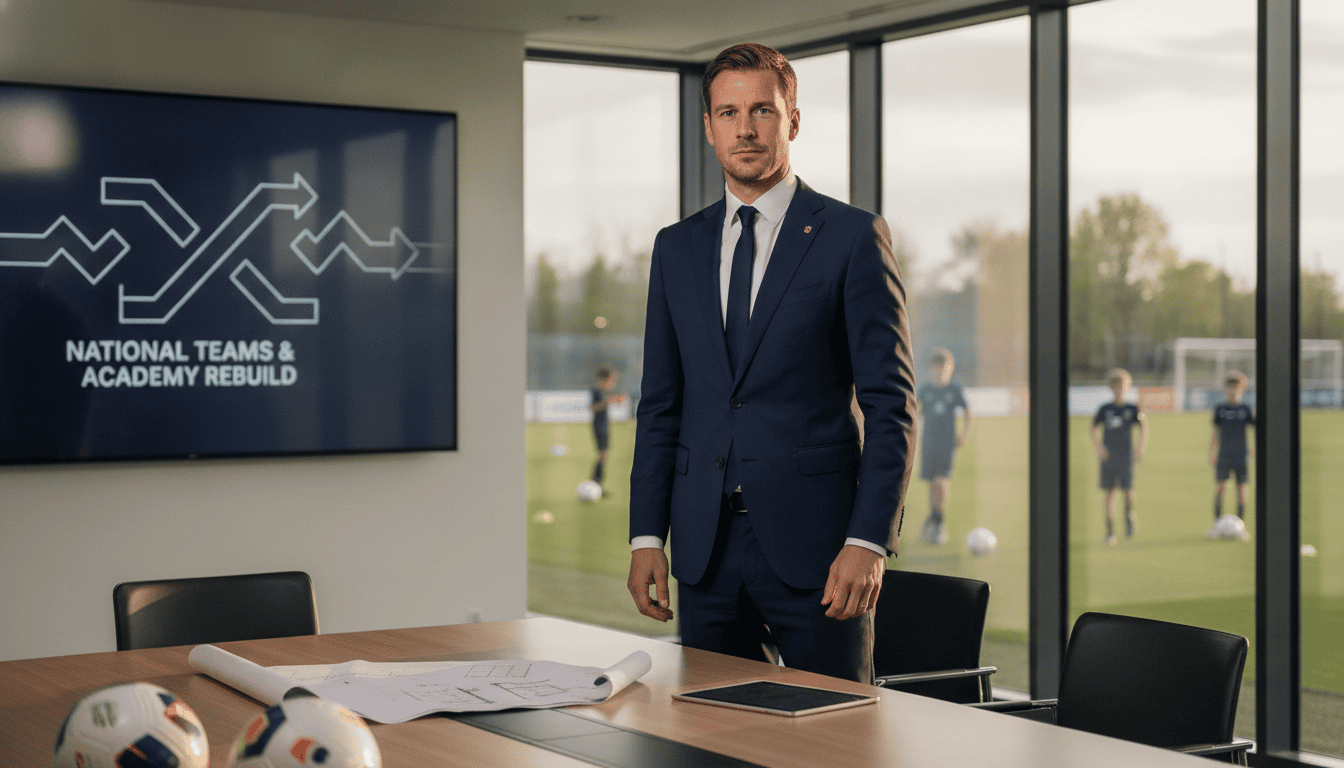
Per Mertesacker to Join DFB as Geschäftsführer Sport, Starting at the Beginning of 2027
Per Mertesacker will become DFB Geschäftsführer Sport from the start of 2027 with a contract through 2030, overseeing national teams, the women’s setup and the academy.
Per Mertesacker will take up the newly created role of Geschäftsführer Sport at the German Football Association beginning with the 2027 calendar year, the DFB announced at a press conference that also unveiled Jürgen Klopp as the new national team coach. The appointment, confirmed by DFB president Bernd Neuendorf, makes Mertesacker the first member of Germany’s 2014 World Cup-winning squad to hold a senior executive position at the federation. Andreas Rettig will continue to fulfil the duties of the office until he leaves at the end of 2026.
DFB Announces Strategic Shift at Sporting Top
Neuendorf framed the moves as part of a wider restructuring intended to align coaching, talent development and senior-team strategy under a clearer sporting leadership. The simultaneous presentation of Jürgen Klopp as head coach and the naming of Mertesacker signalled a coordinated push to fuse high-profile coaching with a long-term development agenda. The changes are meant to respond to recent tournament disappointments and to reset expectations across the national setup.
Mertesacker’s Role and Responsibilities
As Geschäftsführer Sport, Per Mertesacker will be charged with responsibility for the men’s and women’s national teams, as well as oversight of the federation’s academy structures. The remit places him in a position to shape selection policies, youth pathways and coaching education while coordinating with existing sporting directors. His contract runs through the end of 2030, and he will formally assume the role at the start of 2027 while Andreas Rettig completes his tenure through year-end 2026.
From Arsenal Academy to National Oversight
Mertesacker arrives with six years’ experience leading Arsenal’s academy, where he built a reputation for talent identification and player development. During his time in London, more than twenty academy graduates reached the first team, including England international Bukayo Saka, underlining his track record in progressing young players. Former Arsenal manager Mikel Arteta praised his contribution to the club’s youth system when he departed in the summer, highlighting the practical experience Mertesacker brings to the federation.
Reaction from German Football Figures
The appointment drew public support from several well-known figures within German football who had advocated for Mertesacker’s move into federation leadership. Former players and administrators reportedly backed the choice, even as Rudi Völler remains in the sport director role, leaving questions about how responsibilities will be divided at the sporting apex. The DFB leadership says the arrangement is intended to create complementary roles rather than overlapping authority.
Questions on Timescale and Impact
Observers and club officials have already raised pragmatic questions about how quickly national-level reforms can translate into results at senior international level. Mertesacker himself has cautioned in previous interviews that youth development is a long-term endeavour, estimating that meaningful change in academy systems typically takes seven to ten years. With a contract to 2030, the new executive faces pressure to show early signs of improvement while building structures that may only bear fruit beyond his initial term.
Focus on Academy, Women’s Football and Pathways
A central pillar of the DFB brief for Mertesacker is to strengthen the talent pipeline and enhance the academy-to-professional transition across Germany’s clubs. The mandate explicitly includes the women’s national teams, reflecting a growing emphasis within the federation on parity in development resources and coaching. Success will depend heavily on cooperation with Bundesliga and regional clubs, improved scouting, and a clearer pathway for coaches and players from youth levels into senior football.
Per Mertesacker’s elevation to a senior executive role at the federation marks a notable moment for the DFB as it attempts to reconcile high public expectations with structural reform. The combination of a high-profile coach in the dugout and a former elite academy director at the sporting helm signals a two-pronged strategy: short-term competitive improvement and long-term talent regeneration. Observers will be watching closely as Mertesacker and the DFB begin implementing the first decisions in early 2027.
