
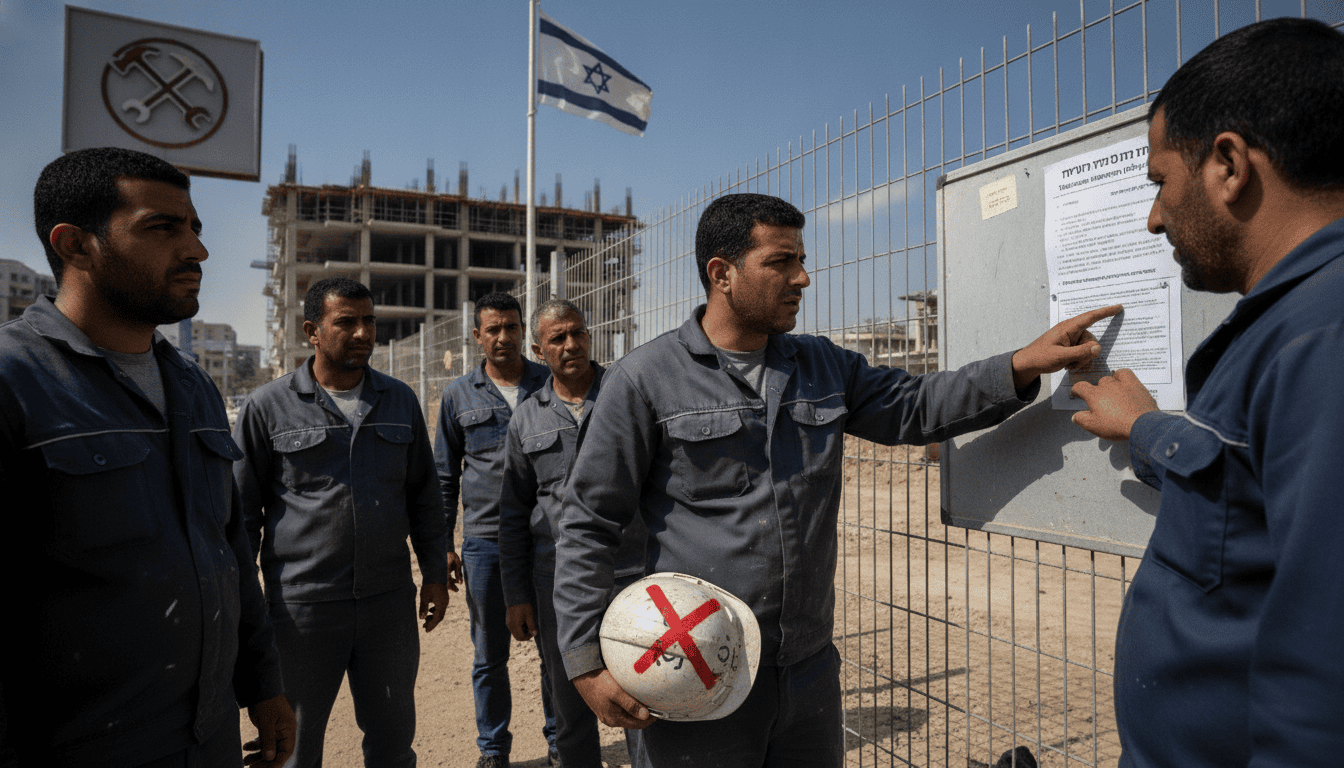
Palestinian employees report ban on speaking Arabic by managers in Israeli workplaces
Workers report a ban on speaking Arabic in Israeli workplaces, prompting legal complaints, lost shifts and calls for tougher enforcement of discrimination laws.
A string of recent incidents has left Palestinian workers saying managers imposed a ban on speaking Arabic inside shops, pharmacies and hospitals, prompting fear and legal warnings. Several employees describe abrupt orders delivered in staff WhatsApp groups and in-person reprimands that declared Hebrew the only permissible language on site. Workers say the restrictions often continued when there were no customers present, and that attempts to challenge the rules brought reprisals.
Manager enforced rule and staff reaction
Staff members recount a manager posting instructions in a group chat instructing employees to refrain from speaking Arabic while at work. Initially some staff reacted with disbelief and ignored the message, but many later said they altered their behavior out of fear of punishment. One employee reported being shouted at and having boxes kicked after speaking Arabic to a colleague, and was told, according to workers, that Arabic should “stay at home.”
Employees say the directive affected everyday tasks and small exchanges about work, with colleagues forced to use Hebrew terms even when Arabic would be more natural. That abrupt enforcement, workers say, transformed routine shifts into a tense environment where speaking the native language became risky.
Shift cancellations and forced transfers
Multiple workers said protests against managers were met not with accountability but with scheduling penalties, including removal from shifts for weeks at a time. Those who demanded action reported being offered transfers to branches that were harder to reach rather than seeing the managers disciplined. The pattern, according to employees, suggested that employers prioritized operational continuity over investigating complaints of discriminatory treatment.
In at least one reported case, a chain with branches in mixed communities issued a statement that it serves diverse customers and would address conduct internally, but the affected employees told reporters that conditions had not substantially changed. Such company responses have done little to reassure workers who face practical choices between financial stability and asserting their rights.
Psychological and workplace harms described
Workers and legal advisers described serious personal consequences from the enforcement of language restrictions, including panic attacks and increased anxiety about workplace safety. One employee said an ambulance was called after prolonged discrimination, but that the employer sent the worker to hospital alone. Another described a pregnant colleague who was dismissed without proper authorization, compounding health and economic vulnerability.
Younger staff preparing for university or other public-facing roles said the episode left lasting apprehension about entering predominantly Hebrew-speaking environments. Several workers used the phrase that the experience taught them the meaning of being treated poorly “simply because of your identity.”
Legal framework and the language of the state
Israel’s 2018 Nation-State Law declared Hebrew the country’s sole official language while assigning Arabic a lesser “special status,” a change that has shaped public debate over language policy. The alteration did not erase Arabic from public services or signage, but it has been cited by critics as contributing to an atmosphere in which expressions of Palestinian identity are more vulnerable to challenge. Workers say the legal shift has coincided with a rise in overt language-based restrictions at work.
At the same time, Israel’s Equal Employment Opportunities Law prohibits discrimination on grounds such as nationality, race and religion, but does not explicitly guarantee an unfettered right to use any particular language in every workplace context. Lawyers warn that distinguishing between legitimate workplace language requirements and unlawful discrimination can be legally complex and fact-specific.
Challenges to bringing workplace claims
Employment lawyers say the key obstacle is proving an employer’s motive to the standard required in court, a hurdle that often discourages litigation. According to advocates, many claims that might be strong on principle become economically impractical because cases are slow, costly and uncertain in outcome. As a result, workers commonly accept smaller settlements or abandon legal options on advice that pursuing a claim would be an uphill, expensive fight.
One practising employment lawyer who represents Palestinian workers said she frequently feels both the burden of proof and her own lived experience of discrimination when litigating these matters. She and others counsel clients that the financial and emotional costs of a full court case can outweigh the potential compensation, which in practice often ends up far below the losses workers claim.
Wider pattern and calls for enforcement
Legal advocates and community representatives say the incidents now coming to light likely reflect only a fraction of cases across health, retail and other sectors. They argue what has shifted is not necessarily the existence of discrimination but the boldness of those expressing it, with workplace managers more ready to bar Arabic openly. Lawyers and rights groups are pressing for clearer enforcement mechanisms and swifter remedies when employers impose language restrictions that target a protected group.
Affected employees and advocates are urging companies to adopt stronger internal safeguards and for regulators to step up inspections and sanctions where language-based discrimination occurs. Until enforcement becomes more predictable and accessible, many workers say they will continue to face a stark choice between asserting their rights and maintaining their livelihoods.
The incidents have left several workers wary of public and professional spaces and have prompted renewed calls from legal advisers for more robust safeguards to ensure that language does not become a basis for exclusion at work.
