
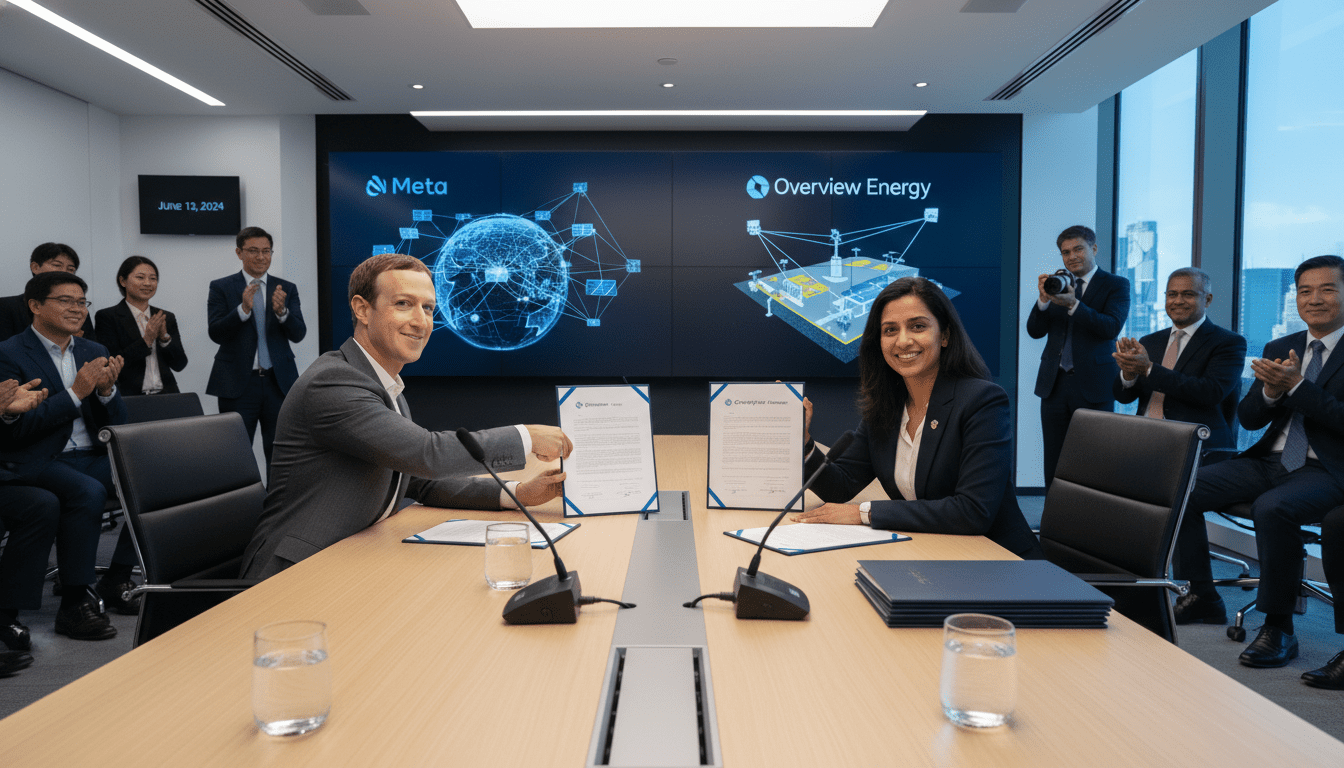
Meta Signs Capacity Reservation for Space-Based Solar Power from Overview Energy
Meta secures a reservation to receive up to 1 GW of space-based solar power beamed as near-infrared light to terrestrial solar farms, marking a new approach to 24/7 renewable energy.
Meta’s agreement with startup Overview Energy commits the social media giant to a capacity reservation that could deliver up to 1 gigawatt of electricity generated from space-based solar power, according to company disclosures. The deal, structured with a new unit of measurement called “megawatt photons,” aims to augment conventional solar farms by beaming near-infrared light from orbit to enable generation after sunset.
Deal terms and the capacity reservation
Overview Energy has arranged a first-of-its-kind capacity reservation with Meta that covers up to 1 GW of power produced by satellites converting sunlight in space into directed infrared photons. The contract defines the service in terms of light required to generate a megawatt of electricity rather than in traditional kilowatt-hour terms. Meta did not disclose financial details publicly, and it is unclear whether payments have been exchanged under the agreement.
How Overview’s infrared beaming system operates
Overview’s concept relies on spacecraft that collect solar energy above the atmosphere and convert it into a wide, near-infrared beam aimed at large land-based solar arrays. Those arrays, if large enough and equipped to accept the beam, would convert the incoming infrared light to electricity using existing photovoltaic infrastructure. The firm says the approach avoids higher-risk transmission methods such as concentrated microwave or high-power laser beams by using a broader, lower-intensity infrared footprint intended to be safe for observers on the ground.
Meta’s energy demand and renewable targets
Meta’s data center energy consumption has risen rapidly as the company scales generative artificial intelligence and other compute-heavy services, with the firm reporting more than 18,000 gigawatt-hours of usage in 2024. To meet growing demand while cutting carbon emissions, the company has pledged substantial renewable investments, including plans to build 30 gigawatts of new clean generation, emphasizing utility-scale solar. Space-based solar power is presented as a complementary option to reduce reliance on battery storage and fossil-fuel backup when solar farms lose daylight.
Deployment timeline and satellite fleet ambitions
Overview says it has already demonstrated power transmission from an aircraft and plans an initial low Earth orbit satellite test slated for January 2028 to validate end-to-end transmission from space to ground. The company projects production launches beginning in 2030 to build toward an eventual fleet of roughly 1,000 satellites in geosynchronous orbit, each designed to operate for more than a decade. Overview estimates an initial coverage footprint stretching from the U.S. West Coast across Western Europe, with a fleet large enough to cover about a third of the globe in later stages.
Technical, safety and regulatory questions
Transmitting energy from orbit raises technical and regulatory questions that go beyond hardware engineering, including spectrum management, air- and space-traffic coordination, and national safety regulations for directed-energy operations. Overview’s decision to use broad infrared beams is intended to mitigate safety concerns, and company leaders maintain the beam intensity will be low enough to avoid harm to people or equipment. Regulators in multiple jurisdictions will still need to evaluate licensing, environmental impacts and compatibility with terrestrial grid codes before large-scale commercial operations can proceed.
Potential effects on solar economics and grid flexibility
If the technology can be scaled and integrated with large solar farms, space-based solar power could improve the utilization rates of utility-scale photovoltaic investments by enabling generation during evening hours. That boost in capacity factor would change revenue models for developers and could reduce the need for costly battery storage at some sites. Energy market operators and utilities would need to adapt grid management practices to account for a new, geographically flexible source of distributed daytime and nighttime solar input.
The Meta-Overview agreement illustrates growing industry interest in unconventional approaches to secure continuous renewable power as compute demand grows. Whether space-based solar power moves from demonstration to dispatchable, widely accepted generation will hinge on successful technical validation, regulatory approvals and demonstrable cost advantages against established alternatives.
