
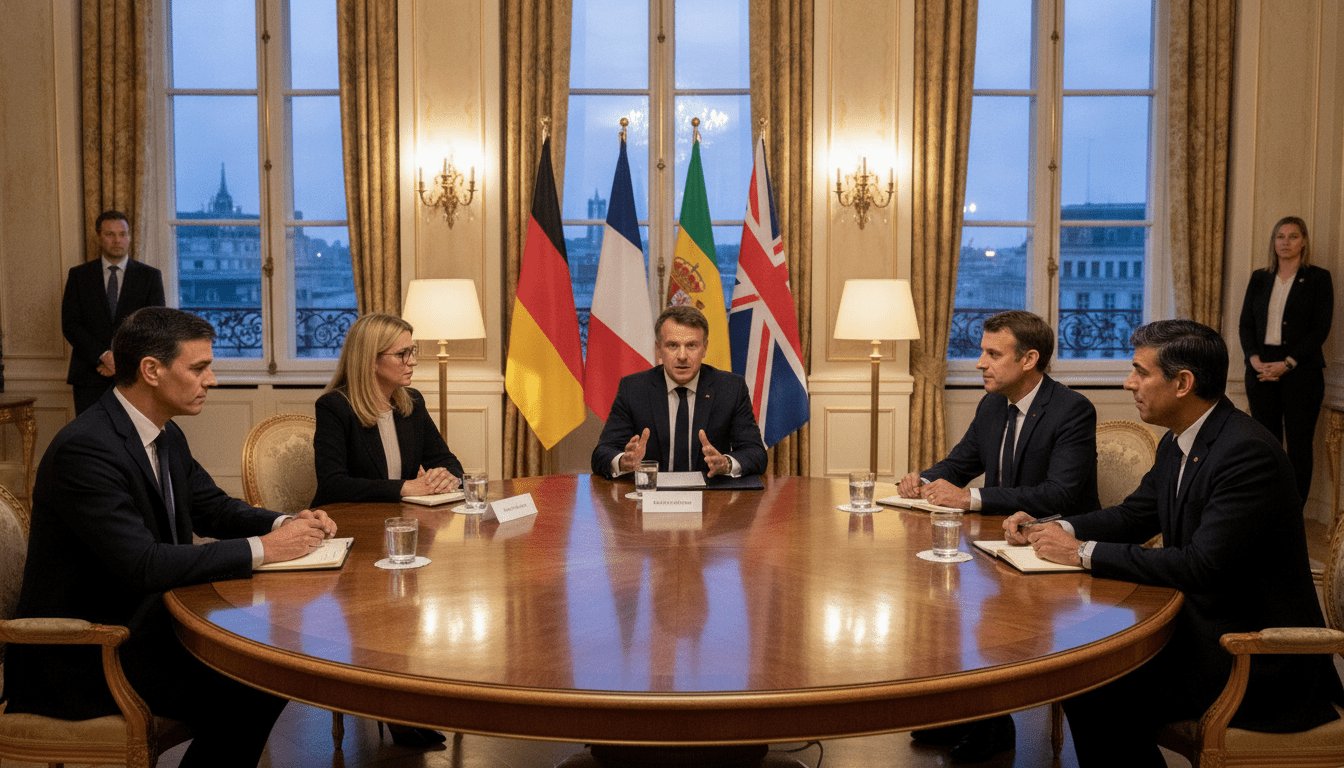
E5 leaders converge in Berlin as NATO summit in Ankara approaches
Chancellor Merz hosted five European leaders in Berlin to align defence spending and strategy ahead of the NATO summit in Ankara, shaping transatlantic relations. The meeting brought Germany, France, Britain, Italy and Poland together to present a unified front on military investment, Ukraine support and regional security. With the Ankara summit less than two weeks away, European capitals signalled an effort to strengthen the alliance’s European pillar amid lingering transatlantic tensions.
Merz convenes five European leaders in Berlin
German Chancellor Friedrich Merz invited France’s Emmanuel Macron, Italy’s Giorgia Meloni, Poland’s Donald Tusk and Britain’s Keir Starmer to the Chancellery for a pre-summit coordination meeting. The gathering, described by participants as an “E5” format, aimed to set a common agenda ahead of the NATO summit in Ankara and to present Europe’s commitments clearly. Officials framed the meeting as both a show of unity and a practical step to harmonise positions on defence spending and diplomatic initiatives.
E5 agree to increase defence investment toward 2035 target
Participants reiterated the commitment made at last year’s NATO meeting in The Hague to substantially raise defence budgets through 2035. The agreement envisions national defence spending climbing to roughly five percent of GDP, split into core military capabilities and security-related infrastructure, a division leaders said would strengthen deterrence. European ministers argued the pooled investment would create a firmer foundation for balanced transatlantic burden-sharing.
Leaders push to strengthen the European pillar within NATO
Merz and his counterparts emphasised their intention to bolster a “European pillar” that complements, rather than replaces, NATO’s transatlantic framework. They framed increased European defence capacity as a way to contribute meaningfully to alliance obligations while preserving close cooperation with the United States. The leaders stressed that stronger European capabilities would aim to prevent unilateral actions and reinforce collective decision-making inside NATO.
Iran and maritime security discussed as part of alliance agenda
Iran emerged as a central topic in Berlin after reports of a US-Iran framework agreement prompted discussion on regional security, including the safety of shipping in the Strait of Hormuz. French and German officials signalled openness to taking part in measures that would protect commercial traffic if conditions and legal frameworks were clarified. Leaders said any European contribution would be conditional and designed to complement broader diplomatic efforts, underscoring the need for clearly defined mandates.
Poland demands representation in negotiation formats
Poland’s prime minister, Donald Tusk, used the meeting to press for direct inclusion of frontline and regional states in any diplomatic or negotiation formats with Russia. Tusk warned that excluding countries that face the most immediate security risks would undermine legitimacy and effectiveness. He urged that Scandinavian, Baltic and Romanian perspectives be fully represented in planning, arguing that regional voices are essential when negotiating with an aggressive eastern neighbour.
Starmer’s political moment and transnational gestures of support
The session took on an emotional tone for Britain’s Keir Starmer, who had announced his intention to step down earlier in the week, prompting colleagues to publicly acknowledge his contributions. Leaders offered formal thanks and reflected on recent cooperative efforts, with Poland highlighting Starmer’s role in stabilising post-Brexit relations during his tenure. The exchange underscored that, alongside policy alignment, the summit calendar will also feature sensitive domestic political dynamics among member capitals.
The E5 gathering in Berlin set out clear priorities for the NATO summit in Ankara: demonstrate increased European defence spending, maintain unity on assistance to Ukraine, define any European role in Middle East maritime security, and resist unilateral approaches that could fracture alliance cohesion. As NATO leaders prepare to meet in Ankara, the message from Berlin was designed to show preparedness and political will within Europe to shoulder a larger share of security responsibilities while keeping the transatlantic bond intact.
