
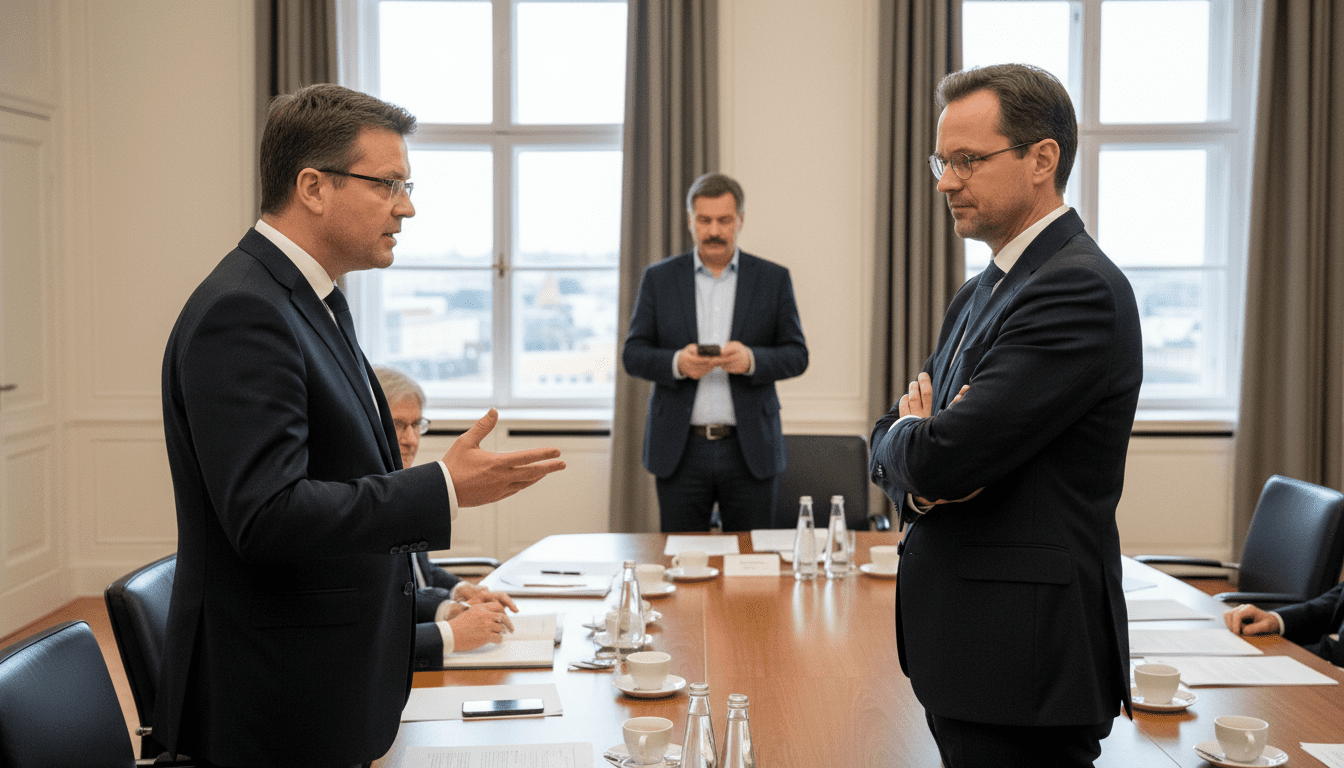
Merz and Klingbeil Clash at Coalition Committee as Söder Stays on the Sidelines
Merz and Klingbeil clashed at a coalition committee meeting, exposing strains in the governing alliance while Markus Söder briefly stayed out and ate pizza.
Tensions between CDU figure Friedrich Merz and SPD politician Lars Klingbeil erupted during a high-stakes coalition committee meeting, according to participants who described a tense exchange. The disagreement centered on the government’s response to an unfolding policy and communication challenge, and it quickly became the dominant thread of the session. Observers said the confrontation underscored mounting friction inside the coalition as ministers grapple with competing priorities.
Heated exchange during coalition committee
Attendees described a sharp, sometimes audible argument between the two leaders that interrupted the normally procedural rhythm of the committee. The dispute reportedly involved both policy specifics and accusations about how the coalition should present a united front to the public. Party staff scrambled to restore order, and several members worked to tamp down the rhetoric before the meeting continued.
Aides on both sides later framed the incident as an intense but resolvable disagreement, while opposition figures seized on the moment to highlight perceived instability. The episode will likely shape short-term messaging from the coalition and inform which issues are moved to the fore in coming days. Internal attempts to contain the fallout are already underway.
Dispute framed around crisis management and messaging
Sources say the core of the disagreement was how the government should manage an immediate crisis and what tone to adopt in public statements. One side pushed for a more assertive policy posture and rapid, decisive communication; the other cautioned against unilateral moves that could alienate coalition partners. The contrast reflected deeper differences over risk tolerance and the balance between political expediency and careful coordination.
Beyond the immediate policy dispute, the clash illuminated a longer-standing disagreement about leadership style and strategy within the coalition. That tension has been manifest in prior meetings, but participants said the committee incident represented a notable escalation. For coalition managers, the challenge now is translating the row into structured negotiations rather than recurring spectacle.
Söder’s conspicuous absence and the pizza anecdote
Markus Söder’s absence from the fray attracted attention almost as much as the quarrel itself, with several accounts noting he chose not to intervene and was instead observed taking a break to eat pizza. Insiders characterized his decision as a deliberate distancing from an intra-coalition spat, signaling a preference for nonintervention at that moment. That posture removes a potential mediating voice and may complicate efforts to broker a quick resolution.
Political analysts say Söder’s choice to stay on the sidelines can be read in multiple ways: as strategic restraint, personal disinterest in the particular dispute, or a signal that he prefers to retain leverage by not aligning publicly. Whatever the motivation, the image of a senior figure removed from the exchange has already been seized on by critics and commentators as evidence of fraying coordination.
Internal reactions and party calculations
Within the CDU and SPD ranks, reactions were mixed between calls for de-escalation and demands for firmer follow-through on the points contested in the meeting. Some coalition members urged rapid clarification so that ministers could return to governing tasks without the distraction of public infighting. Others warned that a failure to address the underlying disagreements could lead to repeated clashes at future gatherings.
Party strategists are now recalibrating talking points and preparing a joint statement to reassure markets, stakeholders, and voters that the coalition remains functional. Behind closed doors, staff are drawing up options for joint appearances and compromise language intended to prevent similar eruptions. The effectiveness of those measures will be judged by whether ministers can present unified positions in upcoming debates.
Potential implications for government stability
While one meeting does not by itself threaten the survival of the coalition, repeated episodes of this kind can erode trust and complicate policy delivery. Political rivals have already amplified the incident, arguing it reveals governance weaknesses and a lack of cohesive leadership. Observers caution that unresolved tensions could slow legislative progress and weaken the government’s ability to respond to further crises.
Senior officials face a choice between recommitting to stricter internal coordination or allowing a looser, more contentious working style to persist. The path they choose will affect not only immediate policy outcomes but also the coalition’s public standing ahead of future electoral tests. For now, party leaders are emphasizing unity while quietly preparing contingency plans.
Following the meeting, coalition chairs scheduled follow-up discussions to mediate the dispute and to delineate clearer protocols for dispute resolution. Staff-level working groups have been told to accelerate coordination on the disputed dossiers and to submit compromise proposals within days. The speed and transparency of those next steps will be crucial in shaping whether this episode becomes a one-off flashpoint or the start of a more sustained internal crisis.
