
Memory chips market narrows to three giants as volatility reshapes supply and strategy
Global memory chips market consolidates around Samsung, SK Hynix and Micron, altering pricing, supply chains and investment strategies in a multi-hundred-billion-euro industry.
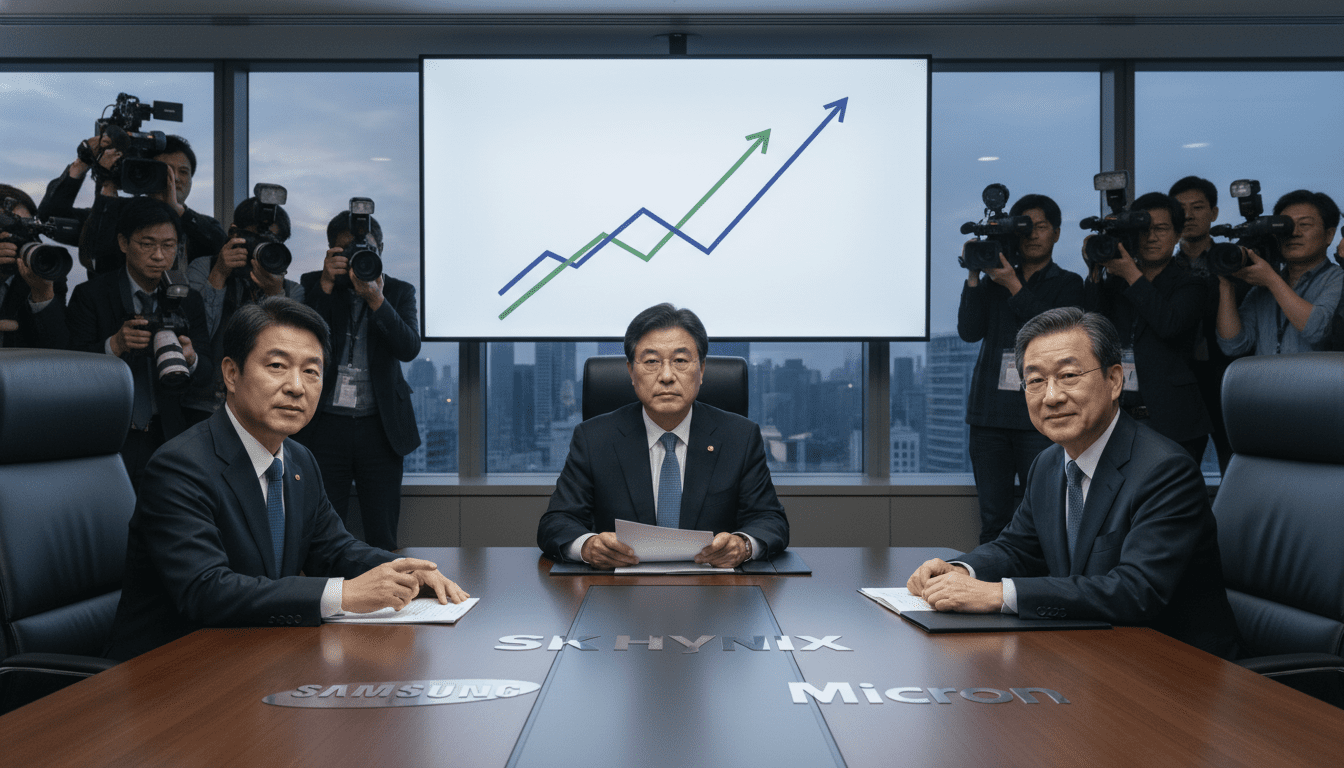
The global memory chips market has narrowed sharply, with Samsung, SK Hynix and Micron now accounting for the lion’s share of production in a business worth several hundred billion euros. Market observers say repeated boom-and-bust cycles have driven smaller competitors from the field and concentrated pricing power among the largest manufacturers. The consolidation is reshaping how devices are supplied and how companies invest in capacity.
Three firms now control the global memory chips supply
Industry consolidation has left only a handful of manufacturers able to sustain the capital intensity and technological complexity of modern memory production. Samsung, SK Hynix and Micron dominate both DRAM and NAND segments, shrinking the number of credible suppliers from the dozens that once competed for market share. That concentration increases the influence of each producer over pricing and capacity decisions across the supply chain.
Insiders note that the high fixed costs of fabs, long product cycles and the need for continuous node advancement have created barriers that favor scale. As a result, newcomers face steep hurdles to enter or re-enter the market, and vertical integration by the incumbents further raises the bar for competition. The current structure leaves the sector sensitive to coordinated investment swings by the big three.
Cyclical price swings remain a defining characteristic
The memory chips business is inherently cyclical, with periods of soaring demand followed by rapid inventory corrections that drive sharp price declines. These boom-and-bust episodes can unfold over months rather than years, amplifying revenue volatility for both suppliers and their customers. Manufacturers often respond by adjusting output, but the lead times for capacity changes mean supply imbalances can persist.
Price volatility affects downstream players from smartphone makers to cloud operators, who must manage procurement and inventory risk. When demand softens, excess capacity can prompt aggressive price competition that erodes margins industry-wide. Conversely, periods of tight supply tend to accelerate investment and stockpiling, feeding the next expansion phase.
Customer and supply-chain consequences across industries
OEMs and hyperscalers face a trade-off between securing supply and controlling costs as the memory chips market tightens. Larger buyers with scale can negotiate long-term contracts or reserve production, but smaller firms are exposed to sudden price spikes or shortages. This dynamic has prompted some buyers to diversify procurement strategies and to increase focus on inventory visibility and flexibility.
At the same time, component shortages or price surges can cascade into product launch delays and margin compression for electronics manufacturers. Suppliers of finished goods are adapting by redesigning products for memory efficiency, exploring alternative configurations, and seeking closer collaboration with chipmakers to align production and demand forecasting.
Investment strategies and capacity management among the leaders
Samsung, SK Hynix and Micron have leaned on differing mixes of capital expenditure, technological roadmaps and geographic diversification to manage cyclical risk. All three continue to invest in advanced process nodes and higher-density memory to capture premium segments and to preserve long-term competitiveness. Strategic timing of capacity expansion has become a central lever for stabilizing revenues and retaining market share.
Outside of pure memory technology, these firms are also broadening capabilities—through partnerships or adjacent businesses—to smooth revenue volatility. Efforts include expanding into custom memory solutions for AI workloads, increasing services tied to data-center customers, and selectively optimizing production footprints to manage geopolitical and cost pressures.
Geopolitical factors and regulation are reshaping production choices
National industrial policies, export controls and subsidy programs are influencing where memory chips are produced and how companies plan future fabs. Governments view semiconductor capacity as strategic, prompting incentives that alter investment calculus for global manufacturers. Trade tensions and technology restrictions can accelerate the localization of supply chains and complicate cross-border collaborations.
Regulatory scrutiny over market concentration and national security considerations may also shape mergers, site selection and technology transfers. For chipmakers, balancing compliance with export rules while meeting global customer demand requires detailed legal and operational planning.
Demand drivers point to long-term but uneven growth
Long-term demand for memory chips is buoyed by data-center expansion, artificial intelligence, edge computing and the ongoing proliferation of connected devices. These structural drivers underpin the case for sustained investment into higher-capacity and higher-performance memory products. However, demand growth is uneven across segments, leaving manufacturers to prioritize where to allocate scarce capital.
Analysts expect that innovation in memory architectures and application-specific solutions will determine which product lines deliver the strongest returns. For buyers and policymakers alike, the challenge will be to reconcile short-term price volatility with the longer-term need for capacity that supports digital infrastructure.
The consolidation of the memory chips industry into three dominant suppliers marks a significant shift in global electronics supply chains and investment dynamics. As manufacturers, customers and governments adjust, the sector is likely to remain cyclical but increasingly shaped by strategic capacity choices, technological specialization and geopolitical considerations.
