
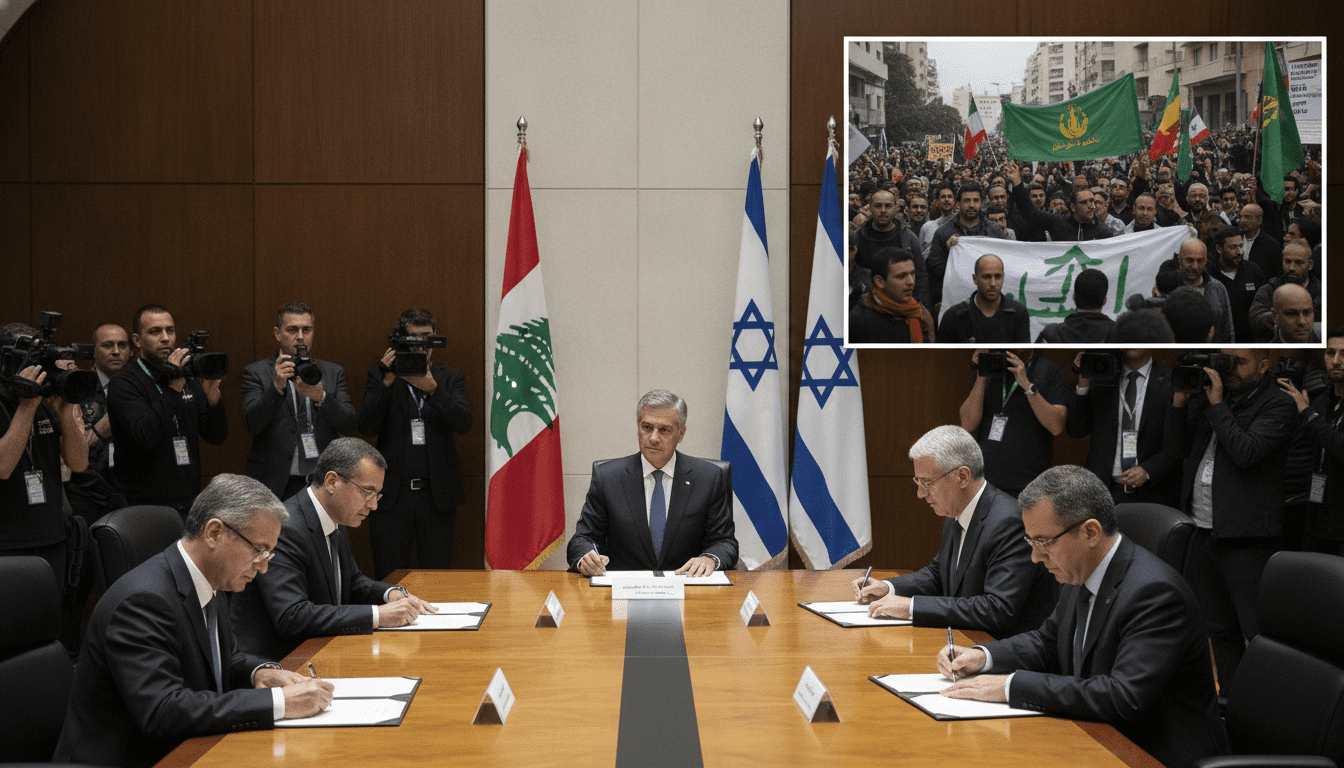
Lebanon-Israel framework agreement signed in Washington seen as first step toward lasting ceasefire
Lebanon-Israel framework agreement negotiated in Washington aims to end fighting, restore Lebanon’s sovereignty and create pilot security arrangements while Hezbollah rejects the deal.
Agreement Reached in Washington
A Lebanon-Israel framework agreement was signed in Washington by the countries’ ambassadors in the presence of U.S. officials, officials said, marking what U.S. Senator Marco Rubio described as a “first step” toward a durable peace. The pact was presented as a pathway to end hostilities and to restore Lebanese sovereignty over territory contested since earlier cross-border clashes. Israeli Prime Minister Benjamin Netanyahu praised the accord as a blow to Iran’s regional influence and reiterated Israel’s commitment to a security zone in southern Lebanon.
Negotiations were brokered by U.S. mediators over several days, with Israeli and Lebanese government representatives taking part but Hezbollah excluded from the talks. The militia, widely regarded as Iran’s principal non-state ally in the region, publicly rejected the framework and said it would not be bound by any agreement reached without its consent.
Key Provisions and Pilot Projects
According to U.S. and Israeli officials cited in reporting, the agreement envisions pilot projects in which Lebanese Armed Forces units would assume control of select areas in the south previously occupied or contested. The U.S. military would monitor those zones to verify that they are not used by Hezbollah as staging grounds for attacks, officials said. Negotiators framed the pilot initiatives as tests of whether the Lebanese state can re-establish authority and prevent armed groups from operating freely.
Lebanon’s government described the framework as a mechanism to end fighting and enable displaced civilians to return to their homes, while Israel emphasized maintenance of a security buffer to protect its northern communities from rocket and drone strikes. Both sides left several key details to follow-up talks, including timelines and the precise role of international monitors.
Hezbollah Rejects the Deal and Protests Erupt
Hezbollah’s political representatives and allied demonstrators swiftly rejected the accord, with a senior Hezbollah parliamentarian warning the deal could only be enforced through force and promising resistance to any governmental measures that would disarm the militia. The movement reiterated that its weapons are central to Lebanon’s defense, a long-standing position that has been a major stumbling block in negotiations.
Street protests flared in Beirut after news of the agreement, with supporters of Hezbollah and allied groups taking to the streets on foot and by motorcycle, blocking roads with burning tires and chanting slogans against the pact, broadcasters and eyewitnesses reported. The demonstrations underscored the political volatility inside Lebanon and the domestic obstacles to implementing a deal that reshapes security arrangements.
U.S. Aid and International Support
The U.S. State Department announced plans to mobilize humanitarian assistance and security support in coordination with the United Nations, including an immediate package of $100 million in aid, senior U.S. officials said. Washington also pledged assistance to strengthen the Lebanese Armed Forces so they can assume greater control over the south and deter non-state actors from exploiting vacuum areas.
U.S. mediators framed the assistance as a confidence-building measure to support Lebanese institutions, not as a substitute for political solutions. International involvement, they said, will focus on verification, reconstruction of damaged communities, and capacity-building for Lebanese security forces to ensure any transition of authority is sustainable.
Security Context and Ceasefire Status
The framework follows a ceasefire between Israel and Hezbollah that took effect on June 19 and has been largely observed after several earlier breaches. Negotiators in Washington aimed to consolidate that truce into a more comprehensive arrangement that would reduce the risk of renewed clashes along the border and create mechanisms to address violations.
Despite the ceasefire, Israeli forces carried out strikes in southern Lebanon as recently as the night before the agreement was signed, highlighting the fragility of the lull and the urgency behind the diplomatic push in Washington. Israeli officials insist that any withdrawal or changes to deployments will be tied to measurable steps toward the disarmament or neutralization of Hezbollah’s military capabilities.
Regional Implications and Iran’s Role
The Lebanon-Israel framework agreement has wider regional implications because Tehran considers Hezbollah a strategic proxy and has signaled opposition to any settlement that would weaken the militia. U.S. and Israeli leaders framed the pact as limiting Iranian influence in Lebanon, an argument echoed by Israeli officials who said the deal undermines Tehran’s objective of using Lebanon as a front against Israel.
Iran, for its part, demands guarantees that any Israeli withdrawal from southern Lebanon will be followed by sustained protections for its allies; that condition makes the Lebanese front a potential sticking point in broader U.S.-Iran negotiations. Diplomats warn that without a way to bring Hezbollah into or reconcile it with any political settlement, the agreement risks being partial and difficult to enforce.
Final paragraph: Implementation of the Lebanon-Israel framework agreement will depend on follow-up diplomacy, the capacity of Lebanese institutions to extend authority in the south, and whether international monitors can reliably verify compliance; the coming weeks will test whether the paper accord can translate into lasting security for civilians on both sides of the border.
