
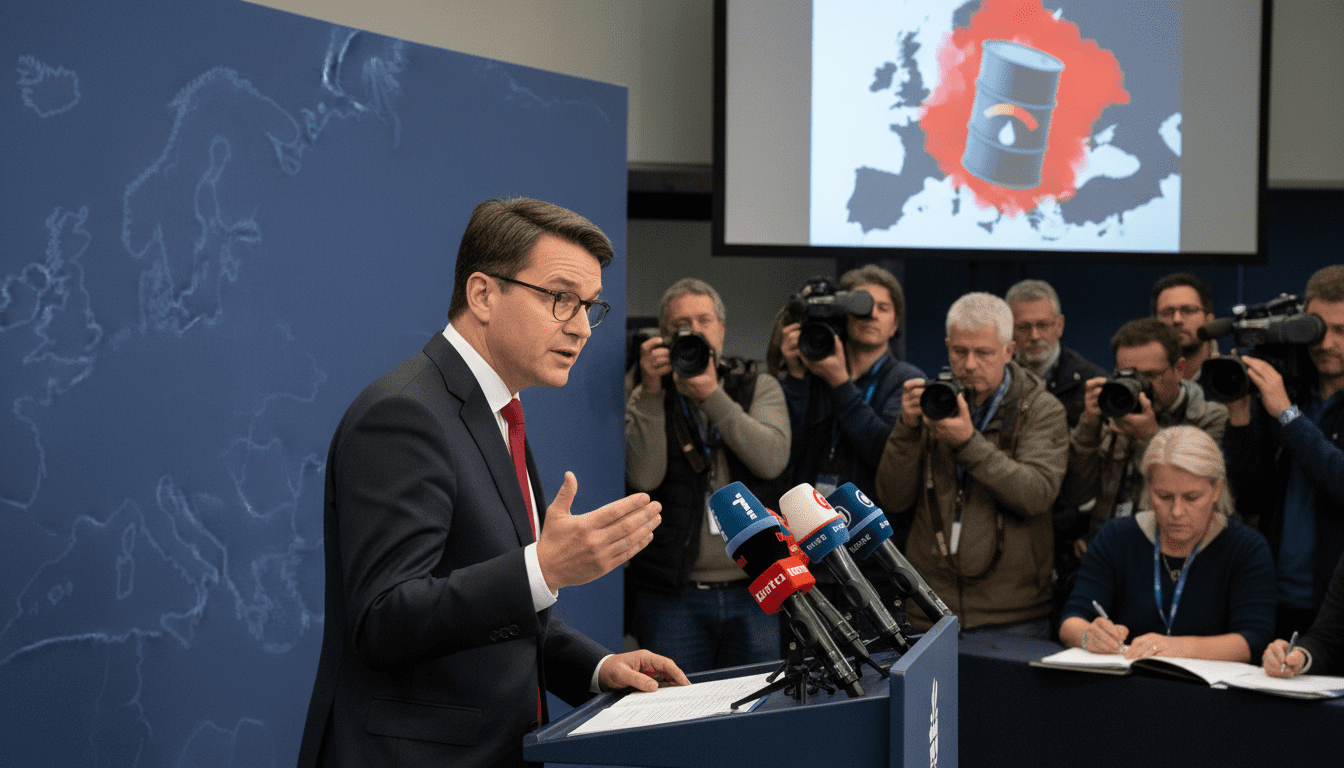
Kerosene shortage warning: Germany’s finance minister urges action after IEA supply alert
Finance Minister Lars Klingbeil warns of a kerosene shortage after an IEA alert, urging supply measures and faster renewable expansion to strengthen national resilience.
Germany’s Finance Minister Lars Klingbeil on Saturday urged immediate measures to head off a possible kerosene shortage after an International Energy Agency warning that parts of Europe could face supply tightness in the coming weeks. Klingbeil said the government must treat the IEA’s forecast seriously and keep both price and supply security under close scrutiny. The minister linked the risk to the broader energy fallout from the Iran conflict and pressed for policy responses to reduce future exposure.
Klingbeil frames shortage as a national security and economic risk
Klingbeil told Spiegel that the kerosene shortage threat requires action beyond market responses to price spikes. He argued that supply security must be monitored “at all times,” and that addressing prices alone would be insufficient. Speaking after participation in spring international financial meetings in Washington, Klingbeil compared the situation to the energy shock after Russia’s invasion of Ukraine, saying the consequences could be prolonged and severe.
Klingbeil also used the warning to press coalition partners for a broader reform agenda. He urged a “large and fair” reform package to make Germany more resilient and less dependent on fossil imports, calling for accelerated deployment of renewables and faster grid expansion to reduce systemic vulnerabilities.
IEA signals immediate short-term pressure on kerosene markets
The International Energy Agency issued an alert indicating several European countries could face kerosene tightness within roughly six weeks if current market disruptions continue. The IEA’s assessment warned that supply chains concentrated in vulnerable regions could transmit shortages quickly to aviation fuels. That forecast prompted heightened attention among European capitals and industry stakeholders to contingency planning.
Analysts at the IEA highlighted that disruptions in production and transport facilities in key producing regions have the potential to restrict jet-fuel availability even if crude supplies remain relatively stable. The warning is notable for its short time horizon and for the focus on refined fuel logistics rather than crude availability alone.
German refinery capacity and import exposure under scrutiny
Germany’s Economy Minister Katherina Reiche responded by stressing that kerosene is produced in domestic refineries and that the country is not entirely dependent on imports. Her comments sought to temper immediate alarm and to highlight local processing capability. Nevertheless, officials acknowledged that a significant share of supply flows originates in the Middle East and other distant markets, which raises vulnerability to regional disruptions.
Industry sources in Berlin say that while domestic refining can buffer short-term gaps, refinery conversion capacity, maintenance schedules and logistical bottlenecks limit how quickly additional kerosene can reach airlines. The balance between domestic production and imports will determine how acute price and supply effects become in coming weeks.
Market signals show rapid price escalation for jet fuel
Since the outbreak of hostilities in Iran, kerosene prices have more than doubled, aviation industry representatives report, creating strain for airlines and freight operators. The German air transport association warned that even if the conflict were to end quickly, market pressures would likely ease only slowly because many production facilities in the region have been damaged. Those firms said that repair timelines and redirected crude flows will influence when kerosene markets normalise.
Airlines and freight carriers are already factoring higher fuel costs into planning, with some carriers weighing adjustments to schedules or capacity, and forward hedging strategies under review. The price surge is also feeding broader inflationary concerns, given fuel’s outsized role in air transport operating costs.
Policy response: short-term safeguards and long-term decarbonisation push
Klingbeil combined immediate risk management calls with a renewed push for long-term decarbonisation to limit dependence on vulnerable fossil supply chains. He urged the coalition to accelerate renewable energy roll-out and to prioritise grid expansion so that electrification and alternative fuels can substitute for imported jet fuel over time. The minister framed those steps as central to both climate goals and national security.
Officials signalled that policymaking in the coming days will weigh strategic reserves, temporary export restrictions, and coordination with EU partners on emergency fuel sharing and aviation priorities. Industry groups have asked for swift government clarity on potential interventions and for measures that avoid unintended market distortions while protecting essential air links.
Germany and other European states are now balancing contingency plans to secure immediate kerosene supplies with structural reforms aimed at reducing future exposure. The coming weeks will test whether short-term measures can keep aviation running while political momentum builds for a larger shift toward renewables and alternative aviation fuels.
