
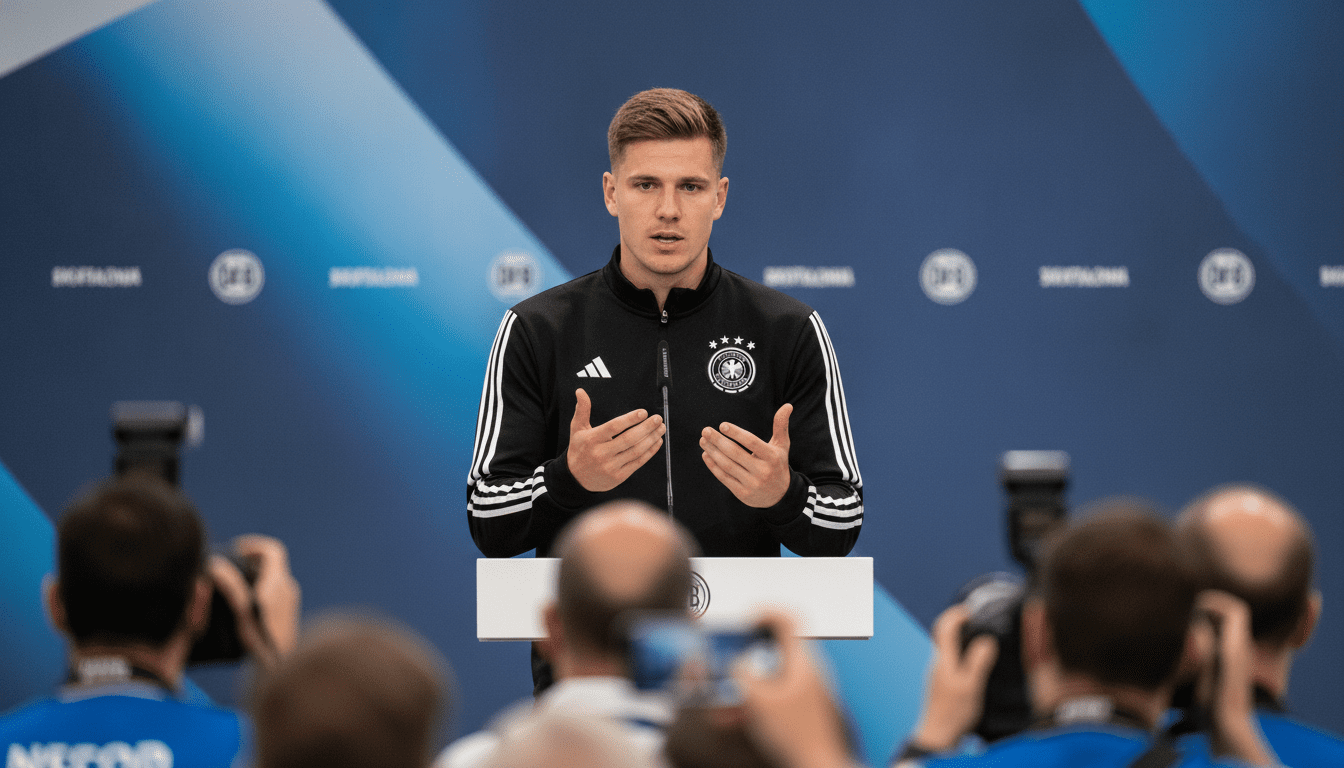
Joshua Kimmich’s measured comments reignite discussion over Germany’s World Cup ambitions
Kimmich’s remarks prompt fresh scrutiny of Germany’s World Cup strategy and squad dynamics ahead of a potential deep run in North America.
Joshua Kimmich’s few sentences at a recent press conference have been replayed and dissected within German football circles, because they encapsulate both caution and quiet confidence about the national team’s prospects at the World Cup in North America. Kimmich framed his comments in a way that suggested preparation for extremes — from an early exit to an improbable title challenge — and that framing has made his words a reference point for supporters and analysts alike. The midfielder’s intervention is now being read as a tactical and psychological signal as Germany navigates a tournament many expect to be decisive for the squad’s immediate future.
Kimmich’s press conference lines and their resonance
Kimmich spoke briefly but deliberately, choosing phrases that can be pulled out later depending on how the tournament unfolds. Those lines were notable less for headline-grabbing bravado than for their utility as a measured hedge against both praise and criticism. Media outlets and social feeds have bookmarked the remarks as a quotable touchstone, useful whether Germany advances deep into the competition or falls short of expectations.
Historical context for the German national team
Germany’s tournament history gives extra weight to any guarded statement from a senior player, because past campaigns have swung between triumph and surprise disappointment. That collective memory means supporters and commentators treat leadership comments as part of a broader narrative about consistency and identity. Kimmich’s words, interpreted against that backdrop, can be read as an attempt to manage expectations while maintaining focus on the job at hand.
Inside the squad: leadership and locker-room dynamics
Within the squad, Kimmich is widely regarded as an influential voice whose public remarks often mirror internal conversations about responsibility and standards. Team leaders typically use press moments to frame the group’s mindset, and Kimmich’s calibrated tone suggests an effort to balance realism with ambition. Teammates have responded privately and in training by reiterating concentration on process rather than scoreboard-driven narratives.
The coaching staff will also factor those comments into their handling of player responsibilities and media strategy. When a senior player frames possible outcomes, coaches can leverage that messaging to reinforce tactical clarity and manage external pressure. That dynamic is especially important for a tournament-stressed squad managing form, injuries, and the inevitable fluctuations of performance.
Tactical implications for the coaching staff
Kimmich’s role as a midfield linchpin gives his public stance added tactical significance, because his on-field responsibilities will shape how Germany approaches games. If his remarks are read as preparation for grinding, organized performances, the team might prioritize structure and defensive solidity. Conversely, if the assessment is taken as encouragement to play with freedom, it could justify bolder selection choices and an emphasis on transitional attacking.
Coaches will weigh those interpretations against opponent scouting, player fitness, and match contexts. Kimmich’s versatility — capable of influencing tempo, cover in midfield, and ball circulation — means his preferred narrative about the team’s approach is not merely rhetorical: it can translate into formation adaptations and match-day priorities.
Public and media reaction across Germany
The German media’s response has been measured, balancing curiosity about the exact phrasing with awareness of the tournament’s unpredictability. Pundits have highlighted how a senior player’s careful wording can reduce pressure on younger squad members while giving journalists a durable quote to reference as storylines develop. Fan responses have ranged from approving to skeptical, but most commentary acknowledges the strategic usefulness of a statement that keeps options open.
Social media amplified segments of the press conference almost immediately, leading to debates about tone and intent. Those debates will likely resurface after each result, with the same sentences resurfacing as either prescient or overly cautious depending on outcomes.
Possible scenarios as Germany progresses in North America
If Germany advances past the early rounds, Kimmich’s comments will be invoked as evidence of pragmatic leadership that helped steady the team. In that scenario, pundits will trace a line between disciplined early performances and any late-tournament surge. Alternatively, if Germany fails to reach expectations, the same lines may be interpreted as an early attempt to deflect criticism and soften fallout.
Either outcome highlights why veteran players use press conferences to set narratives that are resilient to changing fortunes. Kimmich’s intervention functions as a small actuarial hedge: a few carefully chosen words that can be cited whether the campaign becomes celebrated or scrutinized.
Looking ahead, the tournament will test not only tactical plans but also the psychological architecture the squad uses to manage pressure. Kimmich’s remarks have already become one such architectural element, framing a conversation about expectation management that will persist for as long as Germany remains in the competition.
The coming weeks will show whether those carefully placed sentences become a defining motif of Germany’s campaign or simply a footnote in a tournament filled with larger stories.
