
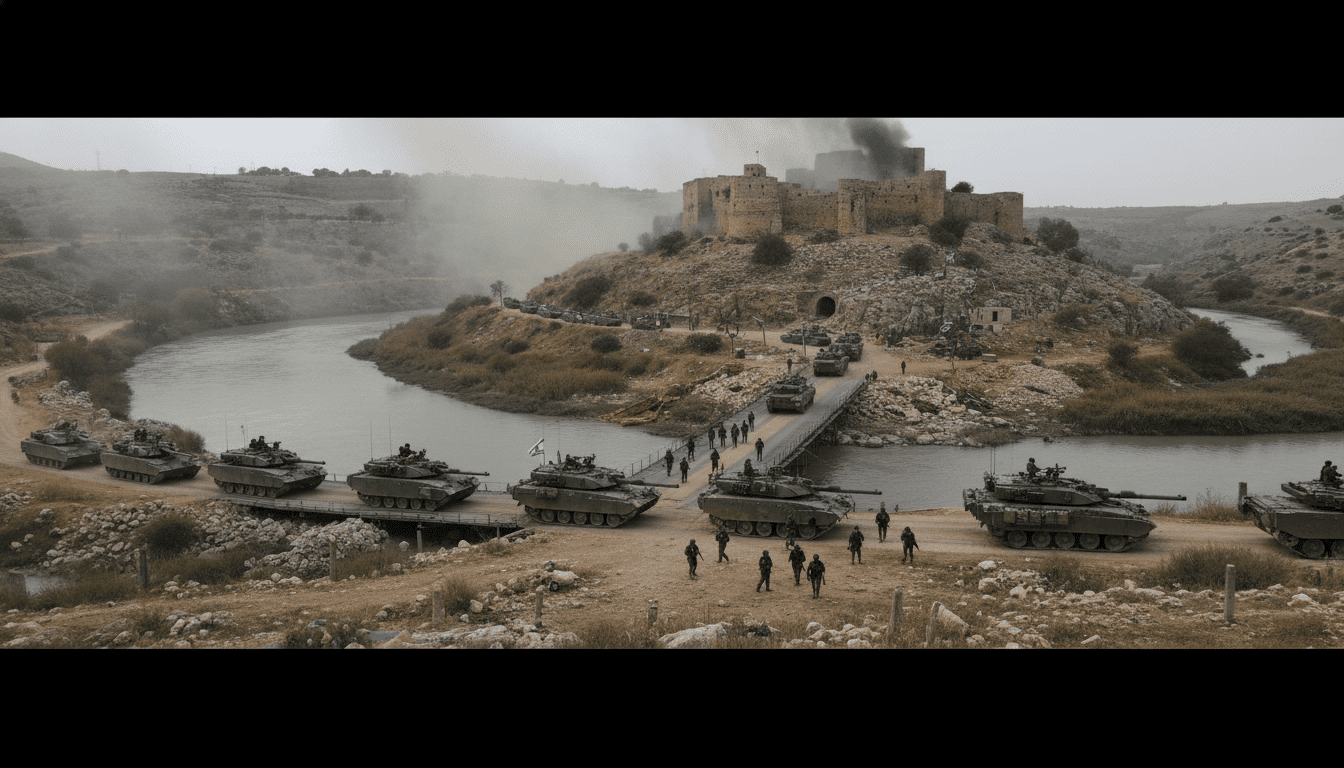
Israel expands ground offensive in Lebanon as troops cross the Litani River
Israel ground offensive in Lebanon widens as troops cross the Litani, seize Beaufort positions and call evacuations amid renewed clashes with Hezbollah and political uproar in Beirut.
Israel’s military announced on Sunday that it has expanded its ground offensive in Lebanon, saying operations aim to extend a “forward defence line” and remove direct threats to northern Israeli towns. Troops have crossed the Litani River, about 30 kilometres north of the shared border, and residents south of the Zahrani River were urged to evacuate due to the risk of strikes.
Operations move beyond the border
The Israeli armed forces said the expansion includes new activity in the Beaufort ridge and the Wadi al-Saluki area in southern Lebanon. Military statements described the effort as designed to strengthen operational control of the south and to neutralise positions that the army regards as immediate threats to communities such as Metula.
Officials also confirmed that Israeli forces occupied the historic Beaufort Castle stronghold, a strategic hilltop position long contested in past conflicts. The crossing of the Litani represents a notable enlargement of the area of operations, marking movement well north of the international Blue Line.
Evacuations and civilian warnings
Israel ordered civilians living south of the Zahrani River to evacuate, citing the possibility of air and ground operations that could endanger populated areas. Local authorities and aid groups in Lebanon said displacement increased as families fled villages and towns judged at risk by military planners.
Humanitarian sources have reported growing disruption to services in southern Lebanon as power, water and communications infrastructure have been damaged or rendered unreliable. Relief organisations warn that continued displacement will deepen needs for shelter, food and medical care across already strained areas.
Beirut accuses Israel of a dangerous escalation
Lebanon’s Prime Minister Nawaf Salam sharply criticised the Israeli expansion, calling recent strikes and ground moves a “dangerous and unprecedented escalation.” In a televised address, he accused Israel of pursuing a strategy of collective punishment and “scorched earth” tactics that force civilians from their homes and devastate towns and villages.
Salam also said the Lebanese government would continue to pursue direct negotiations with Israel as the least costly route to reducing tensions, and he pointed to a planned round of talks in Washington on June 2–3 as an opportunity to press for de-escalation. The prime minister framed diplomatic efforts as urgent in the face of mounting civilian suffering.
Clashes persist despite declared truce
The expansion comes amid continued clashes between Israel and the Iran-backed Hezbollah militia, despite both sides having observed a formal ceasefire since April 17. Each side accuses the other of violations, and exchanges of fire and targeted strikes have continued along the frontier and deeper into southern Lebanon.
Hezbollah has publicly rejected the ceasefire terms and direct negotiations between Beirut and Israel, maintaining its stated objective of resistance against Israel and asserting autonomy from government control. Lebanese officials acknowledge that the state has limited leverage over the militia, complicating efforts to stabilise the border region.
Human toll and mass displacement
Lebanese authorities report heavy civilian casualties and large-scale displacement since hostilities escalated earlier in the year. According to those figures, more than 3,300 people have been killed by Israeli strikes in the conflict inside Lebanon, and over one million residents have been forced to flee their homes, seeking safety elsewhere in the country or across borders.
The destruction of housing, schools and medical facilities has intensified humanitarian needs while complicating access for aid agencies. Emergency responders warn that continued military operations and restrictions on movement will hinder relief deliveries and increase the risk of disease and long-term displacement.
Regional stakes and diplomatic pressure
Regional and international actors are closely watching developments, warning that a widening ground offensive could heighten the risk of a broader confrontation. Diplomatic channels are under pressure to secure renewed restraint, and the upcoming Washington talks are being viewed as a critical test of whether political dialogue can reduce hostilities in the short term.
Analysts say Israeli aims—removing threats to border communities and degrading armed group capabilities—must be balanced against the political and humanitarian costs of extended operations inside Lebanon. Observers also note that any escalation involving Iran or allied groups could further broaden the conflict and complicate efforts to restore a stable ceasefire.
The situation remains fluid, with rapid movements on the ground and ongoing exchanges of accusations between the parties; officials on both sides say they will continue operations they deem necessary for security while diplomatic channels seek to contain the violence.
