
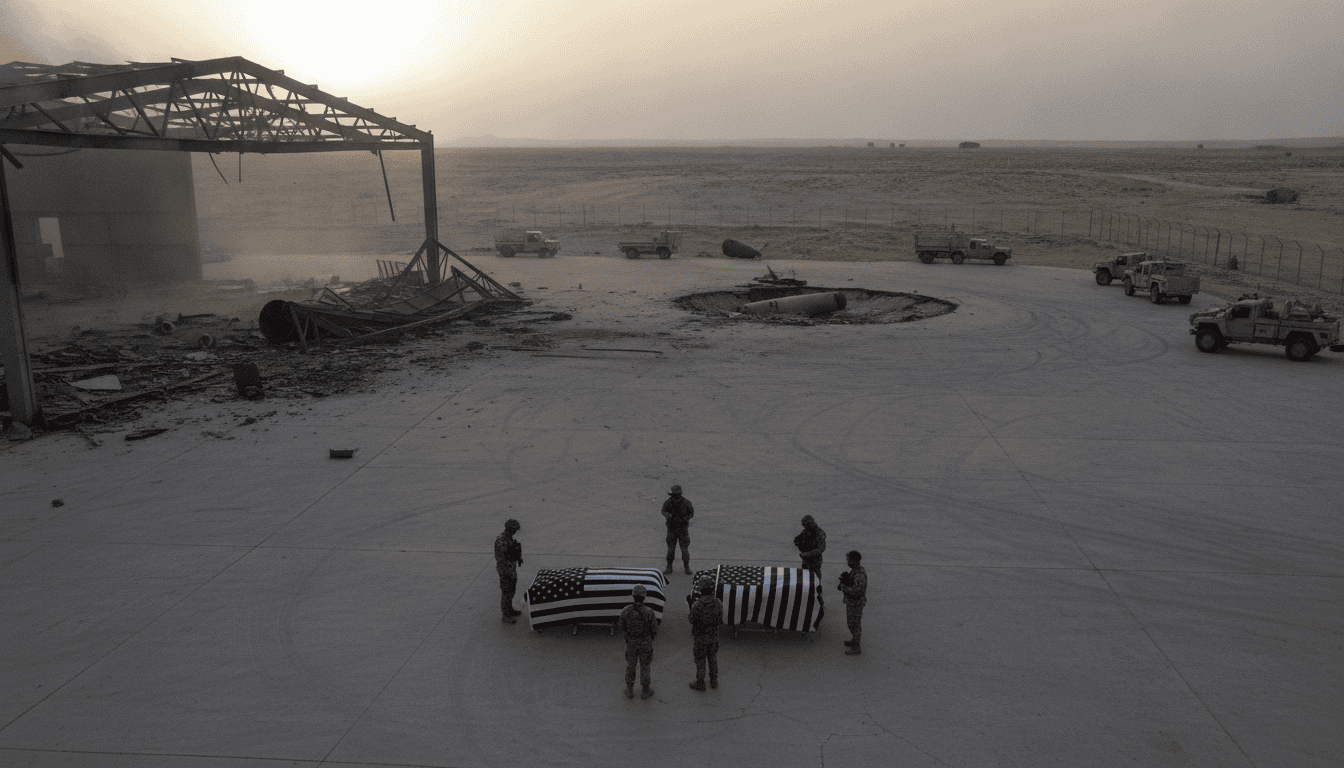
Iranian Missile Strike Hits Jordan’s Muwaffaq Salti Airbase, Killing Two U.S. Service Members
Video shows an Iranian missile striking Jordan’s Muwaffaq Salti Airbase on July 19, 2026, killing two U.S. service members and wounding four others amid the wider Iran conflict.
Strike Captured on Video
A video circulating on social media and reviewed by investigators shows the moment a missile struck a hangar at Muwaffaq Salti Airbase in Jordan on July 19, 2026. The footage, which appears to be taken from inside the base, shows an incoming projectile followed by a powerful impact and a large plume of smoke.
U.S. and Jordanian officials said the projectile was identified as an Iranian-fired missile, though formal attribution and forensic analysis are ongoing. Military investigators have secured the site to preserve debris and sensor data that could corroborate the origin of the weapon.
Confirmed U.S. Casualties and Injuries
U.S. defense authorities confirmed that two American service members were killed in the strike and four others were injured; their conditions have been described as non-fatal by officials. The identities of the deceased have not been released pending next-of-kin notifications and completion of initial investigative steps.
Jordanian military sources said there were no immediate reports of significant damage to base infrastructure beyond the impact zone, but assessments of collateral damage and longer-term operational effects are continuing. Medical personnel at the base treated the wounded before they were transferred to regional medical facilities for further care.
Incident Occurs Amid Broader February 2026 Conflict
The strike at Muwaffaq Salti Airbase came as part of an intensifying series of exchanges since the United States and Israel launched military operations against Iran in February 2026. At least 16 U.S. service members have been killed in the conflict to date, officials said, a toll that has raised concerns about the conflict’s regional escalation.
Analysts say attacks on forward-operating bases risk widening the conflict, complicating logistics and force posture for coalition partners in the region. The Muwaffaq Salti strike underlines vulnerabilities at host-nation facilities that support U.S. and allied operations in the Middle East.
Jordanian and Regional Security Responses
Jordan’s military moved quickly to secure the perimeter of the Muwaffaq Salti Airbase after the strike, increasing air-defense readiness and coordinating with U.S. forces on force protection measures. Jordanian authorities stressed their commitment to safeguarding bases on their territory while working with international partners to investigate the attack.
Neighboring states expressed alarm at the incident and called for restraint as diplomatic channels were activated to prevent further escalation. International organizations monitoring regional security urged all parties to avoid actions that could provoke wider confrontation.
U.S. Military Review and Investigative Steps
U.S. Central Command and Pentagon officials launched an immediate inquiry into the circumstances of the strike, collecting sensor logs, radar tracks, and eyewitness accounts. Forensic teams are examining shrapnel and missile fragments to establish flight path, warhead type, and launch point, which are critical to confirming responsibility.
Officials said any conclusion about retaliation or follow-up operations would be based on the investigation’s findings and deliberations with allied partners, including Jordan. At the same time, commanders on the ground have been ordered to heighten defensive postures and review force-protection protocols at regional installations.
Implications for U.S. Forces and Coalition Operations
The deaths of U.S. service members at Muwaffaq Salti Airbase add to mounting pressure on military planners to adapt tactics and basing strategies. Commanders must balance sustaining operational reach with protecting troops and host-nation infrastructure amid a campaign that has increasingly targeted military facilities.
Policy makers in Washington and partner capitals are expected to discuss whether additional defensive systems, aviation dispersal, or relocation measures are necessary to reduce exposure to long-range strikes. The strike also complicates diplomatic efforts aimed at de-escalation and raises questions about the rules of engagement for coalition forces.
The immediate human cost of the Muwaffaq Salti strike was underscored by the confirmed fatalities and injuries, and U.S. and Jordanian authorities said the investigation will be thorough and transparent to the extent operational security allows.
