
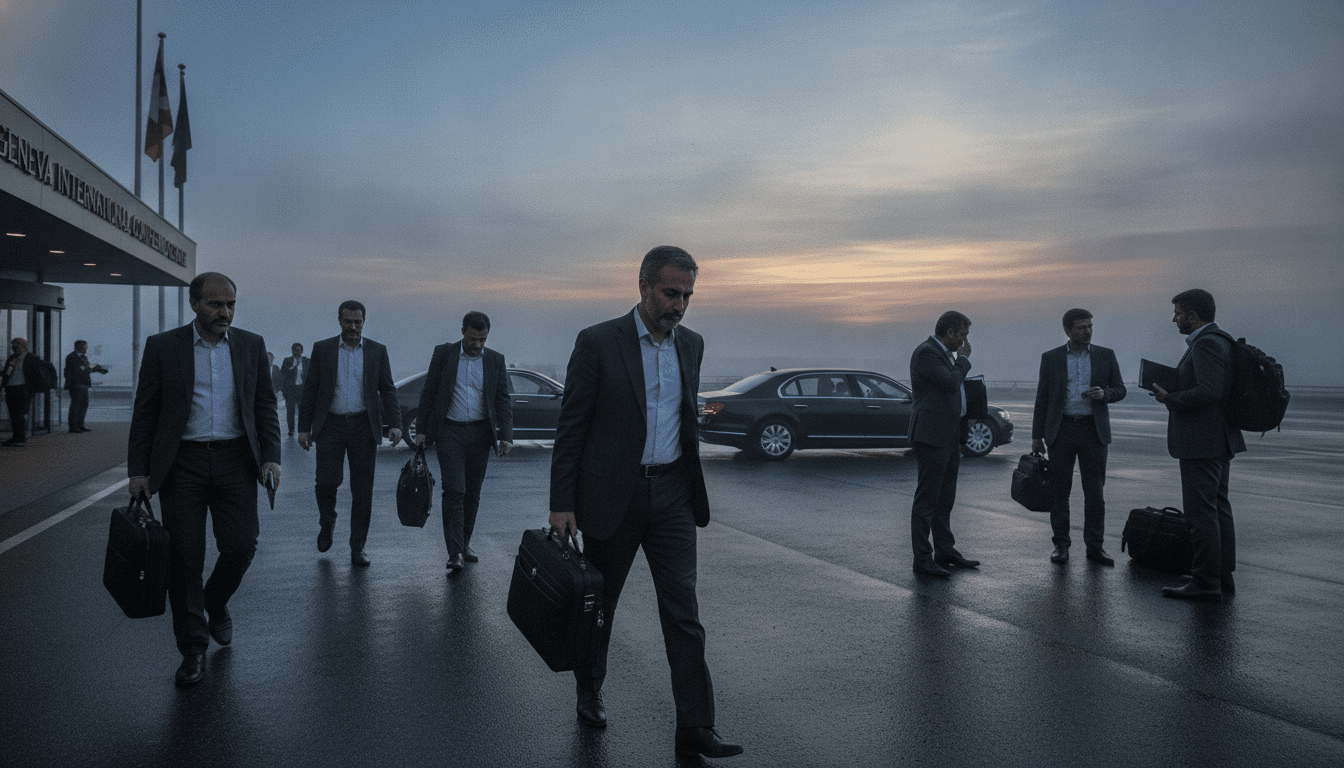
Iran Delegation Departs Switzerland After 18-Hour Talks on Islamabad Memorandum of Understanding
Iran’s negotiating team left Switzerland after an 18-hour round of talks, while technical experts remain to continue negotiations on the Islamabad memorandum of understanding, Iranian media report.
Opening Summary
Iran’s negotiating team departed Switzerland late on the day after an intense 18-hour session focused on the Islamabad memorandum of understanding, Iranian news outlets ISNA and Tasnim reported. The agencies said the delegation’s political and diplomatic members returned home, while a technical team will remain in Switzerland to press forward with detailed discussions. The reports did not specify the city where the meetings were held or provide an immediate timetable for further plenary meetings.
Delegation Leaves After 18-Hour Negotiations
According to ISNA and Tasnim, the departure followed continuous rounds of negotiation that stretched across most of the day and into the night, illustrating the complexity of the matters under discussion. Sources cited by the agencies described the talks as intensive and technical in nature, signaling progress on procedural and implementation questions rather than final political decisions. The move to send the technical team to continue work suggests negotiators are shifting focus from high-level framing to detailed drafting.
Technical Team to Continue Work in Switzerland
Both agencies reported that a specialized technical contingent will stay behind in Switzerland to carry out follow-up work on the Islamabad memorandum of understanding, including drafting language and resolving operational issues. Technical teams typically handle precise language, timelines, verification mechanisms and annexes that require subject-matter expertise, and their continued presence indicates negotiators want to lock down those specifics before senior officials reconvene. ISNA and Tasnim did not identify the size or composition of the technical delegation, nor did they disclose which parties are represented in those working groups.
Terms Under Negotiation in the Islamabad Memorandum
Public reporting to date has not published the full contents of the Islamabad memorandum of understanding, and the Iranian agencies focused on the negotiation process rather than the text itself. Observers say memoranda of understanding often cover implementation steps, technical benchmarks and mechanisms for cooperation or verification, and that these components require prolonged, detail-oriented negotiation. The continuation of technical talks in Switzerland suggests the memorandum contains operational elements that negotiators consider too sensitive or intricate to resolve in a single plenary session.
Statements from Iranian Media and Official Sources
ISNA and Tasnim provided the primary public accounts of the delegation’s movements and the continuation of technical talks, but the agencies quoted unnamed officials and provided no formal statement from Iran’s foreign ministry in the immediate aftermath. State-run and semi-official outlets frequently serve as the first channel for such announcements; however, the absence of a confirmed government communiqué leaves some specifics, including timing and next meeting locations, unverified. Requests for comment to official spokespeople were not cited in the reports, and there was no mention of statements from foreign counterparts in Switzerland.
Regional and Diplomatic Context
The decision to continue technical talks in Switzerland reflects a pattern in which parties use neutral, third-country venues to advance sensitive negotiations and to compartmentalize political and technical tracks. Switzerland’s diplomatic environment and logistics have made it a frequent host for international discussions where drafting and detail resolution are required without immediate political fanfare. The parties’ willingness to extend talks in this setting indicates a shared interest in seeing the Islamabad memorandum reach a form suitable for formal endorsement or further diplomatic routing.
Potential Diplomatic Implications
If the technical team secures agreement on implementation language and mechanisms, the memorandum could form a foundation for subsequent political commitments or for the rollout of joint projects, cooperation frameworks or confidence-building measures. Conversely, prolonged technical wrangling can expose deep differences over sequencing, verification and enforcement, which could delay any final political endorsement. How the remaining technical discussions resolve outstanding issues will shape whether the memorandum becomes a durable instrument or a provisional text requiring further rounds of negotiation.
The continued technical work in Switzerland underscores the incremental nature of complex diplomatic processes. With negotiators shifting focus to fine-grained drafting, observers will watch for any official confirmations, the composition of the technical teams, and announcements of follow-up meetings that would signal the next phase of the Islamabad memorandum of understanding.
