
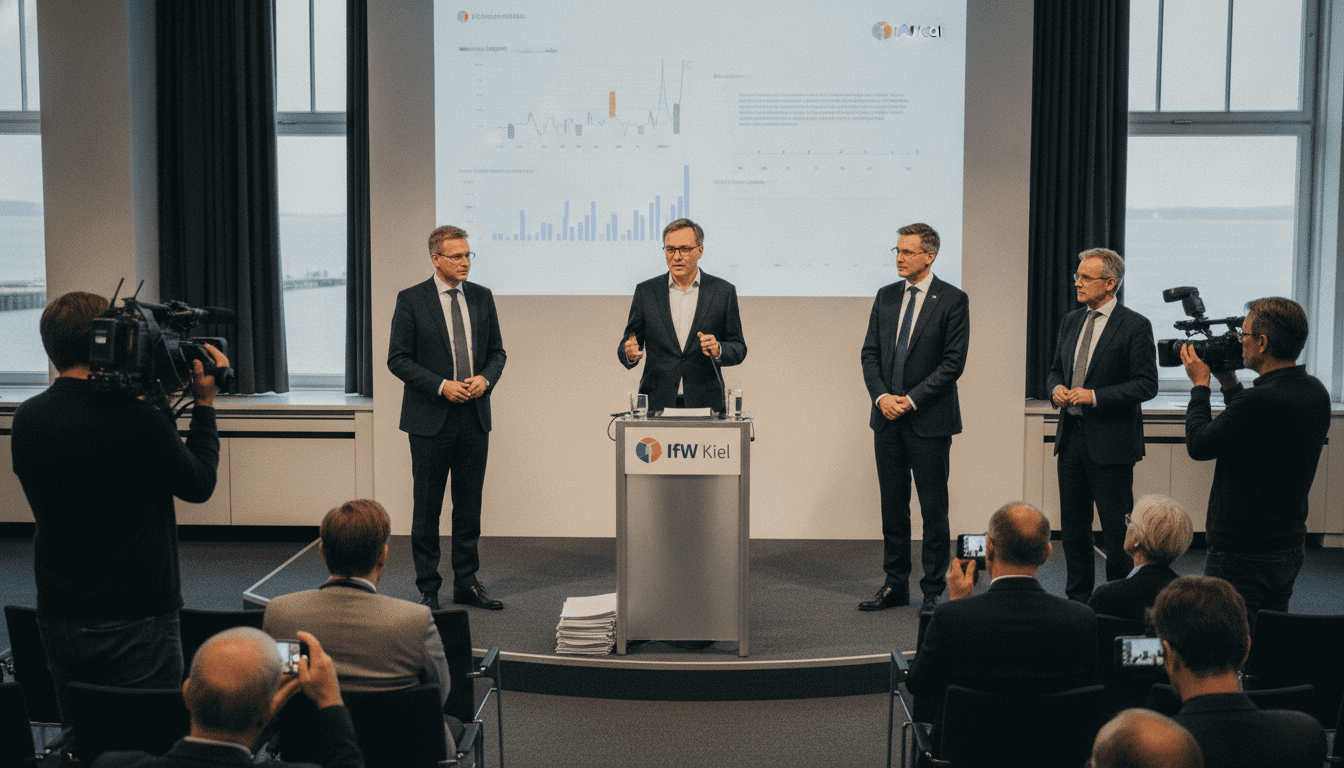
IfW Kiel holds Germany growth forecast at 0.8% despite Iran war impact
IfW Kiel keeps Germany’s 2026 growth forecast at 0.8%, citing public spending that offsets fallout from the Iran war; next-year growth is trimmed to 1.0%.
The Kiel Institute for the World Economy (IfW Kiel) said on Thursday it will maintain its March projection that Germany’s economy will expand by 0.8 percent this year, despite the economic fallout from the conflict involving Iran. The institute noted that fiscal measures, especially rising public investment and defence spending, are providing enough stimulus to offset weaker private demand and external headwinds. IfW Kiel trimmed its forecast for 2027 from 1.4 percent to 1.0 percent, signaling caution about the medium-term durability of the recovery.
IfW Kiel’s headline figures
The institute’s decision leaves the current-year growth estimate unchanged at 0.8 percent, while reducing next year’s outlook to 1.0 percent.
This stance contrasts with several other German economic research bodies and the federal government, which in recent weeks have lowered their 2026 projections to roughly 0.5–0.6 percent. IfW Kiel says the difference reflects stronger expectations for fiscal impulses than many peers have assumed.
How the Iran conflict factors into the outlook
IfW Kiel identified the conflict involving Iran as a material negative for external demand and supply chains, but not a reason to revise the 2026 baseline lower.
The institute described “countervailing forces” acting on the German economy: while geopolitical tensions and related disruptions are weighing on trade and business sentiment, expansionary fiscal policy is supporting domestic activity. That calculus led IfW Kiel to retain the 0.8 percent figure for the year despite the new risks.
Role of public spending and defence outlays
Public investment, notably in infrastructure and rearmament, is the central reason IfW Kiel expects stronger near-term activity than other forecasters.
The institute observed that government spending programmes have begun to raise demand in sectors linked to construction, equipment and procurement. These fiscal flows are concentrated in projects that typically generate immediate domestic economic activity, helping to counterbalance weaker export momentum.
Weakness in exports and private investment
IfW Kiel cautioned that the recovery lacks the broad-based characteristics seen in prior upturns because exports and private investment have not picked up noticeably.
The institute pointed out that, historically, rebounds in Germany have been sustained by stronger external demand and a revival in business investment; those signs are currently limited. As a result, the IfW’s positive assessment depends heavily on continued fiscal support rather than a self-sustaining private-sector upswing.
Comparison with other forecasts and the government
Many research institutes and the German federal government have adopted more conservative 2026 estimates, reducing expectations to about 0.5–0.6 percent.
Those bodies have cited immediate trade disruptions and softer global growth as primary reasons for their downgrades. IfW Kiel’s higher near-term forecast therefore represents a notable divergence rooted in differing assumptions about the scale and persistence of state-driven demand.
Risks and uncertainties ahead
While IfW Kiel retained a modest growth projection for 2026, it emphasized downside risks that could alter the outlook quickly.
The institute highlighted the potential for renewed energy and supply-chain shocks, elevated geopolitical tensions, and a slower global cycle to sap momentum. It also flagged the challenge of transitioning fiscal stimulus into longer-term productivity gains if private investment does not follow.
The coming quarters will test whether public investment can catalyse broader private-sector recovery or whether Germany’s expansion will remain narrowly based and vulnerable to external shocks.
