
Italy’s EU recovery fund race: Local projects deliver but governance and priorities draw criticism
Italy raced to spend its EU recovery fund ahead of an August deadline, turning billions into local projects while raising concerns over priorities and oversight.
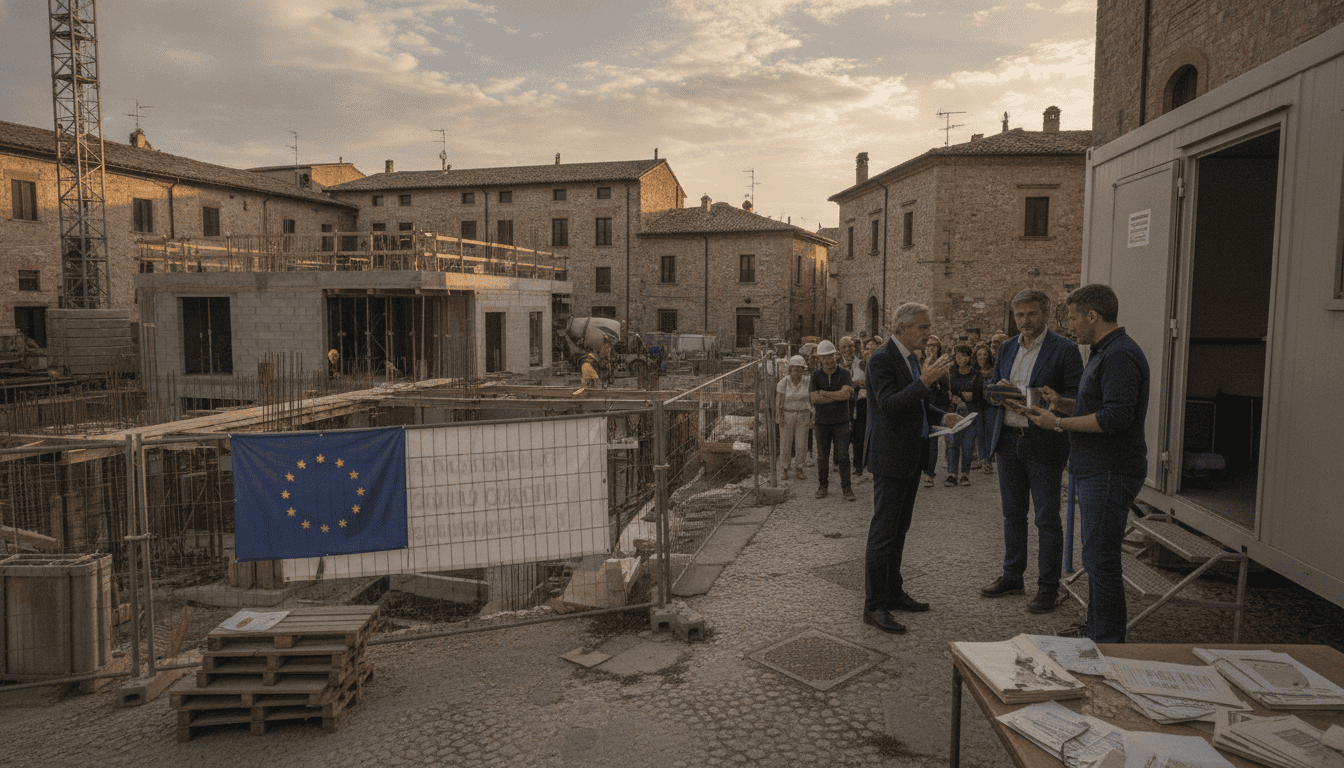
Calascio, a hilltop village in the Abruzzo region, illustrates how Italy directed EU recovery fund money into local revitalisation projects to halt depopulation. The town of 119 residents secured roughly €20 million for renovations, a new campsite, cultural festivals and training programs, showing how targeted grants from the EU recovery fund can produce visible results. Yet the broader campaign to deploy roughly €194 billion for Italy exposed limits in capacity and coordination as authorities scrambled to meet spending deadlines.
Calascio’s village revival
Calascio’s mayor pursued an ambitious plan to stop further out-migration by using recovery fund cash to restore churches, open a sports centre and launch hospitality services. The influx supported business openings and vocational courses for shepherds and tailors, helping revive services that had vanished when the village population shrank from about 2,000 to a few dozen. Local officials say the investment has boosted tourism and created short-term jobs, though long-term demographic change remains a difficult challenge.
Scale and structure of Italy’s recovery funding
The EU recovery fund, adopted in 2021 and financed through joint Eurobond issuance, allocated large sums to member states; Italy’s share was about €194 billion. That package includes roughly €122 billion in low-interest loans and about €72 billion in non-repayable grants, with disbursements tied to reforms and project milestones. The combination of loans and grants expanded Italy’s capacity for public investment but also required complex administrative arrangements to manage funds and comply with EU conditions.
A national sprint against an August deadline
Authorities across Italy faced a binding deadline to commit and spend the money by the end of August, prompting a nationwide push to accelerate approvals and project starts. That urgency produced a wave of infrastructure works — new railway sections, expanded fibre and 5G networks, student residences and childcare facilities — which officials argue would have taken years longer without the recovery funds. The compressed timetable, however, intensified pressure on procurement, planning and local implementation bodies.
Implementation frictions and oversight gaps
While many projects advanced, several ambitious targets were scaled back because of administrative and practical constraints. Successive changes to priorities by Rome and a piecemeal disbursement schedule from Brussels complicated planning for regions and municipalities. Concerns about oversight emerged as national reforms designed to meet EU conditions were unevenly implemented, and critics point to restrictions placed on the national audit office that limited independent scrutiny. At the same time, EU institutions exercised selective monitoring, balancing enforcement with an interest in a smooth roll-out.
Measurable gains in connectivity and services
Despite the problems, the recovery spending produced measurable improvements in infrastructure and public services. Italy’s fibre-optic and 5G rollout advanced to levels above the EU average, and investment in research and public IT systems restored capacity that had been eroded by years of underinvestment. Childcare places were increased, though targets were reduced from initial goals; nonetheless, the new facilities expand access and can support higher female labour force participation in the longer term.
Missed priorities and concentration of benefits
Not all sectors benefitted equally. Essential but less visible works — notably extensive investment in leaky water distribution networks that lose an estimated 40 percent of supply — received too little funding, leaving substantial efficiency gains unrealised. Large firms captured a significant share of transfers in some cases, sparking debate over competitive distortions and whether public money disproportionately advantaged already established companies. Employment services and local job-placement agencies saw only marginal improvements, highlighting uneven outcomes across policy areas.
Italy’s recovery effort also highlighted an old paradox: a rapid surge of funds makes careful, efficient allocation difficult. Regions and small towns sometimes received disproportionate per-capita grants, while other large structural deficits remained under-addressed. The trade-off between speed and strategic selectivity shaped much of the program’s final profile.
The overall verdict is mixed: the EU recovery fund enabled projects and investments that Italy had deferred for decades, delivering tangible benefits in some regions and sectors. At the same time, governance weaknesses, shifting priorities and uneven oversight limited the plan’s transformative potential and left important gaps that will require follow‑up attention.
