
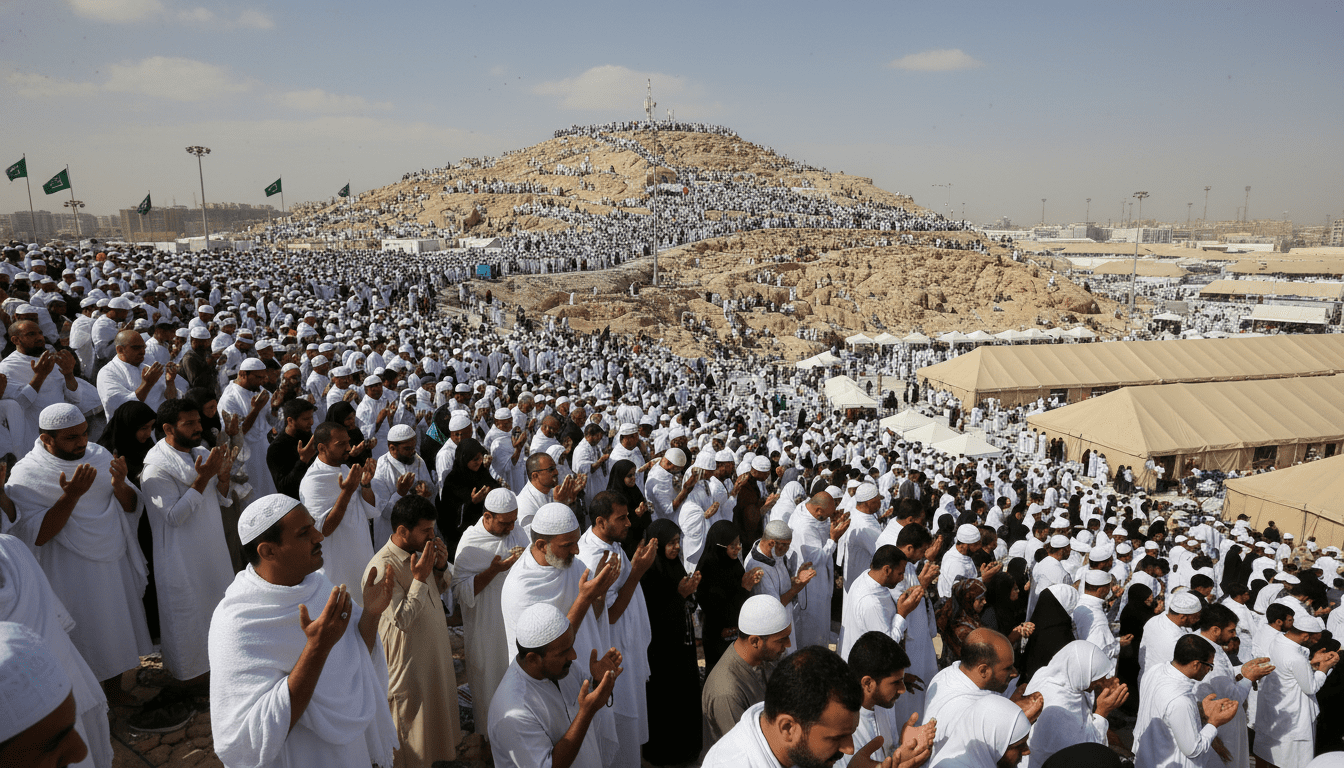
Millions gather on Mount Arafat for Day of Arafah as Hajj reaches spiritual peak
Day of Arafah: millions of pilgrims converged on Mount Arafat on May 26, 2026, for prayers and repentance as Hajj reached its most solemn day, uniting worshippers worldwide.
The Day of Arafah drew vast crowds to the plain of Arafat on May 26, 2026, as pilgrims engaged in concentrated prayer and reflection at the spiritual heart of Hajj. Pilgrims from dozens of countries gathered on and around Mount Arafat to perform rites that Muslims regard as among the most sacred acts of the pilgrimage. Saudi authorities and Hajj organizers coordinated transport, medical services, and crowd control as the number of worshippers peaked during the afternoon vigil. The scene combined solemn devotion with large-scale logistical operations that are now an annual focus for the kingdom and sending countries.
Pilgrims Converge on Mount Arafat
Thousands of groups arrived at Arafat by bus and on foot after leaving Mina early in the morning, following the traditional timetable of the pilgrimage. The plain and slopes of Mount Arafat filled with men and women in prayer, reading scripture, and performing supplications that form the core observance of the day. Organizers said the gathering typically represents the climax of Hajj, with pilgrims spending the day in repentance and petition. The atmosphere was described by observers as intensely reflective, with congregants remaining at Arafat until sunset.
Religious Significance and Core Rituals
The Day of Arafah is widely recognized in Islamic tradition as the moment when Prophet Muhammad delivered his Farewell Sermon, and many pilgrims treat the day as an opportunity for absolution and spiritual renewal. Standing at Arafat — wuquf — is a required rite for those performing Hajj, and scholars emphasize its centrality to the pilgrimage’s legal and spiritual validity. Pilgrims recited prayers, read from the Qur’an, and made personal supplications throughout the afternoon, seeking forgiveness and blessings. Religious leaders on site addressed congregations and offered guidance aligned with longstanding ritual practice.
Saudi Preparations and Infrastructure
Saudi authorities deployed extensive transport networks, temporary facilities, and medical teams to manage the influx of pilgrims to Arafat and surrounding areas. Public health and safety units were positioned along major routes and at staging points to respond to emergencies and maintain order. Organizers also coordinated sanitation services, water distribution, and shaded rest areas to accommodate long hours of observance in the open plain. Officials have increasingly focused on infrastructure upgrades in recent years to streamline movement between Mina, Arafat, and Muzdalifah.
International Pilgrims and State Coordination
Pilgrims represented a broad international cross-section, arriving under the auspices of national Hajj missions and private travel operators that coordinate visas, transport, and accommodation. Many countries deploy medical and logistical contingents to assist their citizens and liaise with Saudi authorities during peak days of the pilgrimage. Embassies and mission representatives maintained contact points to address consular issues and support pilgrims who required assistance. The multinational nature of Hajj continues to place diplomatic and operational demands on both sending states and the host government.
Health, Security and Crowd Management
Health services at Arafat included field clinics, ambulances, and teams trained to treat heat-related and other acute conditions that can arise during prolonged outdoor observance. Security forces implemented crowd-flow measures and checkpoints designed to prevent bottlenecks and ensure safe transit back to Mina after sunset. Organizers emphasized adherence to guidance on hydration, rest, and route timings to reduce medical incidents. Coordination between public health teams and security units proved critical in maintaining steady movement and rapid response capabilities throughout the day.
What Comes Next for Pilgrims
After sunset on the Day of Arafah, pilgrims traditionally depart for Muzdalifah to spend the night and collect stones for the subsequent ritual of stoning the pillars at Mina. This sequence of movements completes the physical arc of the Hajj rites and leads into the final days of the pilgrimage, which include sacrifice, shaving or trimming hair, and the symbolic ritual of the stoning of the devil. Pilgrims then prepare to return home, often deeply affected by the spiritual intensity of the experience and the communal dimension of Hajj. Officials will continue to oversee departures and transport over the following days to ensure orderly dispersal.
The Day of Arafah remains the pivotal moment of Hajj practice, blending centuries-old devotion with modern-scale logistics as millions converge at Mount Arafat to pray, repent, and complete a central duty of the Islamic faith.
