
Bundeswehr mine clearance offer for the Strait of Hormuz tied to strict conditions, Berlin says
Germany to offer Bundeswehr mine clearance in the Strait of Hormuz at Paris talks, but Berlin ties participation to conditions; plus domestic security updates.
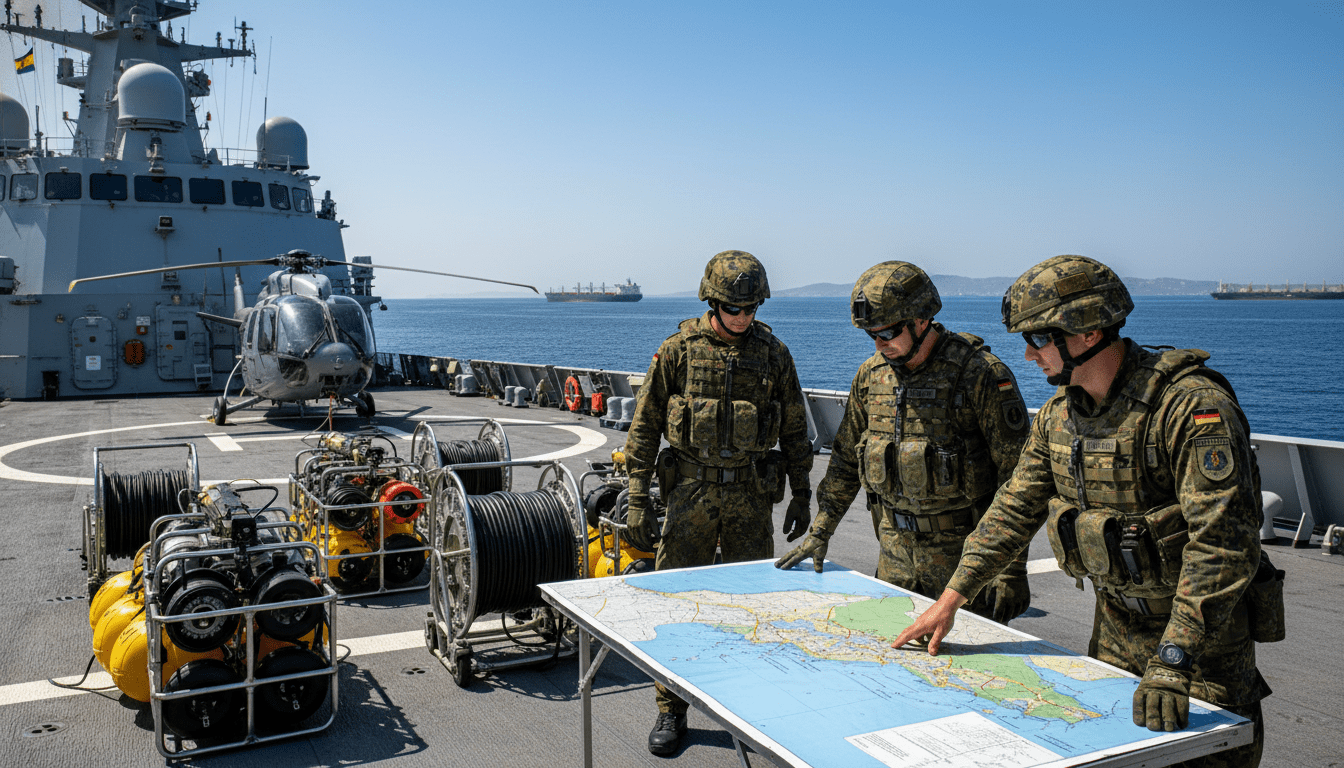
Germany will offer Bundeswehr mine clearance capacities for operations in the Strait of Hormuz at international consultations in Paris, officials said, but any German involvement is bound by firm political conditions. The proposed offer joins a wave of domestic security revelations and political disputes that kept Berlin’s agenda tightly focused on both foreign commitments and internal oversight.
Bundeswehr to present mine-clearing capacities in Paris
Germany plans to make a concrete offer of Bundeswehr mine clearance assets during a round of consultations scheduled in Paris, according to government sources. The offer is described as capacities rather than an immediate operational deployment, signaling Berlin’s intent to contribute capabilities while keeping operational decisions subject to domestic approval.
Officials said the proposal aims to assist in securing commercial shipping lanes if an international mission is established, reflecting concerns about maritime security in the Strait of Hormuz. The offer will be discussed alongside partners’ proposals at the Paris meetings, where coordination on scope and command arrangements is expected to be a key focus.
Merz requires end to hostilities and legal mandates before deployment
Friedrich Merz has conditioned any German participation in mine clearance on three prerequisites: the cessation of hostilities, a clear international mandate — ideally via the United Nations — and a formal decision by the Bundestag. By tying Bundeswehr mine clearance to those requirements, Merz signaled a preference for a multilateral, lawful framework and parliamentary oversight.
His stance narrows the window for rapid German operational involvement, since securing a UN mandate and a Bundestag vote would take time and political consensus. The explicit conditions reflect sensitivity in Berlin to both legal authority for overseas missions and the domestic political appetite for military commitments.
Government disclosure reveals broad surveillance of civil society
Separately, the federal government acknowledged that the domestic intelligence service has conducted regular, often covert checks of citizens and non-governmental organizations when state funds or awards were at stake. Culture Minister Sebastian Weimer’s order to scrutinize three bookstores attracted attention, but officials said that pattern is part of a wider practice dating back to 2017.
According to the government’s account, more than 3,000 civil-society organizations and individuals have been screened ahead of funding decisions or prize allocations, raising fresh questions about oversight, transparency and the criteria used for such checks. Civil liberties advocates urged clearer safeguards and public reporting standards to prevent undue monitoring of lawful activity.
BKA records highest number of politically motivated crimes in decades
The Federal Criminal Police Office (BKA) reported nearly 86,000 politically motivated offences in 2025, marking the highest tally in more than two decades. The BKA’s figures show right-wing extremist crimes remain the largest category by far, though incidents linked to left-wing actors have shown a pronounced increase.
Law-enforcement officials said the surge poses a complex challenge for policing and prevention strategies, requiring both targeted enforcement and community-level interventions. Political leaders across the spectrum called for strengthened measures to counter radicalization while warning against securitizing legitimate political dissent.
Coalition talks in Munich collapse over portfolio disputes
In municipal politics, exploratory talks in Munich between the Greens, the SPD and Volt broke down after Volt withdrew from negotiations citing unresolved personnel demands. Volt had sought control of at least two city departments, a condition Greens and SPD did not accept, prompting Volt to step back “for the time being.”
The rupture leaves the city’s coalition prospects uncertain and highlights the friction small parties can cause in coalition arithmetic when portfolio allocations are pivotal. Local analysts noted that the impasse could force fresh rounds of negotiations or hasten alternative coalition formats ahead of a municipal governing decision.
Health insurers’ savings draft would raise contributions for high earners
A draft savings package circulated within government ranks proposes raising the so-called contribution assessment ceiling for statutory health insurance, effectively increasing payments by higher earners. The plan also foresees a baseline rise of €300 in the assessment threshold, measures designed to shore up insurer finances without cutting core benefits.
The proposal is presented in a referentenentwurf, an internal working draft, and would still need political agreement and parliamentary approval to take effect. Labor unions and employers signaled readiness to debate the changes, while some opposition voices warned of unintended impacts on middle- and upper-income households.
Germany faces a week in which foreign policy choices and domestic accountability intersect, with the proposed Bundeswehr mine clearance offer in Paris taking center stage amid a swirl of security and political developments. The coming days will test whether Berlin can reconcile coalition politics, parliamentary prerogatives and international commitments while responding to rising security concerns at home.
