
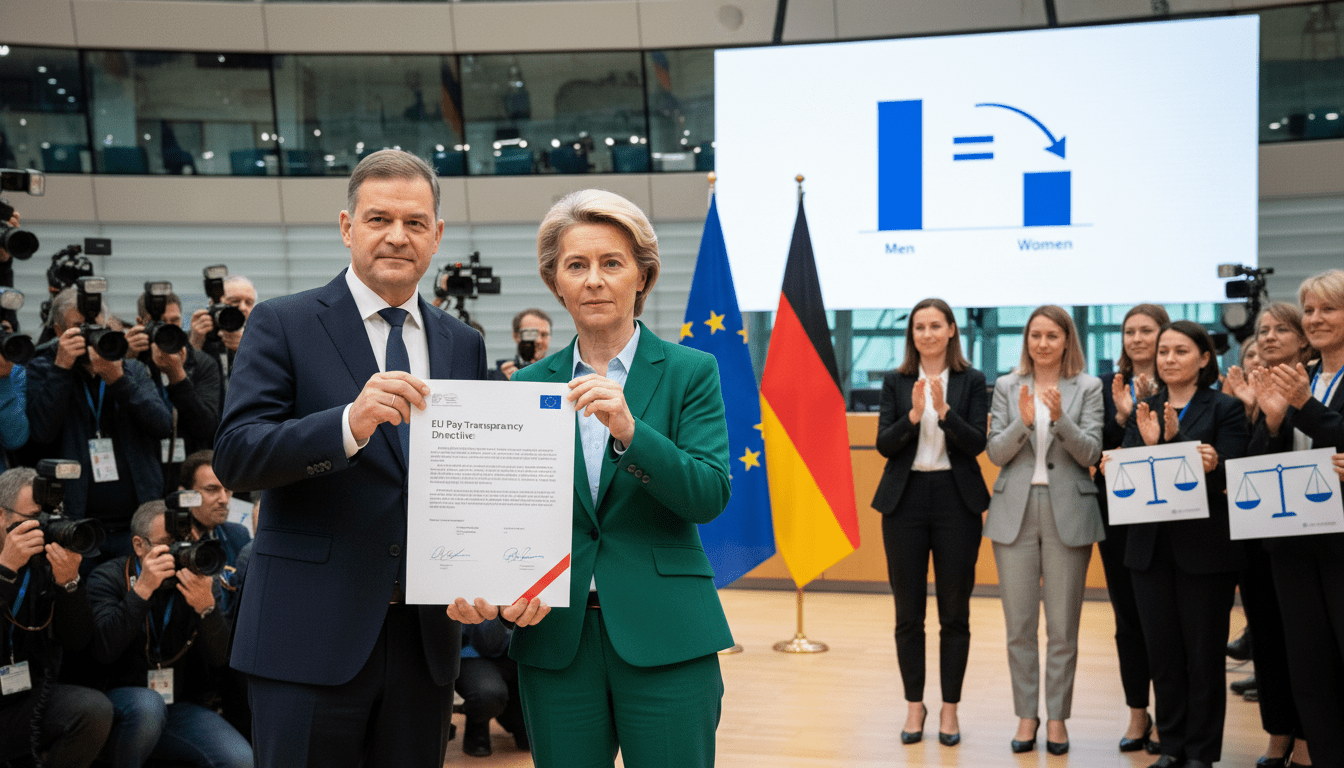
Germany Faces Deadline to Transpose EU Pay Transparency Directive by June 7, 2026
Germany must enact the EU pay transparency directive by June 7, 2026. Experts and legal advisers say the law will enable affected employees to request information, pursue equal pay and in some cases claim back wages where gender-based pay disparities exist.
Germany’s government is now under a clear timeline to transpose the EU pay transparency directive into national law, creating new obligations for employers and new rights for workers. The move follows European-level negotiations that set binding implementation deadlines for member states, and it aims to cut persistent gender pay gaps by increasing workplace transparency.
What the directive requires of employers
The EU pay transparency directive mandates greater disclosure of pay structures and access to pay information for employees, according to legal analysts. Employers will have to make clearer how salaries are determined and respond to requests from workers who believe they are paid less for equal or equivalent work.
The requirement is designed to expose unjustified differences and to encourage remedial action by companies before disputes escalate to litigation. Labour lawyers say the practical effect will vary by sector and company size, but the transparency aim is consistent: reduce hidden criteria that can perpetuate discriminatory pay practices.
Who can use the new rights
Employees who suspect they are paid less than colleagues for comparable work will be able to request relevant information under the new rules, experts say. This includes women who, according to recent figures cited by legal observers, still face a measurable pay gap compared with men.
Adam Sagan, a labour specialist quoted in recent reporting, noted that Germany’s unadjusted gender pay gap remains around 16 percent, and even after accounting for factors such as part-time work and job profiles an adjusted gap of about six percent persists. Those differences, he added, may reflect discrimination and could form the basis for claims when transparency reveals unequal pay for equal work.
Legal pathways and potential for back pay
Legal advisers warn that transparency does more than reveal disparities: it can enable employees to pursue compensation. Where documentation shows unequal pay for equal or equivalent roles, affected workers may have grounds to demand adjustments and, in some cases, retroactive pay for past discrimination.
The possibility of claims covering prior periods raises stakes for employers, prompting companies to audit pay practices proactively. Employment law firms predict an initial wave of internal reviews and negotiated settlements as businesses seek to limit litigation risk and comply with the new disclosure obligations.
Implications for human resources and corporate compliance
Human resources departments will face new responsibilities to document pay decisions and to communicate salary structures clearly. Firms will need to balance confidentiality and data protection with the transparency required by the directive, experts caution.
Compliance programmes are likely to expand, including internal pay audits, revised pay grading systems and training for managers on objective compensation criteria. Companies that already maintain detailed pay frameworks may adapt more smoothly, while others will be pushed to overhaul longstanding, opaque practices.
Timeline for implementation and expected enforcement
Member states must transpose the EU pay transparency directive into domestic law by June 7, 2026, setting in motion a period for national rulemaking and administrative preparation. German ministries responsible for labour and justice are expected to outline draft legislation and enforcement details in the coming weeks.
Enforcement mechanisms — including complaint processes, remedies and possible sanctions — will depend on how Berlin shapes its transposition law. Policymakers must decide how to balance worker rights, employer burdens and administrative feasibility, with observers noting that robust enforcement will be central to achieving the directive’s aims.
The directive’s adoption will likely prompt reactions from labour unions and employer associations, who will lobby on measures such as thresholds for employer obligations and protections for business-sensitive information. Courts may ultimately clarify the scope of rights and remedies as cases move through the legal system.
Implementing the new rules will also involve public information campaigns so employees understand how to request pay data and what remedies are available. Worker representatives and legal clinics are preparing to advise claimants once the national law takes effect.
Germany’s move to transpose the EU pay transparency directive by June 7, 2026 places the spotlight on longstanding wage inequalities. The new framework is intended to make disparities visible and actionable, and experts say that for affected women the law could translate into concrete claims for equal pay and, where justified, compensation for past shortfalls.
