
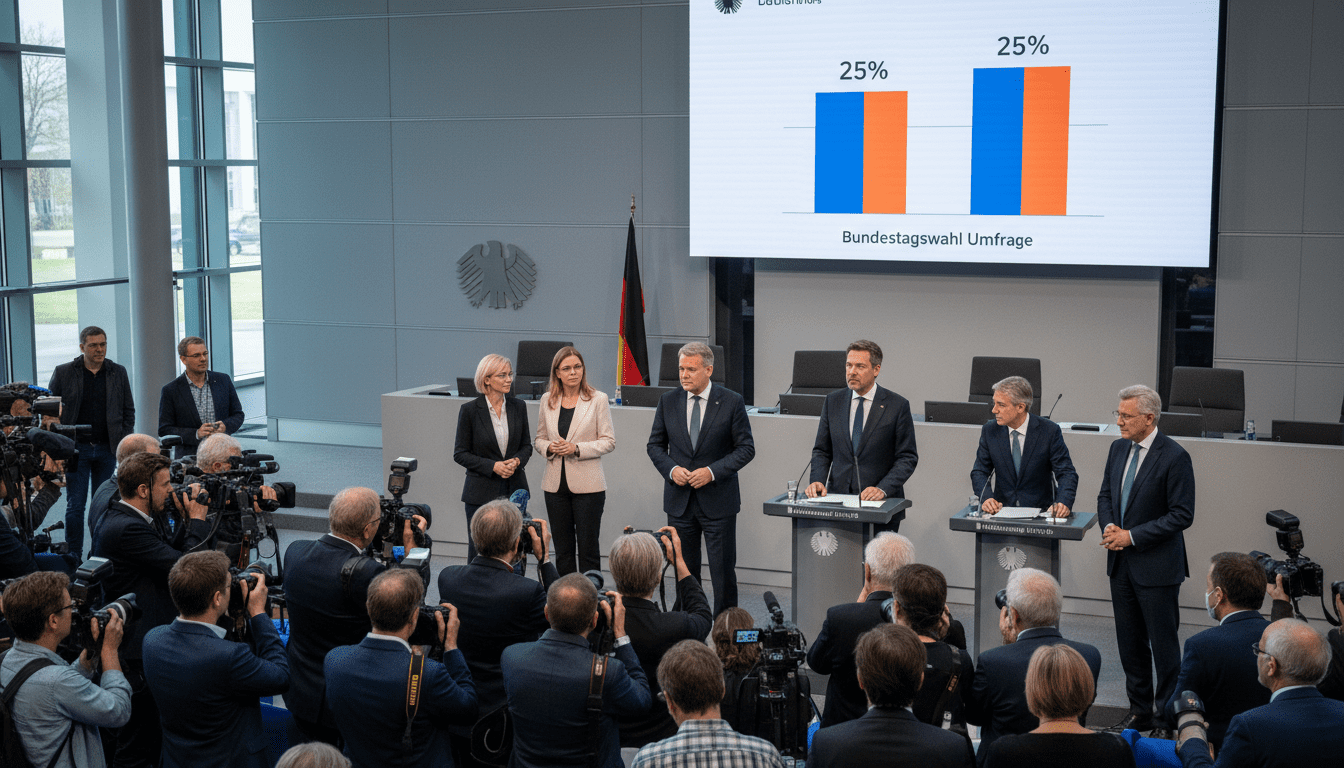
Union and AfD neck-and-neck in Bundestag polls as SPD and FDP lag
Bundestag polls show the Union and AfD tied near 25% while SPD, FDP and several smaller parties remain below previous election levels in the latest public surveys.
Lead findings from the latest Bundestag polls
The most recent Bundestag polls show the CDU/CSU (Union) and Alternative for Germany (AfD) running virtually level, each polling at roughly a quarter of voter intention if a federal vote were held immediately. These snapshots indicate a dramatic reshuffle of party standings compared with the early 2025 election, with several mainstream parties losing ground and the AfD recording notable gains.
Polling firms compiling rolling surveys report this pattern across separate samples, suggesting the parity between Union and AfD is a consistent feature of current voter sentiment. Analysts caution that these are momentary measures of public mood rather than firm forecasts of a future outcome.
Shifts since the February 23, 2025 federal election
Comparing the polls with the February 23, 2025 Bundestag result highlights the shifts: the Union won that contest with 28.5 percent, while the AfD finished second on 20.8 percent. The SPD received 16.4 percent in February 2025, the Greens 11.6 percent, and The Left 8.8 percent. Two smaller parties—BSW and FDP—fell short of the five-percent threshold, recording 4.9 and 4.3 percent respectively at the ballot box.
Current surveys indicate the SPD has declined further from its 2025 level and is now polling well below its past result, while the AfD has increased its support by roughly three to seven percentage points in many trackers. The Union’s polling advantage has narrowed considerably since its brief surge earlier in the year.
How smaller parties are faring in the polls
The Greens appear to have gained modestly and are polling around the low teens, buoyed in part by regional successes such as Cem Özdemir’s victory in Baden-Württemberg’s state election. The Left has improved slightly from its electoral showing and now sits near double digits in some surveys.
By contrast, both the FDP and the BSW remain under the five-percent threshold in most polls, which would render parliamentary entry unlikely if those numbers held on election day. That dynamic raises questions about potential coalition mathematics and which combinations of parties could form a majority.
Why poll figures include substantial uncertainty
Each individual opinion poll typically surveys about 1,000 respondents, meaning every estimate carries a margin of error that can allow for meaningful overlap between parties. To address that uncertainty, one national outlet aggregates the fifteen most recent surveys to produce a corridor of plausible outcomes for each party. When those corridors overlap, it becomes difficult to say definitively which party is ahead.
Polls thus show tendencies rather than precise forecasts. Parties close to the five-percent threshold may either clear it or fall short depending on small swings in public sentiment and the regional distribution of support.
Regional results and their influence on national polling
Recent state-level elections have influenced national perceptions and, in turn, the Bundestag polls. High-profile regional victories can provide momentum for a party and shift media attention, which appears to have aided the Greens most recently. At the same time, fragmented regional support patterns can exaggerate national poll volatility if certain demographics are over- or under-represented in survey samples.
Pollsters also note that voter priorities and turnout intentions can shift markedly between a media-driven reaction and the organized realities of a national campaign, altering how state-level successes translate to federal results.
Implications for government formation and the road to 2029
Because the next regularly scheduled federal election is not due until early 2029, current Bundestag polls should be read as an interim snapshot rather than a definitive guide to who will govern. Between now and that election, political events, leadership changes, policy debates and unforeseen crises could reshape the party landscape significantly.
If the present polling were replicated on election day, the parity between Union and AfD would complicate coalition arithmetic and could leave centrist and left-leaning parties scrambling to form a stable majority. The underperformance of the FDP and BSW relative to the five-percent threshold would also constrain options for coalition building.
Current polling thus raises early questions about long-term political trajectories, but analysts emphasize the considerable time and volatility remaining before the next scheduled vote.
Public opinion research remains a tool for gauging mood, not a ballot-box verdict, and the coming months and years will determine whether today’s Bundestag polls translate into lasting political realignment.
