
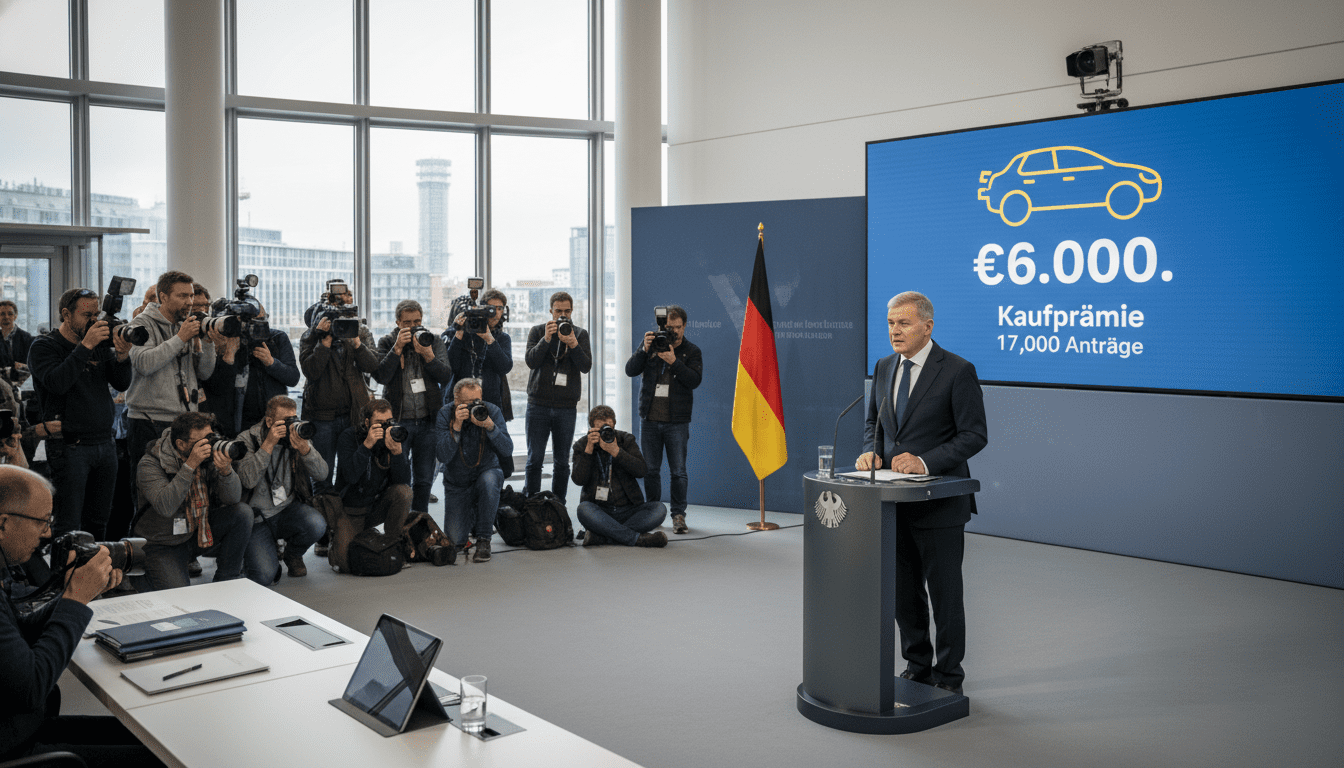
Germany’s Electric Car Subsidy Draws 17,000 Applications Within 24 Hours
Germany’s electric car subsidy drew nearly 17,000 applications in the first 24 hours after launch, signalling strong consumer interest in state-backed EV incentives.
Rapid uptake as applications flood the ministry
The Federal Environment Ministry reported that almost 17,000 claims were lodged roughly a day after the new electric car subsidy scheme opened, reflecting immediate demand from private buyers. Officials said the volume underscores consumer responsiveness to financial incentives and heightened interest in switching to battery-powered vehicles.
Minister Carsten Schneider (SPD) framed the measure as a push toward greater energy independence and resilience against global fuel-price shocks, while the ministry stressed that eligibility requires vehicle registration on or after January 1, 2026. The ministry also noted that the scheme covers purchases and lease agreements for qualifying vehicles, which contributed to the early surge in applications.
Eligibility rules and what vehicles qualify
The subsidy is designed for private, non-company vehicles and applies to new battery-electric cars, certain plug-in hybrid models and electric vehicles equipped with range-extender engines. Range extenders are small combustion units intended to increase the practical driving range of otherwise electric models.
To qualify, applicants must prove the vehicle was registered no earlier than January 1, 2026, and meet other administrative conditions set out by the ministry. Lease contracts are accepted under the programme’s rules, but business or fleet registrations are explicitly excluded from the state contribution.
How much buyers can receive and who determines the amount
The maximum subsidy available under the programme is €6,000 per eligible private buyer, though the exact grant depends on factors including the specific vehicle model, the applicant’s income level and household size. The ministry has said the award scale is intended to target support where it most stimulates private uptake.
Payments will be administered through the established application portal, with processing subject to verification of registration and ownership documents. Officials cautioned that high initial demand could slow processing times as applications are reviewed.
Funding, duration and expected programme reach
Legislators earmarked €3 billion from the federal Climate and Transformation Fund to finance the subsidy through 2029, providing a multi-year budget envelope for the initiative. According to the ministry’s estimates, the allocation could enable support for roughly 800,000 privately purchased or leased vehicles over the funding period.
That projection assumes average subsidy levels and sustained uptake; actual reach will vary depending on how many applicants qualify for the maximum grant versus lower tiers. The multi-year horizon is intended to give market actors and consumers clarity on the government’s medium-term support for electrification.
Global market backdrop and IEA data
The new German incentive arrives amid expanding global electric vehicle adoption, with the International Energy Agency reporting a substantial rise in EV sales in recent years. In 2025, global EV sales reached about 20 million vehicles, an increase of roughly 20 percent year-on-year, and EVs accounted for about one quarter of new car purchases that year.
The IEA has suggested that the share of electric vehicles among new purchases could climb to around 30 percent during 2026, driven by falling battery costs and policy responses to energy market volatility. Production remains concentrated in China, which supplies an estimated 60 percent of global EV volumes, while manufacturers in Europe and North America together account for roughly 30 percent of sales.
Implications for consumers, industry and infrastructure
Industry analysts said the subsidy is likely to accelerate purchase decisions for cost-sensitive private buyers and may prompt manufacturers and dealers to push promotions in the German market. Automakers and leasing firms have already signalled readiness to process incentive-eligible sales, which could further stimulate short-term demand.
Longer-term impacts hinge on complementary investments in charging infrastructure and supply chains for batteries and components. Policymakers acknowledge that grants alone will not resolve all barriers to electrification, and they have pointed to a broader package of measures aimed at improving public charging access and easing the transition for households.
The programme’s early uptake demonstrates clear consumer appetite for electric mobility, but its ultimate success will depend on efficient administration, the availability of charging networks and sustained market supply. Continued monitoring of application volumes, processing times and the interaction with broader EV policies will determine whether the subsidy materially accelerates Germany’s shift to electric vehicles.
