
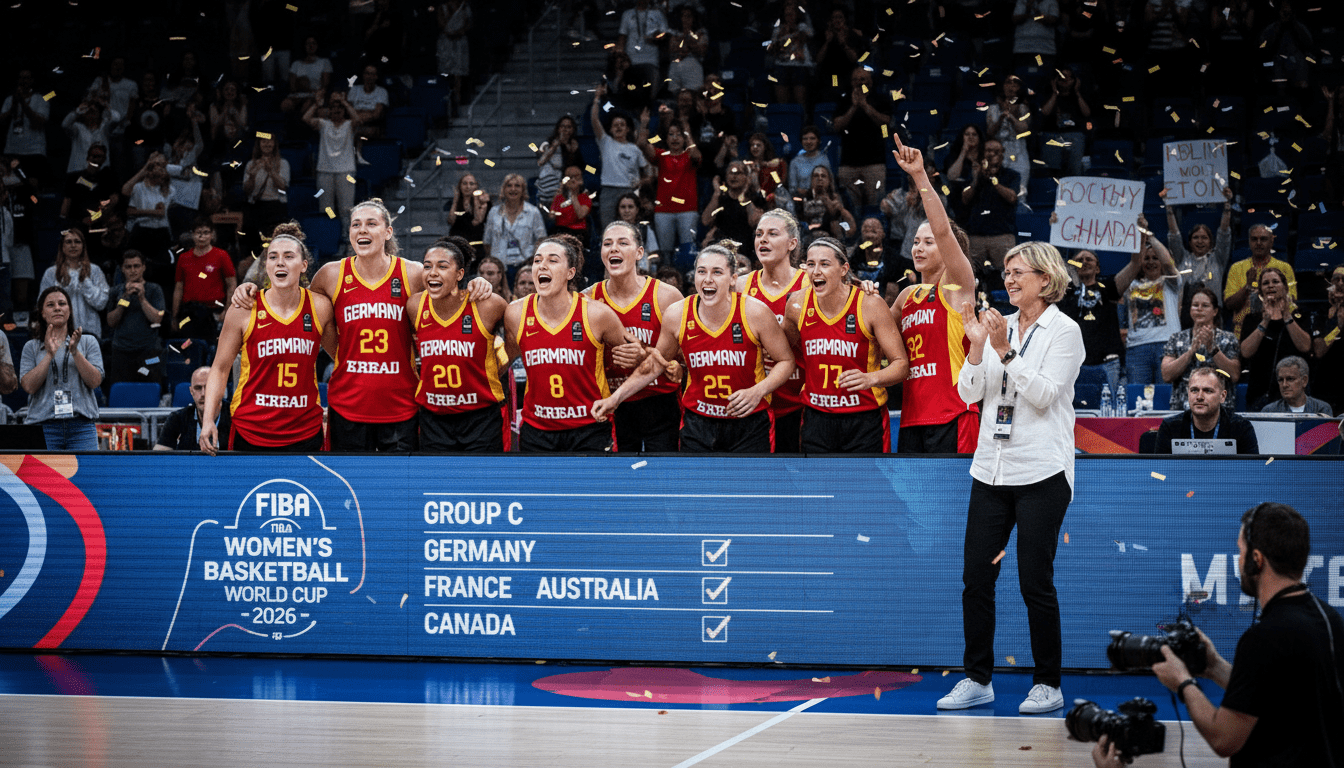
German women’s basketball drawn with Spain, Japan and Mali for Berlin World Cup
German women’s basketball drawn with Spain, Japan and Mali at the Berlin World Cup (Sept 4-13). Five WNBA stars boost medal hopes amid strong ticket demand.
The German women’s basketball team learned its preliminary opponents on the eve of the home World Cup draw in Berlin, landing in a group with Spain, Japan and Mali. The tournament runs from September 4 to 13 and will be staged across the Berlin Arena and the Max-Schmeling-Halle. The draw, held at the Kraftwerk venue, was conducted by Lauren Jackson, Stefan Kretzschmar and breakdance champion Jilou.
Group Draw Places Germany With Spain, Japan and Mali
Germany was drawn into a four-team pool that pairs the hosts with Spain, a perennial European contender, and Japan, a fast and disciplined Asian side. Mali completes the group as the African representative, presenting a varied set of tactical challenges for the hosts.
The grouping sets up a mixture of styles early in the tournament and gives the German women’s basketball team opportunities to test itself against different opponents before the knockout phase. With four group winners advancing directly to the quarterfinals, the importance of finishing top of the pool is clear.
Home Advantage: Venues and Ticket Demand
Organizers confirmed that games will take place in the Berlin Arena and the Max-Schmeling-Halle, venues chosen to accommodate both group play and the tournament’s high-attendance fixtures. The staging across two arenas is intended to maximize local engagement while preserving the atmosphere of a World Cup on home soil.
Interest in the event has been substantial, with the German Basketball Federation reporting more than 76,000 tickets sold for matches so far. Tickets for the final weekend on September 12 and 13—covering both semifinals, the third-place game and the final—are particularly sought after, with over 80 percent of those seats already claimed.
Roster Strength: Five WNBA Players Lead Bid
Germany arrives at the World Cup with its most accomplished squad in decades, featuring five players currently active in the WNBA: Satou Sabally, Nyara Sabally, Leonie Fiebich, Luisa Geiselsöder and Frieda Bühner. That collection of professional experience at the highest club level has raised expectations around the team’s competitive ceiling.
This will be Germany’s first World Cup appearance in 28 years, and the presence of multiple WNBA talents provides depth across positions and matchups. Coaches and federation officials emphasize that the mix of international club experience and home-court support could be decisive in a compact tournament schedule.
Tournament Path and Qualification Rules
The competition format rewards strong group-stage performance: each of the four group winners moves directly into the quarterfinals. Teams finishing second and third in their groups enter a play-in knockout round to contest the remaining four quarterfinal berths.
That structure increases the value of securing first place in the pool, while also giving runners-up and third-placed teams a second route into the final eight. For Germany, the aim will be to avoid the uncertainty of a play-in game and secure direct qualification through consistent group results.
Expectations and Voices: Nowitzki Backs Home Bid
German basketball legend Dirk Nowitzki publicly endorsed realistic but ambitious goals for the hosts, saying a quarterfinal berth should be the minimum objective. He added that with the momentum of home crowds and the squad’s talent, German players “must not hide” and could advance further if the team captures the country’s enthusiasm.
Such high-profile backing underscores national attention on the tournament and raises the stakes for the coaching staff and players. Head coach Olaf Lange inherits both heightened expectations and a supportive environment as he prepares the squad to navigate group play and, ideally, the deeper stages of the competition.
Germany will carry not only competitive ambitions but also a host’s responsibility to deliver a compelling tournament for fans and neutral observers. The next months will be devoted to finalizing preparations, managing player fitness, and using the depth of WNBA experience to forge a cohesive unit ready for the diverse challenges of the World Cup.
