
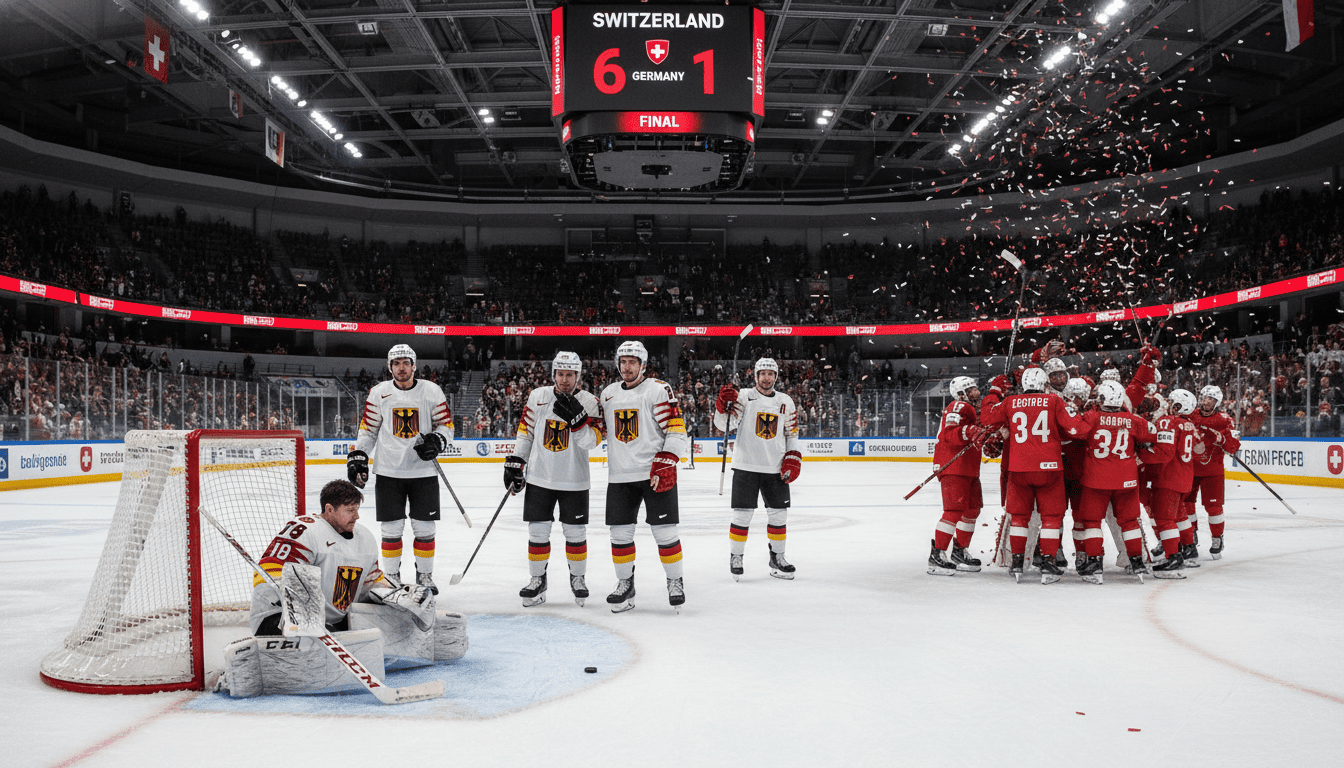
German ice hockey team humiliated 1–6 by Switzerland, faces early World Championship exit
German ice hockey team stunned by 1–6 loss to Switzerland at the World Championship, leaving Germany winless and teetering on group-stage elimination.
Historic defeat in Lausanne
The German ice hockey team was routed 1–6 by host Switzerland, suffering its heaviest World Championship loss to the Swiss since 1937. The result left Germany with zero points after three matches and deepened concerns about a rapid decline since the team’s 2023 silver finish.
Switzerland’s attack capitalized on turnovers and lapses in special teams to build a commanding lead in the second period. The home side’s mix of NHL talent and opportunistic finishing overwhelmed Germany and ignited a vociferous local crowd.
Group position and elimination danger
Germany now sits at the bottom of its group after three straight defeats, with qualification for the knockout stage hanging by a thread. The team must beat the United States in its next match to keep any realistic hope of advancing, a task made more difficult by the quality of the American roster.
The pressure on the German squad is compounded by recent disappointments, including underperformance at the Winter Olympics, and a seven-game World Championship losing streak that marks the nation’s worst run in decades. Failure to advance would mirror last year’s early exit and increase scrutiny on the program ahead of next year’s home tournament.
Decisive moments and match flow
The contest began cautiously, with a scoreless first period masking the growing momentum of the Swiss side. The game turned early in the second when Switzerland struck twice in 35 seconds, exploiting defensive errors and turning a manageable contest into an avalanche.
Key Swiss goals came from Denis Malgin, Sven Andrighetto and Christoph Bertschy, while captain Roman Josi and Nico Hischier added late finishes to seal the margin. Germany’s lone goal arrived from Frederick Tiffels in the 56th minute, a consolation in his 100th international appearance but insufficient to alter the outcome.
Tactical changes and lineup choices
Coach Harold Kreis made several adjustments intended to reinvigorate the team, including a debut start in goal for Jonas Stettmer and defensive rotations that introduced rookie Phillip Sinn. Kreis also shuffled forward lines to generate energy and address struggles in both power play and penalty-killing situations.
Despite the tactical tinkering, Germany failed to establish sustained pressure in the offensive zone, and the power play produced no meaningful chances early in the second period. The changes brought no defensive stability, and individual mistakes—most notably by captain Kai Wissmann before the second Swiss strike—proved costly.
Responses from the camp and consequences
Kreis acknowledged the players’ frustration after the match and emphasized that the squad has been addressing issues in multiple meetings. Forwards and staff highlighted the need for cleaner execution on special teams and greater discipline in possession to prevent quick counterattacks.
With the World Championship and next year’s home tournament looming, national federation officials and supporters are likely to demand answers about recruitment, preparation and in-game management. The coach’s position is under intensified scrutiny as Germany seeks to arrest a worrying trend that has seen the team slip from 2023 success to repeated early exits.
Swiss momentum and tournament context
Switzerland, playing on home ice with several NHL players available, demonstrated why it is considered a title contender at this World Championship. The hosts combined structured defending with fast transitional play, turning turnovers into high-quality scoring chances throughout the middle period.
The victory keeps Swiss ambitions intact after successive silver medals and raises expectations among local fans that this squad can convert near-misses into a championship. For Germany, the contrast between the teams’ trajectories could not be starker, as Zurich/Lausanne venues fill and pressure mounts on the visiting side.
Germany’s immediate challenge is to regroup ahead of the upcoming match against the United States, where a win is essential to avoid a second consecutive group-stage elimination. The team’s ability to correct special-teams breakdowns, limit individual errors and find reliable goaltending will determine whether it can salvage its World Championship campaign.
