
Heatwave in Germany Breaks Record as Highways Buckle, Care Homes and Fire Services Strain
Heatwave in Germany: DWD records 41.5°C in Drewitz, prompting road closures, calls for better protection in care homes, and an elevated wildfire threat across eastern regions.
Germany’s ongoing heatwave registered a new national high on Saturday when the Deutscher Wetterdienst (DWD) recorded 41.5°C at the Drewitz station in Jerichower Land at about 16:30. The extreme temperature followed a 41.3°C reading in Saarbrücken on Friday, and the heat has already strained infrastructure, emergency services and vulnerable populations across the country.
New national temperature record in Drewitz
The DWD designated the Drewitz measurement as a new temperature extreme value, marking a notable jump in the week-long spell of unusually high temperatures. Meteorologists said the reading surpassed Friday’s 41.3°C in Saarbrücken and reflected a broader pattern of persistent heat across central Europe.
Forecasters warned that some regions could see temperatures remain very high into Sunday, with neighboring national services reporting further local peaks that underscore the scope of the heatwave in Germany and beyond.
Extreme heat recorded across nearby countries
The heatwave did not stop at Germany’s borders: Denmark’s weather service reported 37°C in Ødum north of Aarhus — the highest temperature recorded there since measurements began in 1874. Switzerland’s Basel reached 39°C, a new local high, while the Czech national service registered 40.6°C, later revised to 40.8°C, at Doksany north of Prague.
These cross-border records illustrate a regional pattern of heat extremes that meteorological agencies say are exceptional for late June and contribute to rising concerns about heat-related impacts on health and infrastructure.
Autobahns suffer asphalt damage and closures
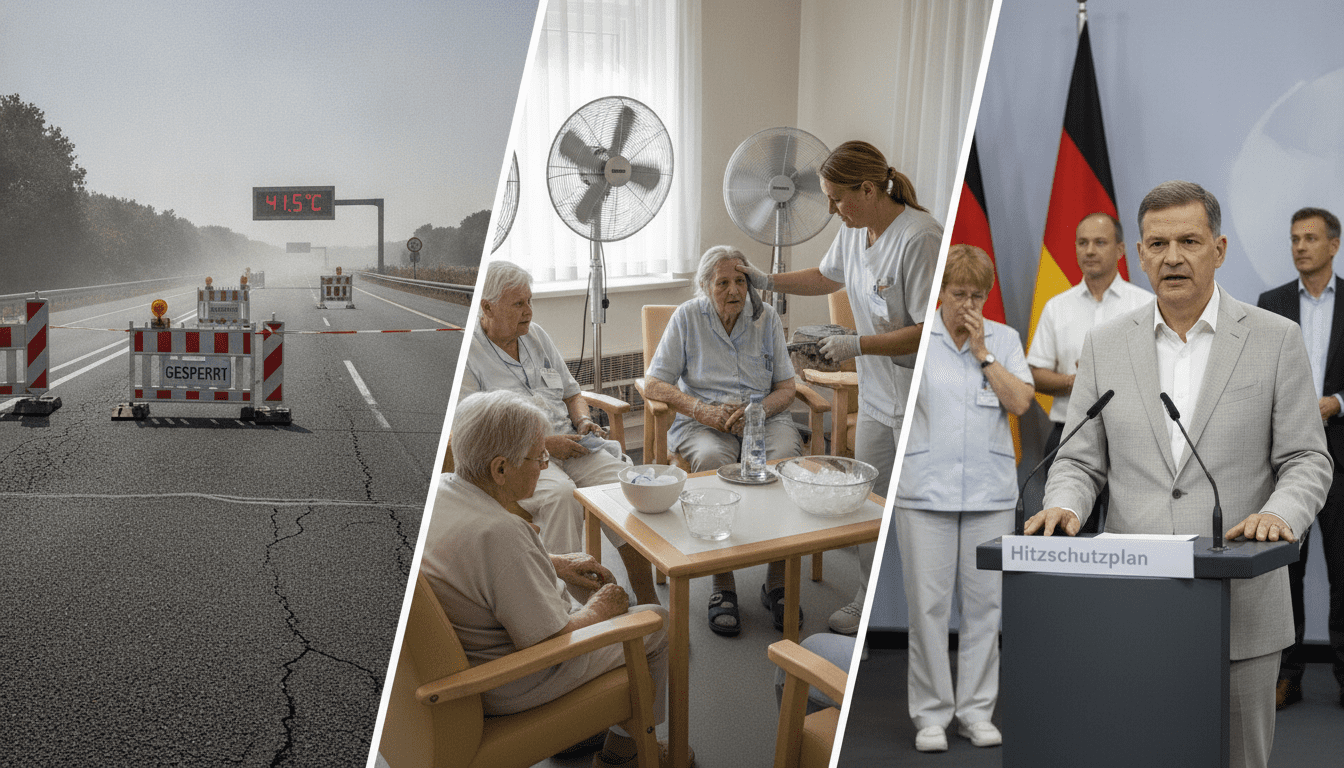
Operators and police reported more than a dozen heat-related pavement failures on Germany’s motorways, with sections buckling as concrete and asphalt expanded under the heat. The federal Autobahn GmbH recorded multiple damage sites and announced extended restrictions on several routes.
Among the disruptions, the A2 toward Hannover near Burg in Saxony-Anhalt remained closed until at least Sunday afternoon, while a full closure continued near Ziesar in the direction of Berlin. Additional damages were reported near Irxleben, and the A10 southern Berliner Ring, between Niederlehme and Königs Wusterhausen, also recorded new defects that required intervention.
Regional traffic authorities and ADAC report lane reductions
Road operators and the ADAC described further heat-related restrictions across several states, including lane closures on the A93 in Bavaria and a single-lane closure on the A7 south of Hamburg. Repair needs were identified on both directions of the A9 near Ingolstadt, and speed reductions were imposed on the A48 at the Rheinbrücke Bendorf and on the A3 near Wiesbaden to reduce strain on compromised surfaces.
Officials urged drivers to expect delays, respect temporary speed limits and avoid stopping on the hard shoulder in heat-affected stretches while emergency crews carry out assessments and repairs.
Patient protection group demands binding investments for care homes
The Deutsche Stiftung Patientenschutz sharply criticized what it called insufficient action to protect care-home residents from extreme heat. Eugen Brysch, the foundation’s chairman, said many of Germany’s roughly 800,000 nursing-home residents were already suffering from the extreme temperatures and called for binding federal investments in heat protection measures this year.
Brysch warned that political pressure had produced plans on paper but not the necessary funding and staffing to implement effective cooling and protective measures, and he urged the federal and state governments to move beyond “actionism” to concrete, financed solutions.
Fire and rescue services face unusually high demand in Mönchengladbach
The Mönchengladbach fire department reported a surge in emergency demand, logging 185 deployments since 07:00 on Saturday. The tally included 124 rescue-service responses, 39 patient transports, ten fire incidents and 12 technical assistance operations, supported by an extraordinary 1,024 incoming emergency calls.
Fire officials said career staff and volunteers were mobilized from leisure time and auxiliary organizations to handle the volume, and they appealed for public cooperation with heat-safety guidance to reduce preventable emergencies.
Gohrischheide wildfire expands amid highest wildfire risk warnings
Drought conditions pushed the DWD’s forest-fire index to its highest warning level for Sunday in parts of Mecklenburg-Vorpommern, Saxony and Saxony-Anhalt, raising concern that small sparks could rapidly escalate. In the Gohrischheide area on the Saxony–Brandenburg border, a wildfire expanded from about three hectares to more than 19 hectares, with firefighters describing the situation as “calm but not stable.”
Authorities noted the site is munitions-contaminated from past military use, complicating suppression efforts and preventing some direct firefighting measures. Around 160 personnel from Saxony and Brandenburg were deployed, and officials warned that strong gusts forecast for Sunday could drive embers into new areas.
The DWD and regional emergency services advised residents to follow local orders, avoid activities that could start fires, and check official channels for evolving restrictions and safety guidance.
As temperatures remain unusually high, authorities emphasized preparedness and caution: users of Germany’s roads should expect disruptions, caretakers must prioritize cooling measures for vulnerable people, and residents in drought-prone areas should heed wildfire warnings and avoid risky behavior outdoors.
