
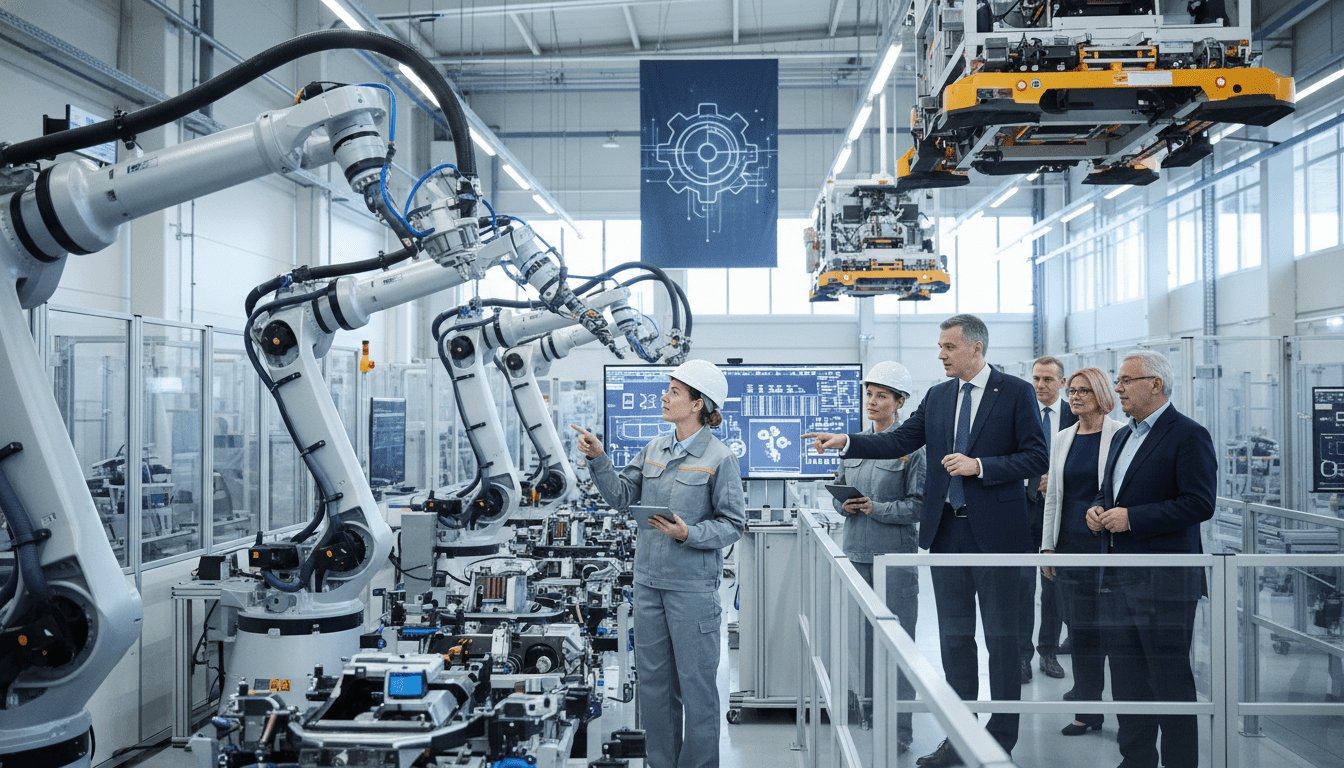
Factory of the future: BCG says AI and robots can keep German manufacturing competitive
BCG finds Germany can regain industrial edge with the factory of the future: AI and robotics cut costs, hold production domestically and reshape jobs.
Germany’s manufacturing sector could be transformed by a new wave of automation, according to an analysis by the Boston Consulting Group that describes a practicable “factory of the future.” The report argues that advances in AI and robotics will allow plants to run with far fewer people on production lines while lowering energy, material and labour costs. If realised broadly, those changes could make domestic production economically competitive with imports for many product categories.
BCG analysis outlines potential gains for German industry
The consultancy’s modelling suggests modern, AI-driven factories can reduce manufacturing costs significantly — in one example cutting production expenses by roughly 43 percent compared with today’s operations. BCG says that improvements in software, sensor networks and robot versatility are driving the shift from pilot projects to scalable factory upgrades. The analysis is based on surveys of around 1,000 industrial companies and internal cost simulations.
BCG executives frame the shift as an opportunity to blunt long-term deindustrialisation trends that have eroded employment and output over the past decade. The firm calculates that more than a trillion dollars of industrial value in Western and Northern Europe is at risk of relocation, while targeted modernisation could retain over €700 billion of value in Germany alone.
Robotics and AI cut costs and expand automation use-cases
Advances in machine learning and simulation mean robots can now be trained in virtual, photorealistic environments and deployed on the factory floor with less bespoke calibration. That lowers the one-time installation costs that previously made automation projects expensive and slow to roll out. BCG estimates that the share of applications that can be automated has risen substantially in recent years, increasing the business case for widescale investment.
Convergence of cheap sensors, predictive maintenance and autonomous scheduling also reduces downtime and operating expenses. Sensor-driven maintenance plans can flag wear before failures occur, and AI systems can schedule repairs or parts replacement without halting production, further compressing total cost of ownership.
Sector winners and losers under the new model
The report says the competitive gap between Germany and lower-cost manufacturing countries will shrink in several industries and even reverse in some cases. Food production and certain segments of consumer goods manufacturing look particularly well positioned to reshore or remain domestic when factories adopt next‑generation automation. Automotive and industrial suppliers also stand to benefit where high quality and local supply chains matter.
Conversely, experts see limited long-term prospects for labour‑intensive sectors such as mass-market textiles and some consumer electronics categories unless those industries fundamentally redesign products or processes. The outlook for machinery and equipment makers is mixed: the sector is not uniformly exposed, but rapid changes could alter competitive dynamics as happened previously in automotive supply chains.
Macroeconomic scale and reshoring implications
If BCG’s scenarios materialise, large swathes of production currently located abroad could become economically viable at home because labour and energy costs would weigh less in a highly automated plant. Logistics, tariffs and the cost of time-sensitive supply chains would then play a larger role in sourcing decisions. That recalibration could support industrial clusters and maintain higher-value activities within Germany and neighbouring markets.
However, the scale of reinvestment required is substantial and concentrated. Decisive outcomes will depend on capital availability, speed of adoption and whether competing manufacturing nations invest in similar technologies at scale.
Employment, skills and regional effects
BCG rejects the notion that automation must inevitably lead to mass unemployment, arguing instead that the nature of work will shift toward maintenance, oversight, process engineering and other indirect production roles. The firm expects continued employment in areas such as equipment servicing, quality control, and software operation even as headcounts on assembly lines fall. It also warns of significant structural change that will require large-scale reskilling and workforce mobility over time.
The challenge will be matching displaced workers with new roles, particularly in regions heavily dependent on traditional production tasks. Without effective retraining programmes and transition support, local labour markets could experience prolonged adjustment pains.
Policy and institutional barriers to transformation
BCG highlights regulatory and labour-market features as critical determinants of how quickly and widely the factory of the future can spread. In Germany, strict employment protection and high dismissal costs may slow corporate willingness to restructure, the consultants say. The report draws contrast with more flexible labour systems, arguing that lower transition costs can accelerate productivity gains and investment cycles.
Policymakers face a delicate balance: easing rules to speed adaptation risks social backlash, while preserving strong worker protections could blunt competitiveness. BCG recommends coordinated policy measures that combine incentives for capital investment, targeted training funds and transition support to smooth workforce shifts.
Germany’s manufacturing future, the analysis concludes, hinges on whether firms and policy makers can align investment, regulation and skills development. The factory of the future promises lower costs and renewed competitiveness but will require concerted action to ensure the gains translate into resilient industry and inclusive labour-market outcomes.
The path forward will depend on pragmatic decisions by companies and government, the mobilisation of capital, and a national effort to retrain and redeploy workers into the new roles created by increasingly automated production.
