
German growth forecast cut sharply as council warns of energy and trade headwinds
Germany growth forecast revised to 0.5 percent in 2026 by the federal economic council amid high oil prices and trade uncertainty
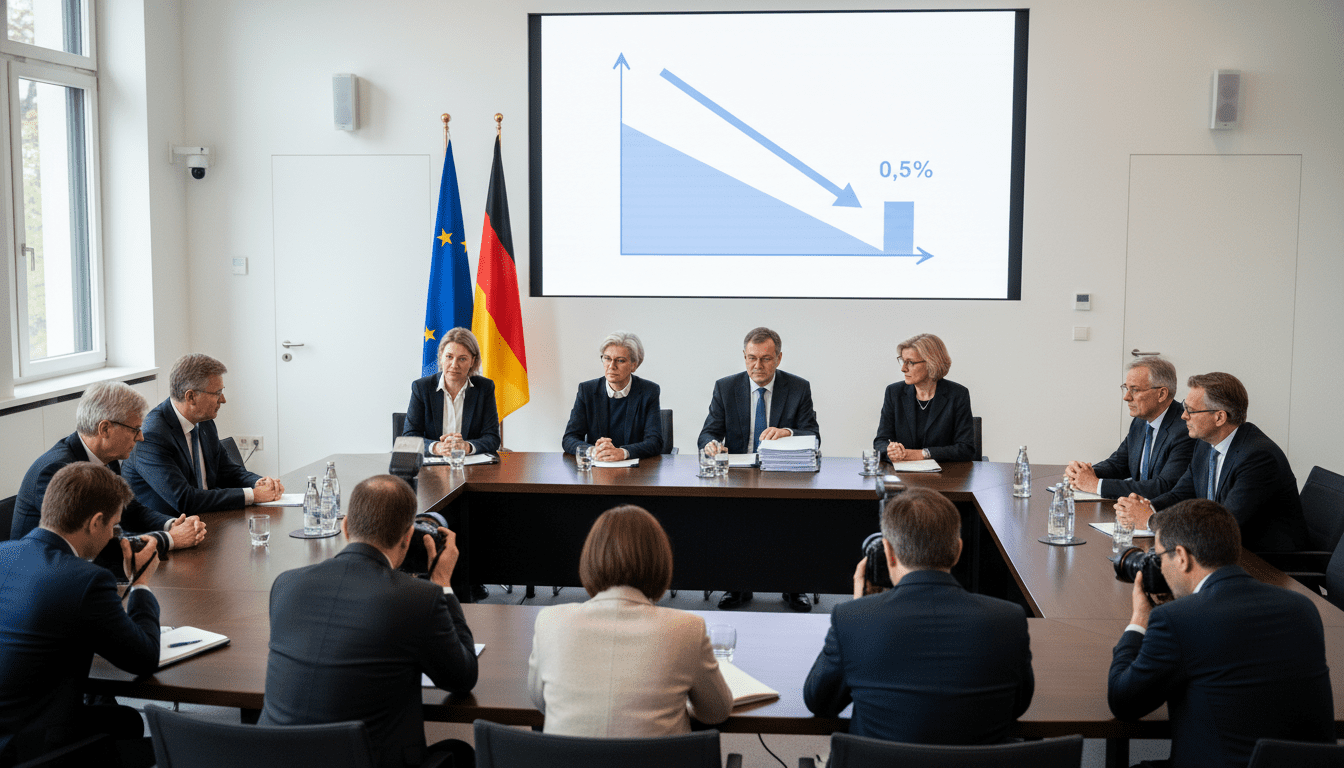
The German growth forecast was sharply downgraded by the federal Council of Economic Experts in its spring report, which now projects only 0.5 percent GDP growth for 2026. The council said the revision reflects a combination of rising energy costs and global trade frictions that have weakened demand and investment. Officials also signalled modest improvement next year with a forecast of 0.8 percent growth while flagging significant downside risks.
Council halves German growth forecast to 0.5 percent for 2026
The council reduced its projection from the 0.9 percent growth it forecast in last year’s annual assessment, bringing expectations closer to those of other leading institutes and the federal government. The council produces two assessments each year and described the spring figure as a calibrated response to fresh international shocks. The downgrade represents an almost fifty percent cut relative to the prior estimate and reflects heightened uncertainty for the remainder of 2026.
Energy price shock and Iran conflict weigh on trade and consumption
The council identified elevated oil prices linked to the conflict involving Iran as a principal factor weakening the outlook for exports and household spending. Higher energy bills erode purchasing power for households and raise production costs for firms, which squeezes profit margins and curtails new investment plans. The council warned that uncertainty about how long the conflict will continue remains a substantial risk to the outlook.
US trade policy and global headwinds compound domestic weakness
Beyond energy markets, shifts in US trade policy and broader external demand have reduced the appetite for German manufactured exports. The report noted that deteriorating global trade conditions lower the volume and value of cross-border commerce, further restraining industrial activity. Together with domestic cost pressures, these external shocks have left Germany’s open economy more vulnerable in the near term.
Inflation and labour market expected to be only moderately affected
Despite the weaker growth profile, the council projects inflation to rise to 3.0 percent this year and to moderate slightly to 2.8 percent next year, above the 2.2 percent recorded in 2025. The council judged that price pressures will be less severe than during the energy-driven spike in 2022 following Russia’s invasion of Ukraine. On employment the council sees only a small uptick in the unemployment rate to 6.4 percent in 2026, with a gradual decline to 6.2 percent projected for 2027.
Public investment and housing construction seen as stabilising forces
The council expects government spending on defence and infrastructure programmes to provide a stabilising fiscal impulse that supports growth next year. Officials also pointed to early indicators in the private housing sector that suggest an expansion in residential construction, which could help offset weakness in other private investment. The report emphasised that these domestic drivers are likely to be the main sources of any cyclical rebound rather than a swift recovery in global demand.
Council role and membership explained for context
The Council of Economic Experts has advised the federal government on macroeconomic policy since the 1960s and issues a formal annual assessment in November alongside a spring update. The body comprises five members appointed for five year terms, and the council’s chair currently leads its public deliberations and recommendations. Its assessments are widely watched by policymakers and markets because they synthesise multiple indicators and provide an independent view on fiscal, monetary and structural policy.
The council’s spring report therefore presents a cautious but nuanced picture of the German economy, combining a markedly lower short term growth forecast with relatively contained inflation and labour market effects. Economic policymakers will face pressure to balance support for investment and housing activity against the need to guard fiscal sustainability while monitoring geopolitical developments that could further alter the German growth forecast.
