
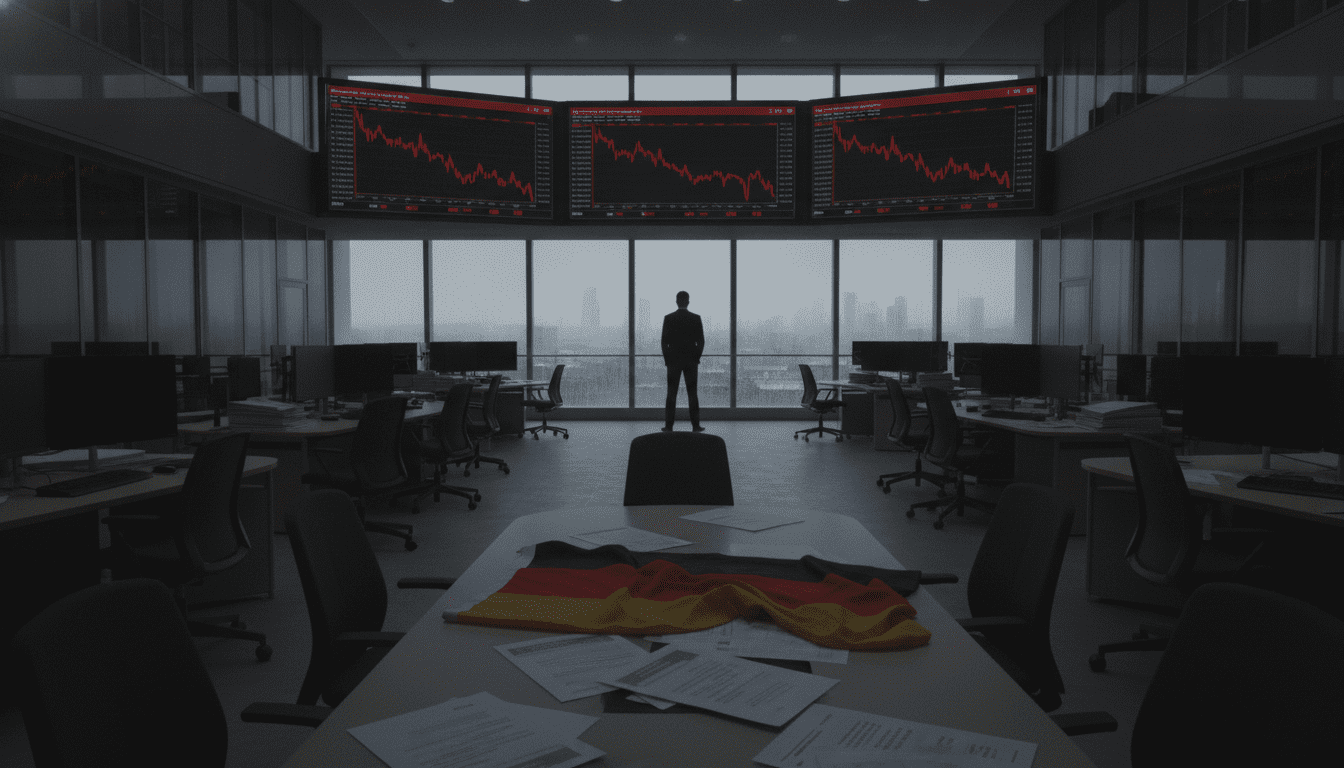
DIW Forecast: German economy set for technical recession as energy shock and geopolitical risks drive inflation
DIW warns the German economy will slip into a technical recession in Q2–Q3, trimming annual growth to 0.5% while energy shocks and Middle East tensions lift inflation.
DIW Predicts Technical Recession
The German economy faces a contraction in the second and third quarters, the Deutsches Institut für Wirtschaftsforschung (DIW) has forecast, marking a technical recession. The institute now projects only 0.5 percent growth for the year, a sharp downgrade that reflects a combination of external shocks and weak domestic momentum. DIW cited rising energy costs and renewed geopolitical instability as primary drivers behind a slowdown that will weigh on household spending and industrial activity.
DIW president Marcel Fratzscher has publicly recommended targeted measures rather than broad fuel subsidies, arguing that direct support for low-income households would be more effective. The institute’s forecast also raises the risk that temporary labor market resilience alone will be insufficient to shield the economy from a prolonged earnings and investment slowdown.
Energy Prices and Middle East Tensions
A surge in energy prices following heightened conflict in the Persian Gulf is central to the DIW assessment, pushing headline inflation higher and squeezing real incomes. The institute expects inflation to reach about 2.9 percent this year, reversing some of the disinflationary trends seen last year. Firms facing higher input costs are likely to delay investment and hiring decisions, amplifying the drag on growth.
Policymakers in Berlin and Brussels are monitoring oil and gas markets closely, warning that further escalation could trigger renewed price spikes. Economists note that even modest, sustained increases in energy costs can act like a tax on consumption, disproportionately affecting lower-income households and sectors with thin margins.
End of the Tankrabatt and Policy Choices
The temporary fuel discount known as the Tankrabatt, a measure that reduced petrol and diesel prices for two months, will not be extended beyond the end of June, coalition sources say. Introduced at a fiscal cost of roughly €1.6 billion to blunt the effect of high oil prices, the rebate was intended as emergency relief rather than a structural subsidy. Coalition partners from the Union and SPD agreed not to prolong the measure, and no immediate replacement has been planned.
Government officials have signaled, however, that they remain prepared to intervene if the situation in the Persian Gulf sharply deteriorates and oil prices surge again. Fratzscher’s proposal for a targeted energy-cost allowance for low-income households has gained traction among analysts who say it would more efficiently protect purchasing power than blanket discounts.
Financial Sector Fallout: UniCredit and Commerzbank
The corporate sector is also adjusting to volatility, highlighted by UniCredit’s growing stake in Commerzbank as the Italian lender moves toward potential control. UniCredit now holds a significant minority position, with reported holdings that reach the high 30s in percentage terms and even higher if derivatives are included. Commerzbank has accused UniCredit of market-manipulative communication and hinted at possible unlawful coordination with investment banks, allegations UniCredit denies.
Regulators and market observers will be watching the ownership moves closely because uncertainty at large banks can ripple through credit conditions. Any prolonged dispute or legal challenge would add to volatility in European financial markets and could affect corporate lending just as the broader economy weakens.
Local Tragedy and Social Strain in Bavaria
Domestically, Germany was shaken by a severe bus collision in the Dachau district of Upper Bavaria that left a child dead and several pupils and a teacher seriously injured. The victims were schoolchildren on an outing when their coach collided with a local line bus, police said in initial statements. Emergency services treated multiple casualties at the scene while investigations into the cause of the crash continue.
The incident has amplified public grief and prompted calls for a thorough probe into vehicle safety and school transport arrangements. Local authorities are coordinating support for affected families and have pledged to expedite the inquiry into how the collision occurred.
Public Unrest and International Developments
Beyond economic and domestic shocks, several international incidents are contributing to a more volatile backdrop. Northern Ireland experienced racially charged disturbances in Belfast, where protests over immigration and a viral video of a violent attack led to clashes and property damage. Authorities are conducting investigations as community tensions remain high.
On the diplomatic front, renewed military exchanges between the United States and Iran — including reports of the downing of a U.S. helicopter and retaliatory strikes — have added unpredictability to global markets. These events, together with regional conflicts involving Israel and Hezbollah, complicate efforts to stabilize commodity prices and resume diplomatic negotiations.
Political Milestones and Global Sporting Protests
Political developments abroad are also notable: Narendra Modi has surpassed Jawaharlal Nehru as India’s longest-serving prime minister, a milestone that has sparked debate about democratic norms and the direction of Indian politics. Meanwhile, the opening of the 2026 FIFA World Cup in Mexico is set against planned large-scale demonstrations by teachers and crime-victims’ families, prompting authorities to suspend classes and order remote work to ease congestion.
These events underscore the intersection of politics, social unrest, and large-scale public gatherings, with implications for security planning and public confidence at home and abroad.
The DIW forecast frames a fragile near-term outlook for the German economy, where policy choices and external shocks will determine whether a brief technical recession becomes a more prolonged downturn. Policymakers face a narrow path: target relief to the most vulnerable, preserve fiscal room for necessary interventions, and monitor financial and geopolitical spillovers closely as the year progresses.
