
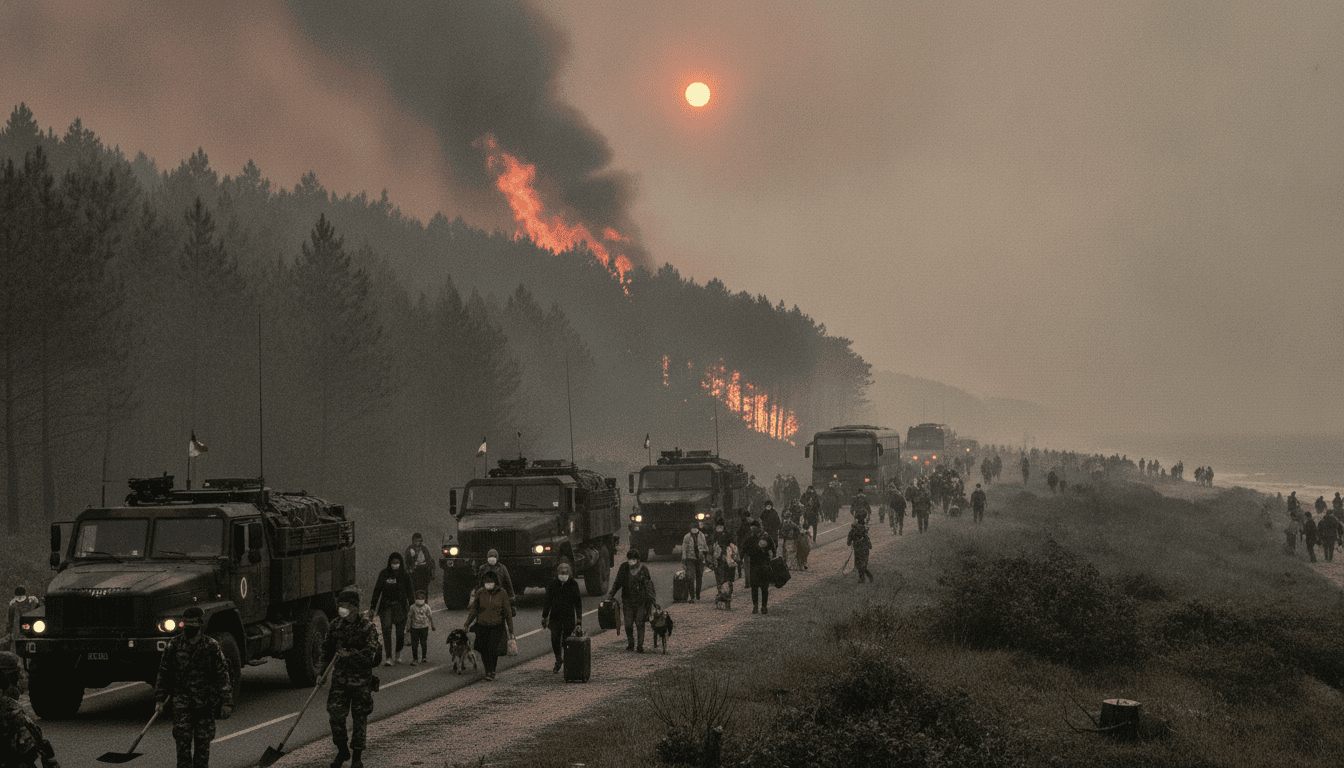
French wildfires force over 200,000 to evacuate as blazes close in on Bordeaux
French wildfires prompt mass evacuations and deployment of 1,500 troops, an A400M aerial tanker and cross-border concerns as fires spread across southwest and southeast France.
The latest wave of French wildfires has driven authorities to order tens of thousands more people to leave their homes, pushing the total number of evacuees past 200,000 as flames advance in multiple regions. Local officials in Gironde asked an additional 55,000 residents to evacuate, while earlier orders had already moved thousands from the outskirts of Bordeaux. Interior Minister Laurent Nuñez warned that several fires remain uncontrolled, and emergency services are prioritizing life-saving evacuations and protection of vulnerable communities.
Large-scale evacuations in Gironde exceed 200,000 people
In Gironde, emergency coordinators issued fresh calls for residents to leave immediately after fires intensified and shifted direction toward populated areas. The new order added 55,000 people to the list of those displaced, taking the nationwide evacuation total well beyond 200,000. Authorities had previously asked some 8,000 people on Bordeaux’s periphery to evacuate, citing the speed and unpredictability of the flames.
Local shelters and temporary reception centers have been activated, and municipal services are coordinating transport for those who cannot depart on their own. Officials stressed that the numbers may change rapidly and urged residents to follow evacuation routes and official instructions to avoid putting firefighters and rescue teams at risk.
Military reinforcements and A400M tanker join firefighting effort
Paris has increased its operational footprint by ordering an additional 500 soldiers to assist firefighting and evacuation operations, bringing the total deployed military personnel to about 1,500. The defense ministry said troops are helping to evacuate threatened settlements and secure abandoned properties, freeing civilian emergency teams to concentrate on containment and rescue. Support roles include logistics, evacuation escort and safeguarding critical infrastructure.
For the first time this weekend, a specially equipped A400M military transport aircraft was used to drop fire retardant, with a single sortie capable of releasing roughly 20 tonnes of suppressant. Officials called the use of strategic airlift a significant augmentation to aerial firefighting assets, while cautioning that aircraft are most effective when coordinated closely with ground crews and favorable weather conditions.
Top officials pledge recovery support and warn of worsening conditions
President Emmanuel Macron pledged government support for affected communities, writing on X that the state would remain “on the ground as long as necessary” to repair and rebuild damaged areas. Prime Minister Sébastien Lecornu warned that worsening weather — marked by high temperatures and gusty winds — could produce “difficult hours” for firefighters and residents alike. Both leaders have called for calm and cooperation while committing resources to emergency operations.
Regional authorities have instituted restrictions around fire zones and are monitoring road closures and power outages that complicate response work. Officials emphasized that recovery planning will begin even as suppression efforts continue, including measures to assess housing damage, provide emergency aid and coordinate with insurance and social services.
Spain records major blazes and cross-border alarm
Across the border, Spain is contending with its own extensive wildfires, underscoring the scale of this year’s Mediterranean fire season. Near Valencia authorities reported one fatality; that blaze was later described as largely under control. Around Madrid, officials ordered evacuations and reported tens of thousands moved to safety — roughly 60,000 people had been relocated in areas southwest of the capital alone.
In the provinces of Ávila and Guadalajara, authorities said some 30,000 people in Ávila and nearly 30,000 more around Madrid were forced from their homes. Two of three fires west of Madrid merged into a larger complex, raising concern that it could join with a neighboring blaze in Castilla y León. The largest fire in Guadalajara has consumed about 32,000 hectares to date, prompting Madrid to declare an exceptional national-level emergency measure to marshal resources.
Scientists cite heat and drought as amplifying factors
Researchers and meteorologists point to unusually high temperatures and prolonged drought as key drivers of the fires’ severity and rapid spread. Climate scientists say that human-caused global warming has increased the frequency and intensity of heatwaves, drying vegetation and creating conditions ripe for large, fast-moving wildfires. Local experts noted that parched forests and scrublands are burning more readily and producing extreme fire behavior that challenges traditional containment tactics.
Dry fuels and strong winds have complicated aerial drops and ground hose lines, sometimes producing spot fires well ahead of established perimeters. Officials called for long-term adaptation measures, including landscape management, early-warning systems and expanded aerial and ground capacity to respond to simultaneous large incidents.
Emergency crews continue containment work while authorities coordinate housing and assistance for displaced families. The situation remains fluid, with additional evacuations and tactical adjustments possible as weather forecasts and on-the-ground assessments evolve.
