
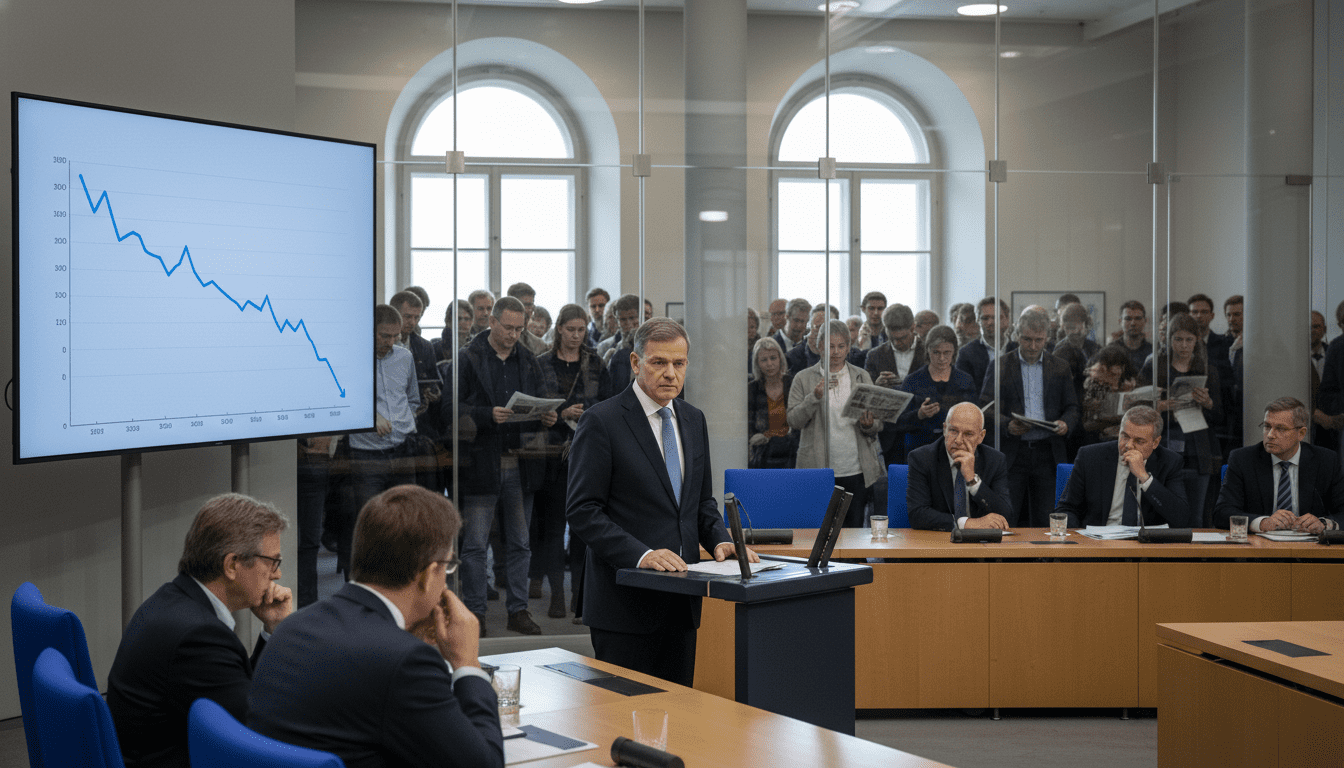
German economy faces longest slump since 2019 as public concern rises
Germany’s economic stagnation since spring 2019 is dragging public confidence down, with rising concerns over growth, jobs and the limits of state support.
Germany’s economy has not produced meaningful material growth since spring 2019, a stretch that economists and polling firms now call the longest stagnation in the country’s postwar history. Public unease is sharp: recent surveys show a large share of Germans consider the national economy one of the country’s chief problems, even as many households still report stable personal finances. The gap between national indicators and private sentiment is widening, raising questions about political messaging, social media influence and the scope of future policy responses.
Economic output has been flat since spring 2019
Official and private-sector measures indicate that aggregate material wealth creation in Germany has barely advanced in recent years. Weak industrial investment, disrupted supply chains and slower global demand combined to keep output muted well before the energy and inflation shocks of 2022. That prolonged plateau has left business leaders and analysts warning that long-term productivity gains are needed to restore sustainable growth.
For households the picture is mixed. While macro figures show stagnation, many families have maintained consumption and savings patterns that have so far prevented a broad-based consumer crisis. This divergence complicates both economic forecasting and policy choices, because broad headline numbers do not always match lived experience in towns and regions.
Public mood diverges from personal finances
Surveys reveal a striking discrepancy: a majority of people assess the country’s economic health as poor, yet a substantial share still rate their own household situation positively. That split suggests that anxieties about the future and collective risks drive perceptions more than immediate personal hardship. It also means political debates around the economy tap into fears that are not evenly distributed across the population.
The perception gap matters for democratic politics and consumer behavior. If people believe the national economy is failing, they may limit spending or support parties promising decisive action, even when their own finances are stable. Conversely, complacency among those who feel secure could reduce pressure for reforms that would boost productivity and long-term resilience.
Political messaging struggles to regain credibility
Historically, governments have sometimes sought to bolster confidence with optimistic narratives during downturns. That approach has become fraught, however, because voters increasingly distrust assurances that appear to downplay structural problems. Attempts to project confidence risk being dismissed as spin unless backed by clear, measurable policy steps that address the underlying causes of stagnation.
Political leaders now face a delicate trade-off: communicating urgency without triggering panic, and presenting realistic reform plans without undermining short-term stability. The ability to persuade the public that proposed measures will deliver tangible improvements will be crucial to restoring trust in economic stewardship.
Social media and extremist narratives amplify pessimism
Digital platforms can intensify perceptions of decline by amplifying extreme or pessimistic viewpoints, creating information cocoons in which the most alarming messages stand out. That effect can make national sentiment appear darker than aggregate indicators suggest and can fuel political polarization. Observers warn that when negative narratives become widespread, they can feed into the agendas of fringe actors who benefit from public disillusionment.
At the same time, the speed and scale of online discourse make it harder for mainstream institutions to correct misinformation or to nuance complex economic realities. Effective public communication will require not only accurate data but also better use of channels that reach everyday citizens outside of curated social bubbles.
State support has softened shocks but now faces limits
Germany’s longstanding fiscal capacity allowed large-scale interventions during successive crises — from the 2008 financial shock to pandemic relief and energy-price backstops after 2022. Those measures protected many households and industries and prevented deeper social dislocations. Yet repeated interventions have eroded the scope for additional large-scale relief without jeopardizing fiscal priorities.
Policy makers now confront harsher trade-offs: blanket subsidies and tax-free top-ups that were politically feasible earlier are harder to justify or afford, and some firms simply lack the margins to provide one-off payments to staff. As a result, targeted structural measures, rather than emergency transfers, are increasingly seen as the more sustainable path.
Reform options focus on bureaucracy, productivity and technology
Economists and industry groups point to a combination of administrative streamlining, investment in digital infrastructure, and adoption of automation and artificial intelligence as core levers to lift productivity. Reducing red tape could lower costs for small and medium-sized businesses, while better digital tools can amplify output from existing work hours. These changes will require coordinated public policy, training programs and incentives for private investment.
Investment in workforce skills and a clearer regulatory framework for new technologies are also central to any credible recovery plan. Policymakers who present concrete timelines and measurable targets for these reforms are likelier to win public buy-in than those relying on broad reassurances.
Germany retains significant economic strengths, but overcoming a multi-year stagnation will need honesty about structural weaknesses and a sustained push for productivity-enhancing reforms that match the scale of the challenge.
