
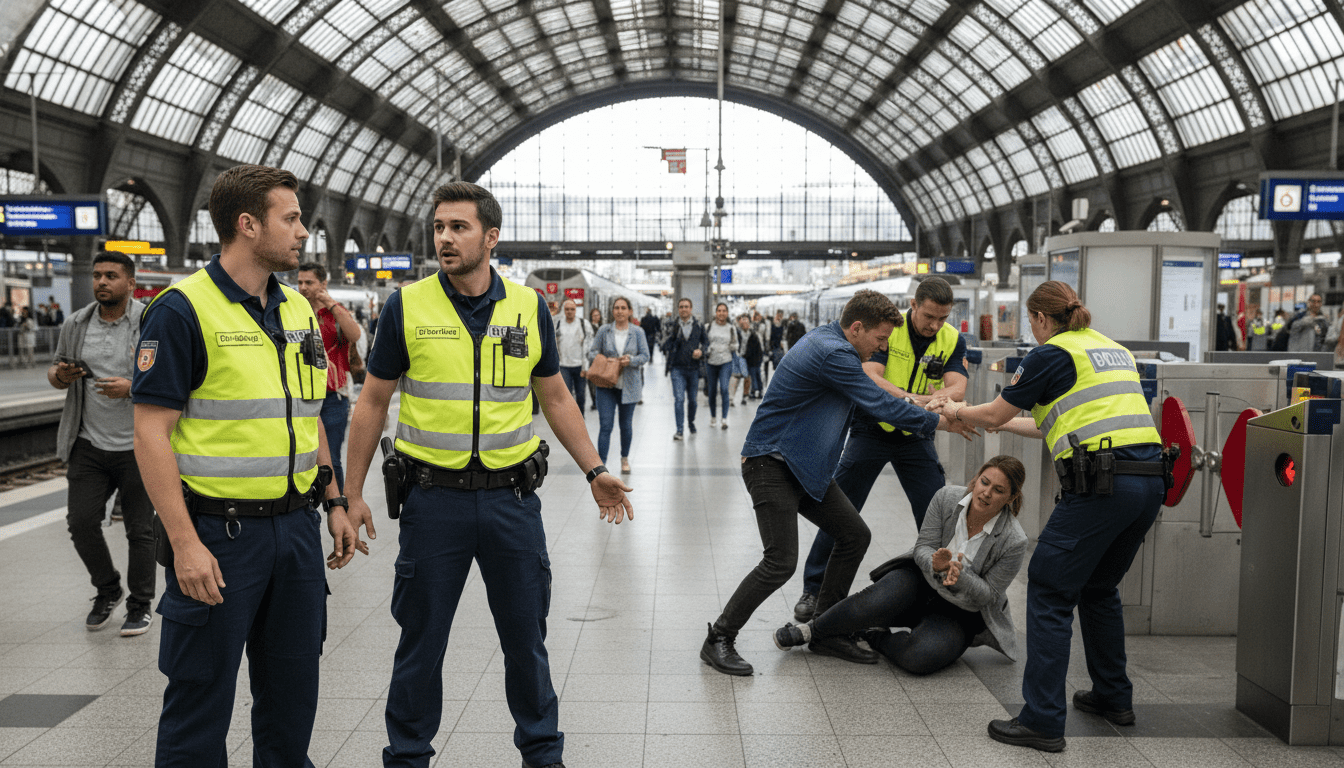
Rising Violence Strains Security at Frankfurt Hauptbahnhof
Security staff at Frankfurt Hauptbahnhof report insults, assaults and rising crime; authorities deploy rapid-response teams and joint patrols to boost safety.
Frontline security workers at Frankfurt Hauptbahnhof say their daily duties increasingly involve managing aggression, drug-related disorder and violent incidents. The station’s rapid-response teams are regularly called to intervene when standard patrols cannot contain escalating situations. Union surveys and police figures cited by officials underline a wider rise in attacks on railway staff and passengers across the network.
Security Workers Describe Daily Threats
Sascha, a leader of a mobile support unit, says insults and threats have become routine, and that the primary objective is to return home healthy each day. He and colleagues face verbal abuse from a broad range of people — from marginalized drug users to otherwise ordinary travelers who vent frustration at staff. The emotional toll is real; even experienced responders who previously worked in emergency services describe scenes that remain with them long after a shift ends.
Martin Burkert of the railway and transport union has warned that employees on trains and in stations are becoming targets of a coarsening public climate. The union’s survey found a high incidence of workplace violence: many staff report having suffered physical assaults, and an even larger share report repeated verbal aggression. A death of a train attendant following an assault in February has been cited by union representatives as a stark example of the stakes involved.
Rising Crime Figures at Stations
Preliminary statistics compiled by the Federal Police show more than 208,000 offenses recorded on trains and at stations in the past year, including 27,818 violent crimes and 2,209 sexual offenses. Major hubs such as Cologne, Hamburg, Hannover, Leipzig and Frankfurt accounted for a large portion of these incidents, with Frankfurt registering 520 violent crimes alone. Authorities describe certain stations as locations where high passenger volume, social problems and organized criminal groups intersect to create complex policing challenges.
Railway officials caution that, measured against millions of daily journeys nationwide, the individual risk for travelers remains low, but they acknowledge an unmistakable rise in conflicts that mirror broader societal tensions. Police and transport spokespeople point to increasing impatience and diminished social restraint as contributing factors to a higher frequency of confrontations in public spaces.
MUG Rapid Response Unit
The Mobile Support Group (MUG) acts as the railway’s specialist intervention team, mobilizing when regular two-person patrols are insufficient to manage serious incidents. Team members undergo selection tests and must demonstrate both physical fitness and psychological resilience before joining the unit. On duty they combine de-escalation techniques with the capacity to intervene physically when necessary, always framing force as a measure of last resort.
Sascha and his colleague Mario, both veterans of security work, say the team’s role covers a wide range of situations: managing large crowds at demonstrations or sporting events, responding to violent altercations, and deterring theft and vandalism. Their presence aims to protect passengers and staff while ensuring that interventions are proportionate and legally sound.
Nighttime “Zombieland” and Organized Crime
Staff describe the station’s after-dark environment as a battleground for a range of social issues, with drug use and homelessness particularly visible in the evenings. An English publication once labeled the surrounding quarter “Zombieland,” a characterization that staff say captures the scene’s chaotic and desolate aspect caused in part by crack and alcohol dependency. Operators must balance humane treatment of vulnerable people with the need to prevent disturbances that endanger passengers.
Beyond local homelessness and addiction, authorities note the activity of organized groups that travel across regions to commit property crimes and drug offences at major hubs. Those dynamics complicate enforcement: house bans and short-term removals have limited effect when professional offenders can return or when dependency drives repeat presence on the premises.
Joint Patrols and New Cooperation
Since last September, Deutsche Bahn has joined the city of Frankfurt, state and federal police and the local transport operator in a formal cooperation to reinforce security around hot spots. The agreement foresees joint patrols at critical points, coordinated responses to incidents and shared situational awareness to anticipate large-scale problems. Officials say the collaboration aims to make enforcement more visible and to pool resources for faster, safer interventions.
For frontline teams this means more frequent combined deployments and clearer lines of authority when incidents escalate. Management and union representatives alike stress that coordinated action must be coupled with preventive social measures if the underlying causes of disorder are to be addressed.
Human Cost and Frontline Resilience
Workers recount specific episodes that illustrate the physical and psychological risks they face: from encountering people armed with knives and broken bottles to witnessing fatal accidents and administering emergency containment. Many colleagues adopt personal precautions — avoiding predictable habits, maintaining readiness to act and using protective equipment — yet the unpredictability of incidents remains a constant concern. The accumulation of traumatic experiences leads some staff to seek time off or professional support to cope.
Despite the hazards, staff also report moments of gratitude and purpose: assisting lost travelers, preventing escalations that could have become worse, and occasionally receiving gestures of thanks. For many on the ground, the job is a vocation defined by a daily negotiation between humane care for vulnerable people and the enforcement of public order to keep millions of commuters moving.
Frontline teams and officials say that improving safety at Frankfurt Hauptbahnhof requires both visible security measures and sustained investments in social services that address addiction, homelessness and organized crime. Until those structural issues are tackled, staff and passengers will continue to rely on rapid-response units and joint patrols to manage the station’s complex and often volatile reality.
