
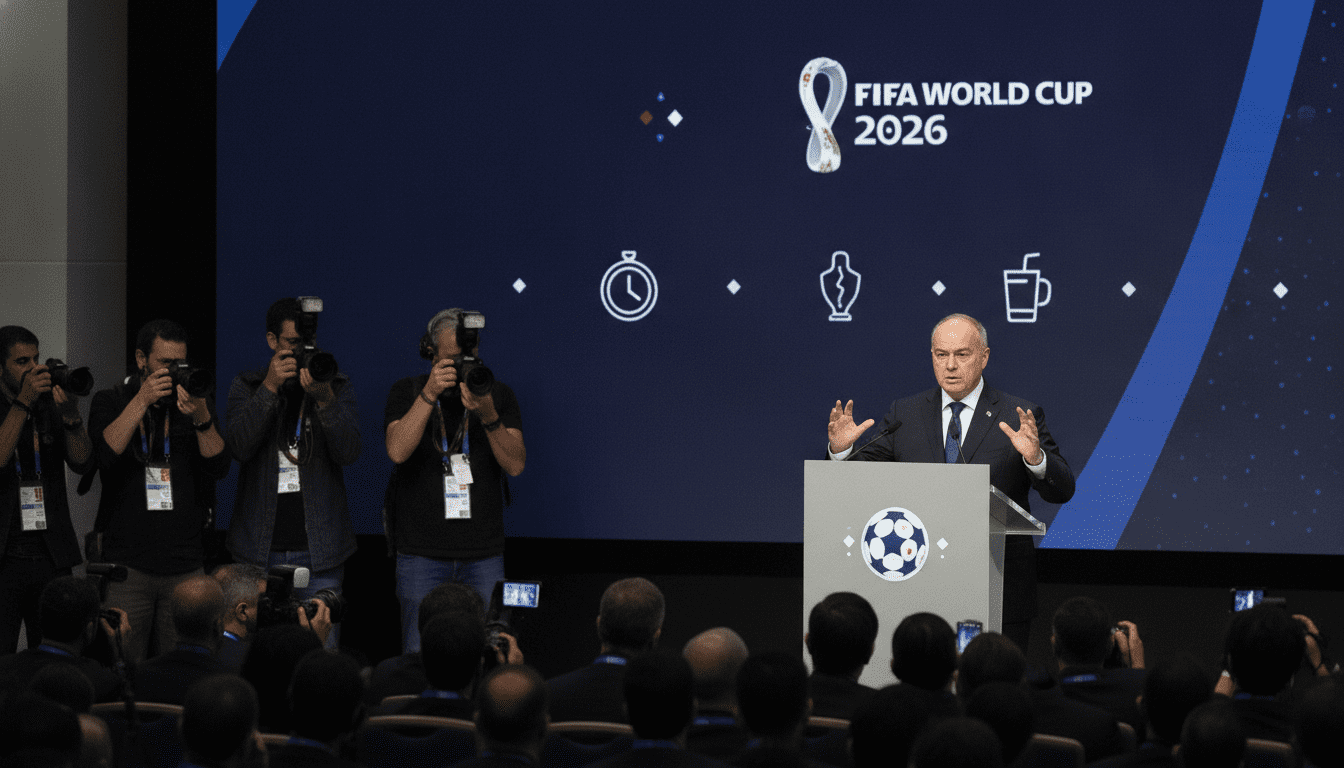
FIFA World Cup 2026 rules overhaul introduces drink breaks, countdowns and VAR expansion
FIFA World Cup 2026 rules bring sweeping changes including mandatory drink breaks, new timing limits and expanded VAR powers that will reshape match-day protocol. The adjustments affect pre-match protocol, in-play timekeeping and disciplinary procedures across the 48-team tournament. Organizers say the measures aim to improve player welfare, pace of play and decision accuracy, while critics warn of tactical and commercial consequences.
All 52 players to stand for national anthems
Teams will now place all 26 squad members — including substitutes — around the centre circle during national anthems, meaning 52 players will stand on the pitch before kick-off. The change formalizes pre-match presentation and establishes uniformity between both sides regardless of whether players choose to sing.
Match protocol previously required only the starting XI to line up; the new arrangement increases on-field numbers and may create a denser visual for broadcasters and stadium audiences. FIFA officials presented the update as part of wider efforts to standardize ceremony and reduce ambiguity about player positioning.
Mandatory drink breaks and new advertising windows
For the first time at a World Cup, FIFA has mandated a three-minute drink pause after 22 minutes of each half, regardless of ambient temperature or roofed stadiums. Organizers have confirmed these breaks are compulsory and will create dedicated windows for television advertising during live play.
The provision formalizes what were previously discretionary “cooling breaks” used only in extreme heat and transfers money-making potential to broadcasters. Broadcasters and sponsors will benefit from guaranteed ad inventory, while coaches may gain a new tactical moment to address teams mid-half.
New five-, ten- and 60-second timing rules
A suite of timing rules will be enforced to speed up restarts and substitutions, with referees counting down by hand for short time limits. Goal kicks and throw-ins must be taken within five seconds, or possession will be awarded to the opponent via corner or throw, respectively.
Substitutes must leave the field within ten seconds of being replaced, or the incoming player will be held off for one minute before entering play. Players treated on the pitch must exit and wait 60 seconds before returning, though the referee can signal an immediate return in certain cases; goalkeepers and injuries resulting from fouls are among the exceptions.
Group-stage tiebreaker shift favors head-to-head
The tournament will apply head-to-head results before overall goal difference when teams finish level on points in the group stage. If the head-to-head is tied, organizers will revert to total goal difference, goals scored and then fair-play points, with the FIFA rankings used only if all other metrics remain equal.
This reversal from prior practice amplifies the importance of direct matchups and could alter strategic approaches in group fixtures. Teams in later groups may still gain an informational edge in scenarios involving best third-placed qualifiers, creating tactical incentives toward particular scorelines.
Best third-placed teams and the expanded knockout picture
For the first time, eight of the twelve third-placed teams will qualify for a new Round of 32, producing a larger knockout bracket. Which group third-placed teams advance will determine specific matchups and FIFA has published a comprehensive annex enumerating all possible combinations.
Because there is no head-to-head comparison among third-placed teams, goal difference and goals scored will decide their ranking, potentially favoring teams in later-scheduled groups that know the targets required to progress. The expanded format increases opportunities for comeback narratives but also adds complexity to fixture planning.
VAR expansion and semi-automated offside technology
Video assistant referees will see a substantial increase in remit at the World Cup, with permission to review corner-kick decisions and second yellow cards that lead to sendings-off. VAR teams will be larger than in domestic leagues, and additional assistant VARs will support complex review workflows.
Semi-automated offside technology will send a direct signal to the on-field assistant for offside positions of ten centimetres or more, using AI-created 3D player avatars to speed and refine decisions. VAR will also be able to review fouls that occurred before a corner or free kick was taken, broadening the scope of retrospective intervention.
Disciplinary tweaks respond to recent incidents
Several disciplinary rules have been tightened following high-profile incidents in recent competitions, with referees empowered to immediately red-card players who leave the field in response to a whistle. The so-called “Senegal rule” targets mass protest exits and aims to deter collective abandonment of play.
A new measure permits red cards for players who hold a hand over their mouth in confrontational exchanges, a response to a high-profile case involving alleged racist abuse; referees retain discretion where gestures appear non-confrontational. Additionally, yellow cards will be wiped after the quarter-finals and following the group stage to prevent minor bookings from excluding players from later knockout fixtures, though two yellows still trigger a one-match suspension.
FIFAs changes also include guidance to prevent tactical simulation of injuries, with referees instructed to stop players from moving toward coaching areas during on-field treatment. Separate protocols allow substitution for serious head injuries even if a team has exhausted normal changes, reinforcing player safety.
The landscape of the FIFA World Cup 2026 rules is changing in ways that touch ceremonial, commercial and competitive aspects of the game. Teams, coaches and broadcasters will now have to adapt practices and tactics ahead of the tournament, while referees will shoulder new responsibilities in managing time, discipline and technology on the pitch.
