
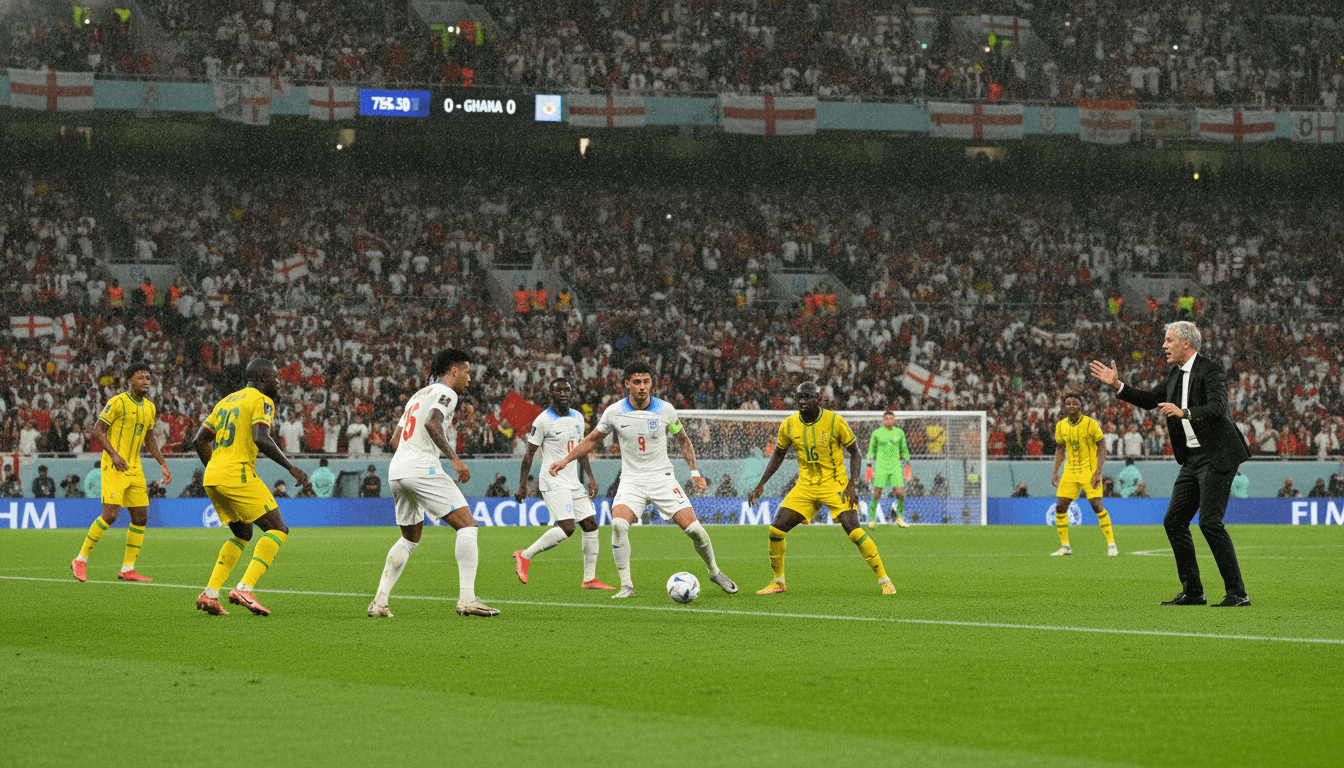
England vs Ghana: Tuchel’s England dominate possession while Ghana’s defence frustrates the favourites
England vs Ghana — Thomas Tuchel’s England dominated possession but Ghana’s disciplined defence held firm, frustrating the favourites in a tense, even duel.
The England vs Ghana match saw Thomas Tuchel’s side control large swathes of the ball without finding a clear-cut finish, as Ghana defended with exceptional organisation and resilience. England’s passing sequences repeatedly probed the Ghanaian backline, but the visitors relied on disciplined positioning and last-ditch blocks to deny space. The contest turned into a test of patience, with the favourites searching for a breakthrough against a compact defensive unit.
England control possession throughout the contest
Tuchel’s team registered significantly higher possession, using short, controlled build-up play through the centre and width to unsettle Ghana. The English midfield rotated the ball efficiently, aiming to create overloads and openings, but penetrative opportunities were scarce. Repeated crosses and late runs into the box produced promising moments that were neutralised by Ghana’s defenders and the woodwork.
Ghana’s defence absorbs pressure and clears danger
Ghana defended deep and compact, prioritising blocking passing lanes and protecting the penalty area with disciplined marking. Several of England’s best chances were nullified by tight clearances and goal-frame interventions that kept the scoreline intact. The visitors showed tactical calm, sacrificing territory in order to congest the final third and frustrate England’s forwards.
Key chances and near-misses defined the match
Despite dominant statistics, England struggled to convert dominance into decisive moments, with a handful of long-range efforts and drilled crosses narrowly missing their target. Ghana responded with a few swift counters, testing goalkeeper reactions and earning set-piece opportunities. The game’s tempo swung between controlled possession and sudden, frenetic passages that produced near-misses rather than goals.
Tactical adjustments under Tuchel failed to unlock Ghana
Tuchel introduced positional changes aimed at stretching Ghana’s lines and increasing vertical penetration, but the visitors reacted by narrowing gaps and doubling up on dangerous attackers. Full-backs were kept from advancing freely for long spells, limiting the supply to England’s wingers and forwards. Substitutions injected fresh legs but not the decisive tactical shift needed to breach Ghana’s organised defence.
Set-pieces and physicality became defining factors
As open-play chances remained at a premium, both sides turned to set-pieces to manufacture openings, with corners and free-kicks creating the clearest threats. Ghana’s aerial discipline in defensive situations mitigated England’s deliveries into the box, while England pressed to win second balls and capitalize on rebounds. The physical duel in midfield and on the flanks ensured neither team could settle into a sustained attacking rhythm for long.
Implications for England and Ghana going forward
For Tuchel and England, the match highlighted the need for sharper finishing and greater creativity in tight spaces if they are to convert possession into goals against organised opponents. Ghana’s performance will be hailed for its collective discipline and ability to frustrate a technically superior side, providing a blueprint for operating without the ball. Both teams leave the fixture with clear takeaways about defensive solidity and the margins required to turn control into results.
The match ultimately underscored football’s delicate balance between domination of possession and the clinical execution needed to convert that control into goals, leaving both sets of supporters contemplating what might have been.
