
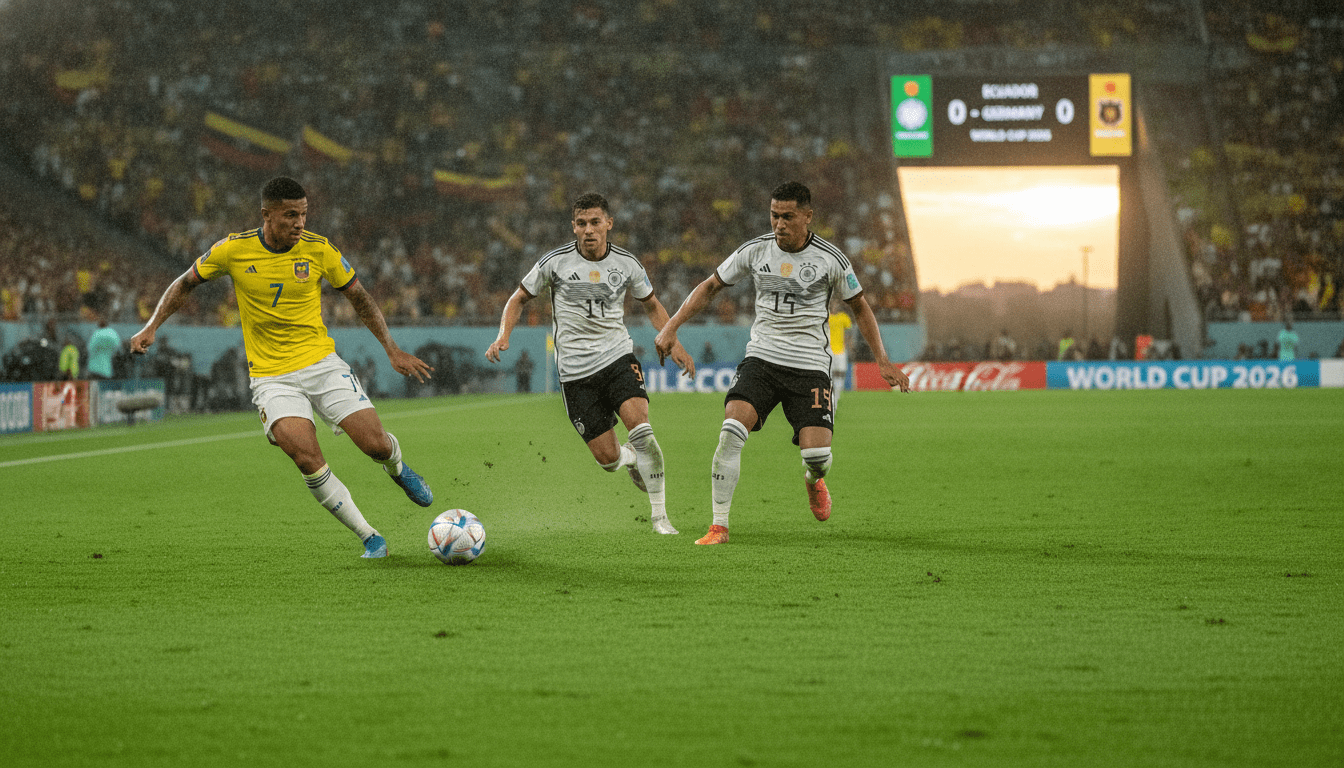
Germany vs Ecuador: Tactical preview as Ecuador’s wing play tests a rested German side
Germany and Ecuador face a decisive final group match as Ecuador chase the only remaining path to the knockout stage, bringing a quick, wing-driven attack that will test Germany’s squad rotation and tactical adjustments. Germany, having already secured the top spot in the group, can use the game to sharpen defensive coordination and ball progression under pressing. The clash offers a contrast of objectives and styles: Ecuador must press and attack aggressively to survive, while Germany can both manage risk and trial solutions for higher-stakes opponents.
Ecuador’s wing threat
Ecuador arrives with an offense defined more by speed and wide overloads than by headline goalscorers, making the team dangerous even when the scoreline looks modest. Their game plan centers on quick one-on-one runs from the flanks and regular attempts to isolate full-backs or inverted defenders. Dribbling wingers and a midfield that can shuttle forward create repeated opportunities to stretch defenses and deliver low crosses or cutbacks into the box.
This wing-centric approach resembles the profile that unsettled Germany in prior matches, and it forces opponents to decide between compact central defending or aggressive wide tracking. For Ecuador, success depends on creating those isolated scenarios and exploiting moments when the opposing side’s full-backs or midfielders are out of position.
Defensive core and individual quality
Ecuador’s backline is compact and organized, built around a pair of central defenders who offer both aerial presence and ball-playing ability. Their midfield anchor combines physicality with the mobility to cover ground and recover loose balls, making transitions back into defense more secure. That concentration of quality in central areas means that Lagos-style wide entries are often contested inside the penalty area rather than allowed to develop freely.
Those individual strengths give Ecuador resilience against direct attacks and make them hard to break down in congested situations. Germany will have to probe with patience and precision if they are to find passing lanes or create overloads that pull Ecuador’s compact block out of shape.
German tactical responses
With qualification already secured, Germany can afford to prioritize tactical rehearsal alongside maintaining form and energy levels. Managers have experimented with shifting Joshua Kimmich deeper into midfield pockets and using Antonio Rüdiger to neutralize threatening wide run-ins, which created a more robust three-man defending phase in recent fixtures. Such adjustments reduced exposure to isolated duels and allowed Germany to keep a numerical balance in central defensive zones.
If Germany opts to maintain possession and invite pressure, the key will be the timing of forward runs and the weight of passes to break the first line of Ecuadorian pressure. Rotation and selective rest are also likely, but the coaching staff appears focused on embedding alternative defensive shapes that can be deployed against teams that deliberately force one-on-one scenarios on the wings.
Pressing battle and group stakes
Ecuador’s tournament mathematics are clear: a win is required to keep their hopes alive, which incentivizes an early, aggressive press that can disrupt Germany’s building from the back. That kind of sustained man-oriented pressing across the pitch would be a novel challenge for Germany in this tournament and could reveal vulnerabilities similar to those seen in earlier international friendlies. Germany must therefore balance patience on the ball with decisive vertical passing to prevent the press from turning possession into dangerous turnovers.
For Ecuador, executing an organized high press requires disciplined runs and consistent support from the midfield to cut passing lanes rather than leaving the flanks exposed. If they can force errors or hurried clearances, they increase the chance of quick transitions and scoring opportunities, which is the most realistic route to victory.
Final group match as a rehearsal ground
Beyond the immediate stakes, the match functions as a valuable rehearsal for Germany’s potential path deeper into the competition. The coaching staff can use competitive minutes to refine coordination between midfield pivots and attacking runners, working on the precise pass weight and timing that dismantle compact defenses. Practical repetitions in a match setting—timed runs, clipped through-balls, and midfield shifts—are difficult to simulate fully in training, making this fixture a high-value exercise.
Ecuador’s requirement to press and attack also allows Germany to test contingency plans under pressure, including how the defense reorganizes when full-backs are outnumbered and which midfield combinations best shield the backline. Those observations will feed into selection decisions for later rounds and help prioritize which tactical options deserve further practice.
Germany vs Ecuador will therefore be judged on two fronts: immediate result and information gathered. Ecuador need three points to stay alive, and Germany can use the encounter to sharpen the very tactical responses that might decide future knockout matches.
The match presents a tidy tactical narrative: Ecuador as the hungry, wing-oriented challenger and Germany as the assured group leader seeking refinement and resilience. How well Ecuador converts their flank speed into clear chances and how effectively Germany converts possession into incisive sequences will determine whether the last group game is a tense fight for survival or a controlled experiment with eye on the knockout rounds.
