
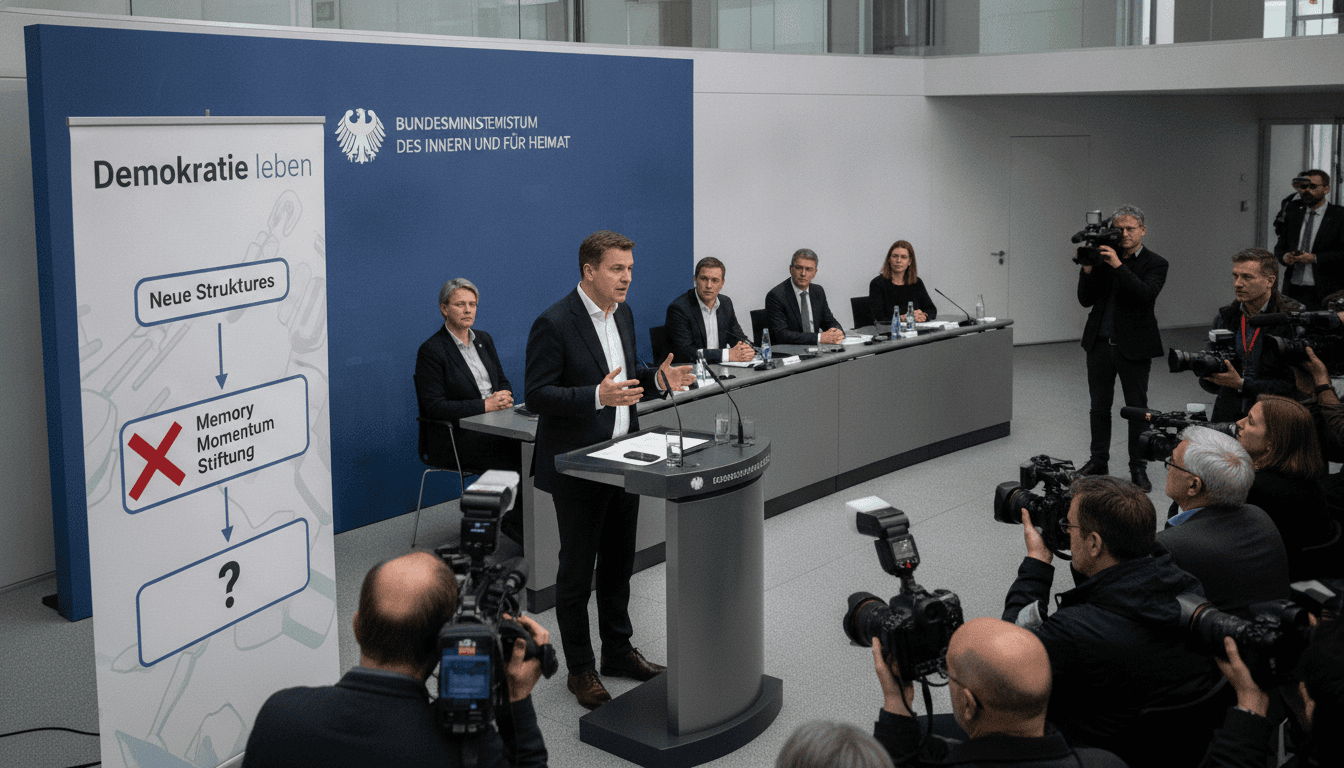
Demokratie leben reforms threaten Dachau’s “Memory Momentum” antisemitism project, SPD warns
Bavarian SPD lawmakers say changes to the Demokratie leben funding rules could halt “Memory Momentum,” a Dachau-based antisemitism-prevention project that has received about €400,000.
The Bavarian SPD delegation has urged Federal Family Minister Karin Prien to explain why the Demokratie leben program’s restructuring would strip funding from a digital antisemitism-prevention initiative in Dachau. The warning centers on “Memory Momentum,” a Max-Mannheimer-Haus project designed to collect and share reports of antisemitic incidents on a digital learning platform for educators, which was scheduled for completion by 2028.
SPD letter demands ministerial response
The letter from SPD MP Michael Schrodi, signed by several Bavarian SPD deputies, characterizes the programmatic changes as capable of eliminating support for projects that are not politically controversial. The lawmakers say the new criteria require projects to be active in at least three German federal states to remain eligible for Demokratie leben funding, a threshold Memory Momentum cannot meet given its Dachau-based study center.
The deputies call the funding shift “a fatal signal” amid a rise in antisemitic incidents and ask for a formal explanation of how the restructured program will prioritize digital antisemitism prevention. They also demand clarity on transitional arrangements for already funded initiatives and whether exceptions will be made for projects operating from single-state research centers.
Memory Momentum’s digital approach and timeline
Memory Momentum was conceived as a digital repository and teaching resource that allows students and teachers to document and analyze antisemitic incidents, blending historical education with contemporary prevention tools. Project planners had intended a phased rollout culminating in 2028, aiming to integrate classroom modules and teacher training with the online platform.
According to the SPD deputies, approximately €400,000 has been invested in Memory Momentum to date, funding research, platform development, and preliminary outreach to schools. The potential abrupt withdrawal of support raises concerns among educators involved in the pilot about continuity of the platform and the ability to finalize planned materials for classroom use.
New eligibility rules and practical barriers
Under the revised Demokratie leben criteria, national-scale impact and cross-state partnerships have become key eligibility gates, officials say, a move framed as an attempt to allocate funds to initiatives with broader geographic reach. For locally anchored but innovative projects, that requirement can be prohibitive: Memory Momentum’s coordination and data hub are tied to the Dachau study center, and partner organizations that might expand the project are themselves applying for new grants and cannot serve as guarantors under the current cycle.
Critics argue the three-state rule could disadvantage specialized, evidence-driven projects that rely on concentrated research bases or local archives. Project leaders and some lawmakers warn that the policy risks favoring repetitive, larger-scale applicants while sidelining niche programs with demonstrable educational value.
Political contradiction over digital antisemitism focus
The case has prompted questions about consistency within federal policy, as Minister Prien has publicly identified combating antisemitism in digital spaces as a funding priority. SPD MPs highlight the apparent contradiction between that stated focus and the practical effect of rules that may end funding for a digital antisemitism-prevention platform.
Opponents of the reform say the municipal and regional roots of many educational projects are not incompatible with national priorities, and that the ministry should devise mechanisms to support digital innovation regardless of the project’s geographic footprint. The SPD group’s demand for a ministerial statement aims to reconcile stated objectives with implementation measures.
Local and sectoral reactions
Educators and civil society organizations working on Memory Momentum say the project fills a gap in classroom tools that link historical awareness to real-time incident reporting and teacher support. They caution that losing grant continuity now would undercut trust among participating schools and jeopardize years of preparatory work.
Some advocates propose interim funding bridges or special exemptions that recognize the national value of a locally managed digital repository. Others call for clearer communication from the ministry about how projects will be phased into the new funding model to avoid sudden disruptions.
The SPD letter requests specific answers on whether projects like Memory Momentum will receive transitional support, how the ministry will assess the educational impact of single-state initiatives, and whether alternative criteria might be used to preserve innovative digital projects.
Questions now center on whether the ministry will issue clarifying guidance or modify eligibility to prevent high-profile projects from collapsing during the restructuring. The exchange underscores tensions between centralizing funding priorities and sustaining locally rooted educational innovation in the fight against antisemitism.
Demands for a public response and a path forward are mounting as project stakeholders await a ministerial reply and potential adjustments that could determine whether Memory Momentum completes its planned rollout.
