
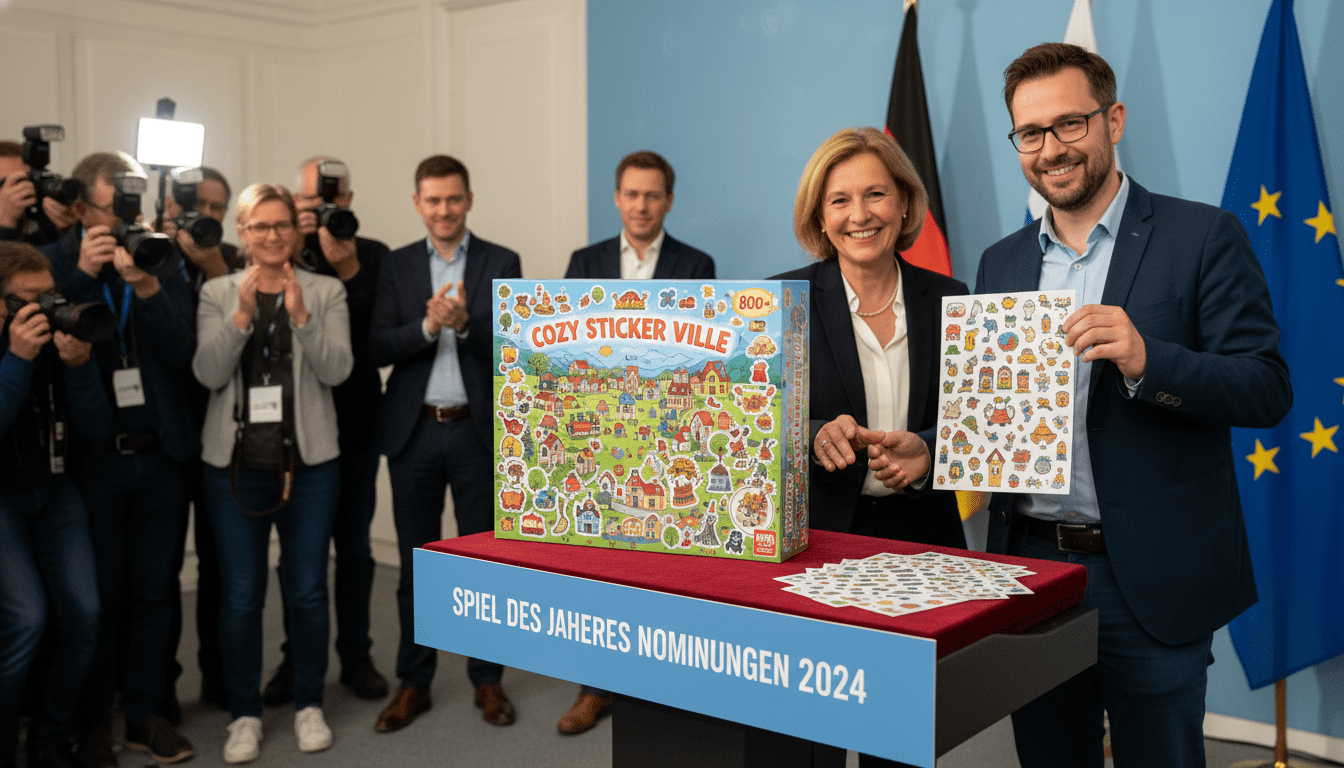
Cozy Sticker Ville leads Spiel des Jahres nominations ahead of July 12 decision
Cozy Sticker Ville named among the top three Spiel des Jahres nominations, highlighted for innovation and social critique in a field of 440 eligible titles.
The jury of the Spiel des Jahres on May 19, 2026, revealed a three-game shortlist for the main prize that places Cozy Sticker Ville at the forefront of this year’s nominations. The choice, announced by jury chair Harald Schrapers at the Playce games café in Frankfurt, marks the culmination of an assessment of 440 games released in German between April 2025 and March 2026. Winners in the three award categories will be declared on July 12, 2026, in Berlin.
Cozy Sticker Ville leads Spiel des Jahres nominations
Cozy Sticker Ville attracted attention for combining a highly tactile component—more than 800 stickers—with cooperative village-building play across multiple sessions. Designed by American author Corey Konieczka and distributed in Germany by Asmodee, the game is built for repeated play, offering two distinct sides on its game board that extend the campaign to around twenty sessions. Jury members cited not only the mechanical novelty but also the title’s capacity to provoke discussion on social themes as factors in its nomination.
Three shortlisted titles for the main prize
Alongside Cozy Sticker Ville, the jury nominated Morty Sorty and Dito for the Spiel des Jahres shortlist, forming the trio from which the main winner will be chosen. Morty Sorty, produced by Schmidt Spiele and written by Austrian designer Markus Slawitscheck, casts players as apprentice sorcerers who must arrange ingredients on a shelf, blending spatial planning with elements of chance. Dito, a lively party game from Game Factory by Martin Ang, targets group play for three or more participants and was singled out for its creative party dynamics.
Notable omissions and the broader selection list
Several well-regarded releases did not make the shortlist but remained on the jury’s extended selection list of highlighted games. The cooperative deduction title Take Time, previously considered a strong contender by commentators, appears among six additional selections rather than among the final three. The jury’s longer lists underscore the depth of this year’s catalogue even as only three titles have been elevated to the decisive shortlist.
Kennerspiele spotlight veteran designers and app integration
The nominees for the Kennerspiel category bring established authors and varied design approaches into focus, including app-assisted play. Donald X. Vaccarino’s Moon Colony Bloodbath, subtitled “Catastrophes with Notice,” is one of the Kennerspiel picks and continues the trend of internationally authored designs earning recognition. Reiner Knizia’s Rebirth sends players to a post-apocalyptic Scotland to reconstruct society, presenting Knizia with another opportunity to add to his extensive awards record. Boss Fighters, by Michael Palm and Lukas Zach and published by Pegasus Spiele, stands out for integrating tablet or smartphone support into its cooperative boss-battle structure.
Gender imbalance and growth in the eligible pool
This year’s eligible pool expanded by about 14 percent compared with the previous cycle, reflecting a larger volume of new releases in German-language markets. Of the 440 games examined by the jury, only ten were authored solely by women, representing roughly 2.3 percent of submissions, while 94 percent were credited to male authors and the remainder to mixed teams. The jury’s statistics highlight a persistent gap between the demographics of players and those of game creators, with the presence of female players far outstripping female authorship.
French influence visible in children’s game nominations
The children’s game category shows a noticeable French imprint: all three nominees—Buh Party, Die Insel der Mookies and Verflixt verzaubert—are authored by French designers. Christoph Schlewinski, coordinator of the Kinderspiel jury, pointed to longstanding differences in market structures and visibility as partial explanations, noting higher birth rates and prominent presentation of children’s titles at events such as the Cannes fair. The strength of French entries suggests regional industry dynamics continue to shape what reaches German retail shelves and jury attention.
The jury process remains active as volunteer members continue to play and evaluate shortlisted and selected titles ahead of the July 12 award ceremony. The Spiel des Jahres has, since its inception in 1979, had a demonstrable effect on sales and visibility for winning and nominated games, and industry observers expect the July announcement to shift retail orders and consumer interest. The final decisions will reflect both the jury’s playtesting and its appraisal of design, accessibility and thematic resonance.
