
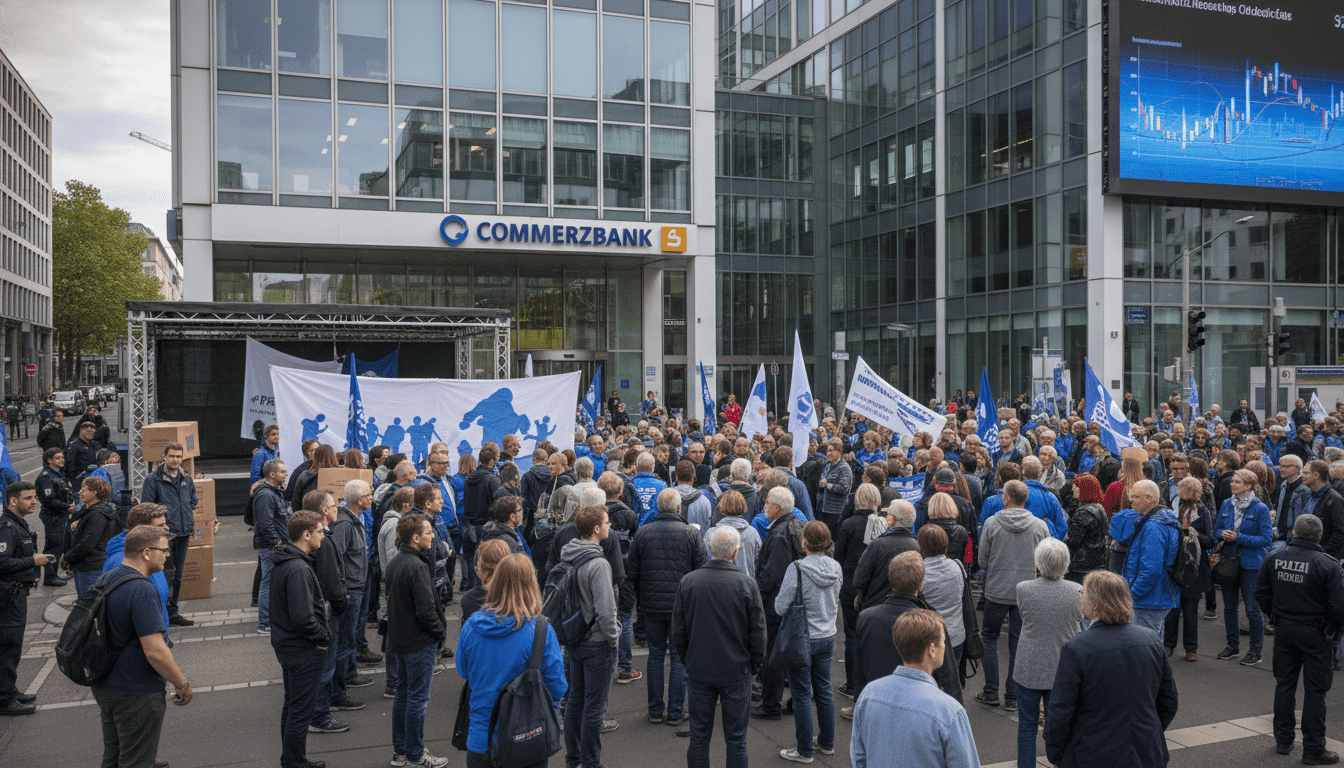
UniCredit takeover of Commerzbank sparks protests in Wiesbaden as job-cut fears mount
Wiesbaden protesters warn the UniCredit takeover of Commerzbank could trigger mass job cuts, after reports UniCredit did not attend the shareholders’ meeting.
The UniCredit takeover of Commerzbank dominated activity outside the bank’s shareholders’ meeting in Wiesbaden as employees gathered to oppose a potential merger. Demonstrators held placards asserting the bank’s independence and warned that a deal would put thousands of jobs at risk. The mood reflected deep unease among staff and union representatives about the strategic and human-cost implications of a cross-border consolidation.
Protesters mobilize ahead of shareholders’ meeting
Dozens of employees and union members assembled outside the meeting venue in Wiesbaden holding signs including the slogan “We are the bank — strong and independent.” The demonstration took place hours before Commerzbank’s shareholder session and drew attention from local media and labour representatives. Organisers said the action was intended to send a clear message to shareholders and to any potential suitor about the workforce’s resistance to an unsolicited takeover.
Union officials and supervisory board members addressed the crowd, underscoring the depth of concern among staff about the direction of any future negotiations. The protest highlighted broader anxieties within the bank about preserving its operations and identity in Germany should a foreign suitor assume control. Organisers stressed that the demonstration was peaceful but resolute in demanding guarantees for jobs and the bank’s autonomy.
Management reiterates demands for shareholder premium
Commerzbank Chief Executive Bettina Orlopp told attendees and the press that the bank remained willing to engage in dialogue but insisted any transaction must recognise shareholder value. Orlopp emphasised that a takeover proposal should include a premium for existing shareholders and acknowledgement of Commerzbank’s business strengths. She framed those conditions as non-negotiable elements for meaningful talks, signalling that the bank would not accept a deal that ignored investor or operational realities.
Management also reiterated its own plan to improve profitability should Commerzbank remain independent, outlining a separate proposal to reduce around 3,000 positions as part of a transformation program. That parallel plan was presented by executives as aimed at securing the bank’s future viability while attempting to limit disruption. The juxtaposition of internal restructuring and an external takeover proposal intensified debate about the best route for the bank.
Unions single out UniCredit chief as a focal point of distrust
Verdi union representative and supervisory board member Frederik Werning expressed blunt scepticism toward UniCredit’s leadership, saying he and many colleagues did not trust UniCredit CEO Andrea Orcel’s plans. Werning warned that if Orcel’s approach mirrored past restructuring at UniCredit’s German units, staff could face deep cuts. His comments captured a wider unease within employee ranks about the cultural and managerial fit of an Italian-led integration.
Union and works council spokespeople warned that previous consolidations under UniCredit in Germany had resulted in heavy job losses, and they fear a repeat on a larger scale. Those warnings fed into the protesters’ messaging and framed much of the public debate around the potential takeover. Labour representatives called for legally binding job guarantees before any transfer of control could be considered.
Dispute over job-cut estimates and scale of impact
Estimates of potential job losses varied sharply between the involved parties, illustrating the uncertainty driving protests and political attention. Commerzbank has publicly cited a possible reduction of 10,000 to 11,000 positions in the event of a full integration, while UniCredit has reportedly spoken of some 7,000 roles that it considers redundant in Germany. Works councils, citing internal assessments and comparisons with the bank’s Munich unit, have warned of a worst-case scenario reaching as many as 23,000 jobs lost if operations are handled the same way as at the HypoVereinsbank.
Those divergent figures have become a central fault line in negotiations, complicating both communications with employees and public perception. Analysts say the wide range of estimates reflects differing assumptions on overlap, integration strategy and regulatory constraints. The dispute over numbers has increased pressure on both boards to provide clearer, concrete plans and to engage with unions to limit fallout.
UniCredit’s reported absence and implications for talks
According to a report citing two people familiar with the matter, UniCredit did not attend the shareholders’ meeting in Wiesbaden, a move interpreted by some observers as a tactical distance or a signal that formal negotiations remain paused. The absence of the potential acquirer at a key meeting heightened tensions among employees and raised questions about the pace and transparency of any takeover attempt. Industry commentators suggested that skipping the session could be intended to avoid direct confrontation, but it also left unresolved questions in the public sphere.
Commerzbank executives maintained that talks remain possible but stressed that any approach must respect shareholder interests and operational realities. The lack of direct engagement at the meeting made it harder for shareholders and employees to gauge the seriousness and terms of any proposal. That vacuum has amplified calls for clearer timelines and for regulators to outline how they would assess such a cross-border transaction.
Regulatory and political risks for a cross-border consolidation
A potential UniCredit takeover of Commerzbank would not only affect staff and shareholders but would also invite close scrutiny from German and European regulators. Policymakers have in recent years shown heightened sensitivity to banking-sector consolidation, particularly where job losses and national economic interests are implicated. Officials in Berlin and Frankfurt could weigh in on any deal under national security, competition, or financial stability considerations.
Beyond regulatory review, a takeover could reshape the structure of retail and corporate banking in Germany, with implications for customers, local branches and regional economies. Municipal leaders and employee representatives have already warned that large-scale branch closures or job cuts would have significant local consequences, underscoring the political stakes of any transaction.
The shareholder meeting concluded amid unresolved questions about timing, numbers and the scope of possible talks, leaving employees and investors awaiting clearer signals from both banks and regulators.
