
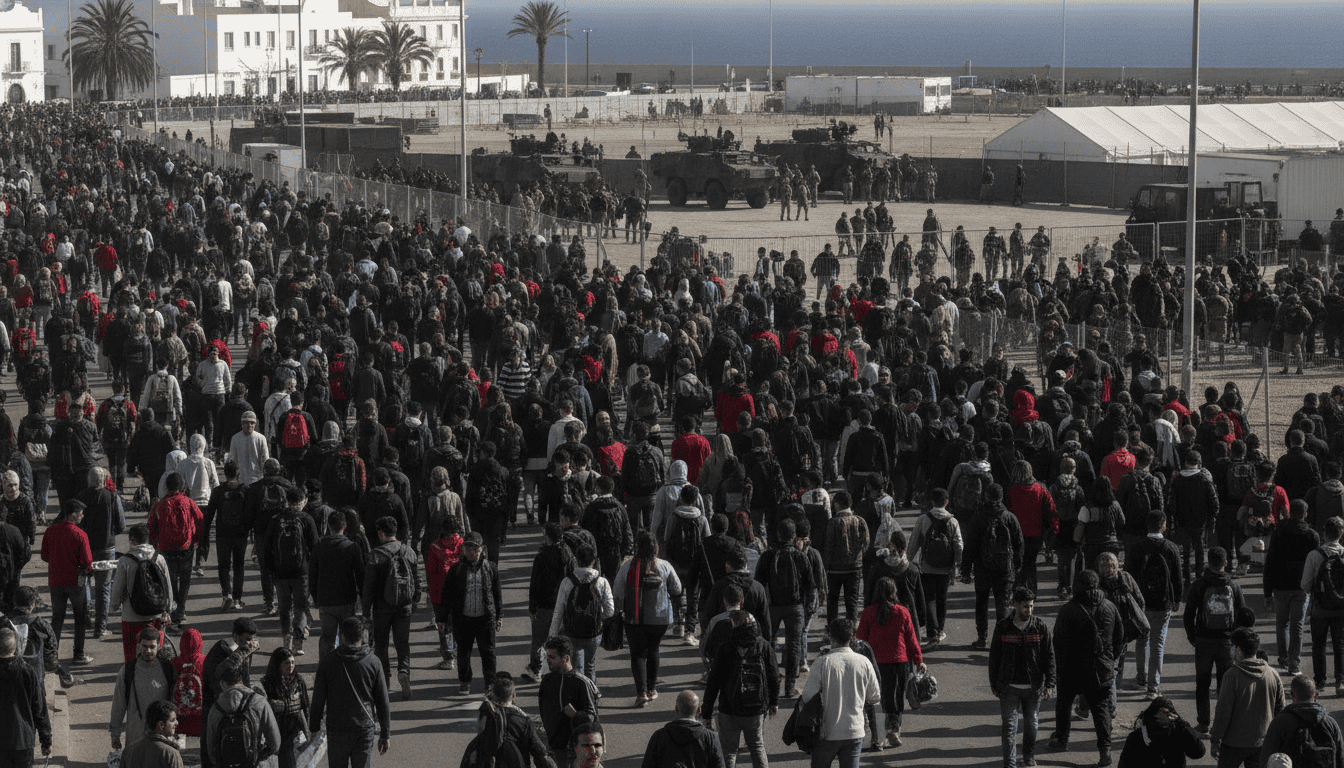
Ceuta migrant influx: Tens of thousands cross from Morocco as Spain deploys army
Tens of thousands of migrants arrived in Ceuta from Morocco, straining local services and prompting an army deployment as authorities reported hundreds of deaths and mounting diplomatic tensions.
The Ceuta migrant influx saw an unprecedented surge this week as Spanish authorities tallied roughly 49,000 people reaching the North African exclave, according to statements attributed to the Interior Ministry. Many arrivals were young Moroccans who waded or swam across the Strait of Gibraltar and later moved through the small Spanish city, while regional officials described a situation of total humanitarian and social emergency. The national government mobilised the army, sent senior ministers to the enclave, and faced immediate criticism from opposition parties over preparedness and response.
Mass arrival overwhelms local capacity
Ceuta’s municipal services and the lone reception centre were rapidly overwhelmed as thousands arrived over consecutive days. Shops shuttered amid fears of unrest and dozens of newly arrived migrants slept in the open while overcrowded facilities strained to provide food, shelter and medical care. Local leader Juan Jesús Vivas publicly warned Madrid that Ceuta faced a total humanitarian and social emergency and appealed for urgent reinforcement.
Officials reported a mix of families, single young men and non-Moroccan migrants among the arrivals, with footage showing exhausted people using flotation devices or wearing wetsuits after long hours in the water. Jubilant scenes followed some landings but were mixed with distress and confusion as municipal authorities struggled to process and accommodate the influx.
Fatalities and rescue operations reported
Rescue services recovered multiple bodies as the crossings continued through night and day, with public broadcaster RTVE reporting 19 dead recovered by morning. Many migrants swam or clambered over rocks beneath the enclaves’ high border fences, increasing the risk of drownings and injuries during the hazardous crossings. Emergency teams and police worked to retrieve victims and assist survivors while hospitals and humanitarian groups dealt with a growing caseload.
Tensions escalated at some crossing points where clashes were reported and images circulated of burned vehicles on the Moroccan side near Fnideq. Spanish security forces said they used crowd control measures while attempting to manage large groups arriving simultaneously, a situation officials described as chaotic and dangerous.
Spanish state response and political pressure
The national government moved quickly to bolster security, authorising an army presence to secure the Spanish outpost and flying Prime Minister Pedro Sánchez and the interior minister to Ceuta. Reinforcements from the mainland were dispatched to support local police who were described as overstretched. Opposition parties including the conservative PP and the right wing Vox criticised the minority government for failing to anticipate or prevent the surge.
Authorities also implemented operational measures at other entry points, temporarily closing the Melilla border after several hundred people scaled that fence. Madrid framed the mobilisation as necessary to restore order and protect residents, while urging European partners to offer support for managing the migration challenge.
Legal constraints complicate returns
Madrid faces legal constraints in returning migrants quickly to Morocco because of a recent Spanish Supreme Court ruling that limits immediate expulsions for arrivals by sea. The ruling bars so called hot returns without procedural safeguards when migrants reach the enclaves by water, a restriction that migrants themselves reportedly cited when resisting summary repatriation. That legal backdrop has complicated efforts to repatriate large numbers rapidly and has forced authorities to balance international obligations with operational needs.
Spanish officials emphasised ongoing coordination with Moroccan counterparts to accelerate voluntary returns and organised repatriations, but stressed that any returns must comply with domestic and international legal standards. The legal complexity has become a central issue in the government’s operational planning and public debate.
Morocco’s actions and bilateral cooperation
Moroccan authorities said they had launched large operations in northern regions to stem departures and blamed criminal networks for organising the crossings. Morocco’s ambassador in Madrid, Karima Benyaich, expressed regret over the crisis and called for orderly repatriation, underlining Rabat’s stated interest in managing migration flows cooperatively. Spanish officials described bilateral migration coordination as intensive and characterised relations with Rabat as fundamentally robust.
Observers noted past instances where Morocco has used migration flows as leverage in diplomatic disputes, notably in 2021 when authorities permitted large numbers to cross amid tensions over the Western Sahara. Officials in both countries denied immediate political motivations, even as analysts suggested regional dynamics including relations with Algeria and broader strategic considerations could influence responses.
European reactions and diplomatic fallout
The surge in Ceuta quickly reverberated across Europe, reigniting debates over border management and Schengen rules. Italy’s prime minister called for extraordinary measures and proposed a temporary suspension of Schengen arrangements with Spain, a move that prompted Madrid to summon the Italian ambassador and sharply rebuke such rhetoric. Other European capitals and the EU offered support including border agency assistance while political leaders sparred over responsibility and solidarity.
Across the continent, domestic political figures seized on the crisis to press for stricter controls, while commentators stressed the need for coordinated EU solutions that address root causes of migration as well as immediate humanitarian needs. A White House spokeswoman also weighed in, echoing international concern and highlighting political implications beyond Europe.
The Ceuta migrant influx has laid bare the complex mix of humanitarian urgency, legal restraint, bilateral diplomacy and domestic politics that defines contemporary migration management, and authorities warn the situation remains fluid as they work to stabilise the enclave and process thousands who have arrived.
