
Caporalato Violence in Calabria: Four Migrant Farmworkers Burned Alive in Minivan
Four migrant farmworkers were burned alive in a minivan near Amendolara, Calabria on June 1, 2026, in an incident officials say is linked to Caporalato exploitation and wage disputes.
Minivan fire kills four near Amendolara on June 1, 2026
A minivan carrying five migrant agricultural workers caught fire on June 1, 2026, near the town of Amendolara in Calabria, leaving four dead and one survivor with second-degree burns. Local prosecutors and police say video footage and witness testimony indicate the blaze was deliberately set after an argument over withheld wages. Authorities describe the event as part of the wider, entrenched problem of Caporalato—the illegal labour brokerage system that exploits seasonal workers across southern Italy.
Survivor account and surveillance evidence
The sole survivor, a 35-year-old Afghan man, told investigators he escaped through the vehicle’s rear hatch after suffering burns to his hands and arms. Prosecutors say surveillance cameras at a nearby service station recorded two men pouring fuel into the minivan’s interior, igniting it, and blocking the doors from the outside. Investigators report that the suspects fled on foot in the moments after the vehicle became engulfed in flames, and later were arrested wearing the same clothing seen in the footage.
Arrests and the state of the investigation
Police in the region arrested two men of Pakistani origin within hours of the fire, and officials described the evidence as “overwhelming.” Both suspects have exercised their right to silence, while forensic teams continue to examine the vehicle and camera recordings. Local prosecutors have opened a homicide investigation, and authorities in Cosenza have said they will pursue all leads to determine motive and any links to organised labour brokers or criminal networks.
Wage disputes and living conditions described by witnesses
According to the survivor’s statements, the victims had been working as strawberry pickers and claimed they had not been paid their agreed daily wage of €45 since April. He told investigators that food rations were insufficient and that multiple workers were crammed into single rooms at shared accommodations. Testimony and prior inspections of similar sites in the region reflect a pattern in which payments are controlled by intermediaries rather than being handed directly by employers, increasing the vulnerability of day labourers.
Patterns of lethal exploitation in Italian agriculture
The Amendolara killings are the most recent in a series of fatal episodes tied to exploitative farm labour practices in Italy. Officials and rights groups point to past tragedies, including a deadly bus crash in August 2018 that killed 12 seasonal workers in Apulia and the June 2024 death of a worker, Satnam Singh, in Latium after an industrial accident. These incidents, rights advocates argue, expose systemic negligence that can escalate into lethal outcomes when oversight, registration and legal protections are absent or ignored.
Criminal networks, economic incentives and the Caporalato system
Experts and unions say Caporalato survives because powerful economic incentives link agricultural buyers, processors and retailers to a supply chain that rewards low costs. Labour intermediaries, sometimes described as caporali, extract fees for transport and accommodation and often collect wages to control workers’ earnings. Trade unions estimate hundreds of thousands of agricultural workers operate without proper contracts in Italy, making them susceptible to exploitation by local criminal groups that profit from both cheap labour and ancillary illegal activities such as the adulteration and illicit trade of agricultural products.
Political reaction and public protests
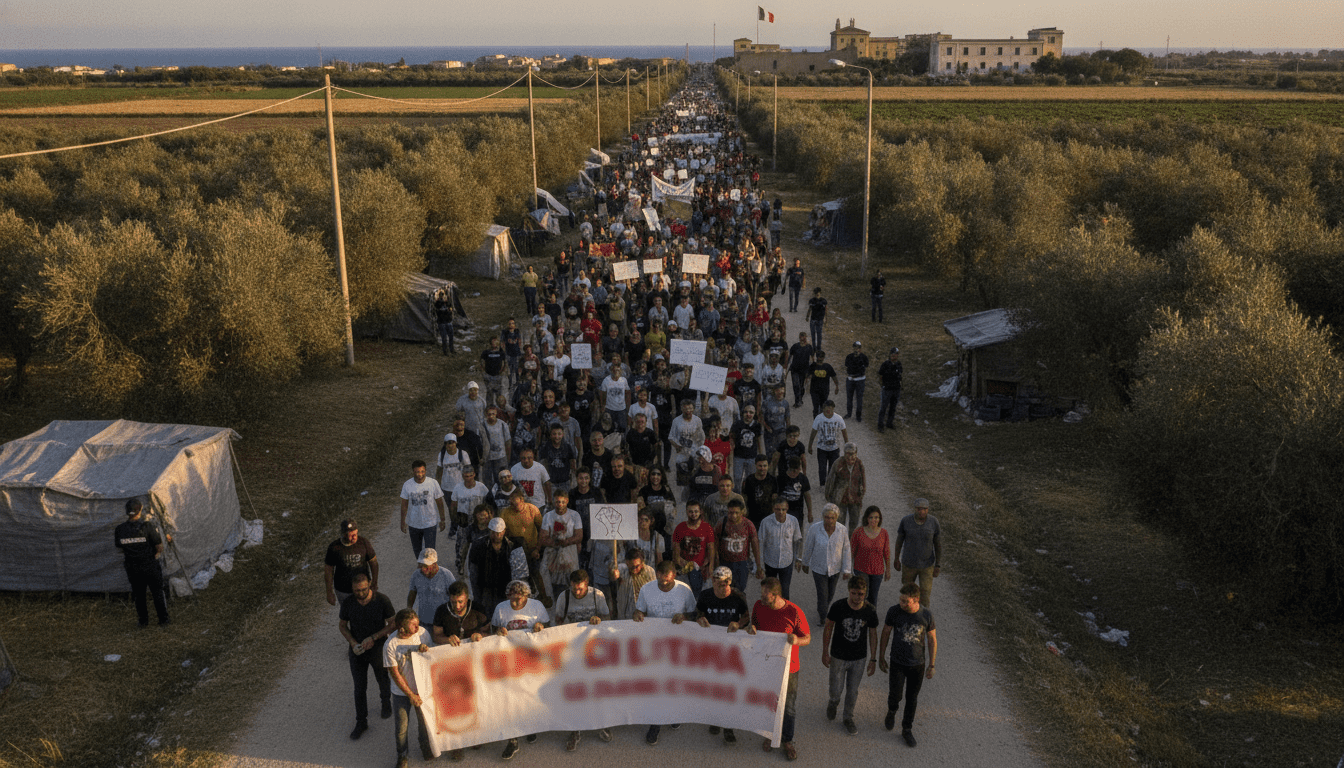
The killings provoked immediate political statements and street action. Prime Minister Giorgia Meloni expressed shock and demanded a full investigation, reiterating promises to confront violence and barbarity. Opposition figures and union leaders led demonstrations in Amendolara days after the incident, calling for stronger enforcement, seizure powers for businesses implicated in exploitation, and structural reforms to protect seasonal workers. Demonstrators and advocates urged concrete measures beyond expressions of sorrow, pointing to existing laws—such as the 2016 statute criminalising Caporalato—that they say are insufficiently enforced.
A broader network of civil-society groups and trade unions has renewed calls for systematic inspections, improved housing and transport regulation, and legal channels that allow migrant workers to secure wages directly from employers. They are also pressing for penalties that reach agribusinesses and supply-chain actors who benefit from illicit labour practices.
The Amendolara atrocity has reopened debates over how Italy polices rural labour markets and the extent to which organised crime and economic pressures enable modern slavery. As investigations proceed, relatives of the victims and campaigners will be watching for swift prosecutions, clear accountability and policy changes to ensure similar violence does not recur.
