
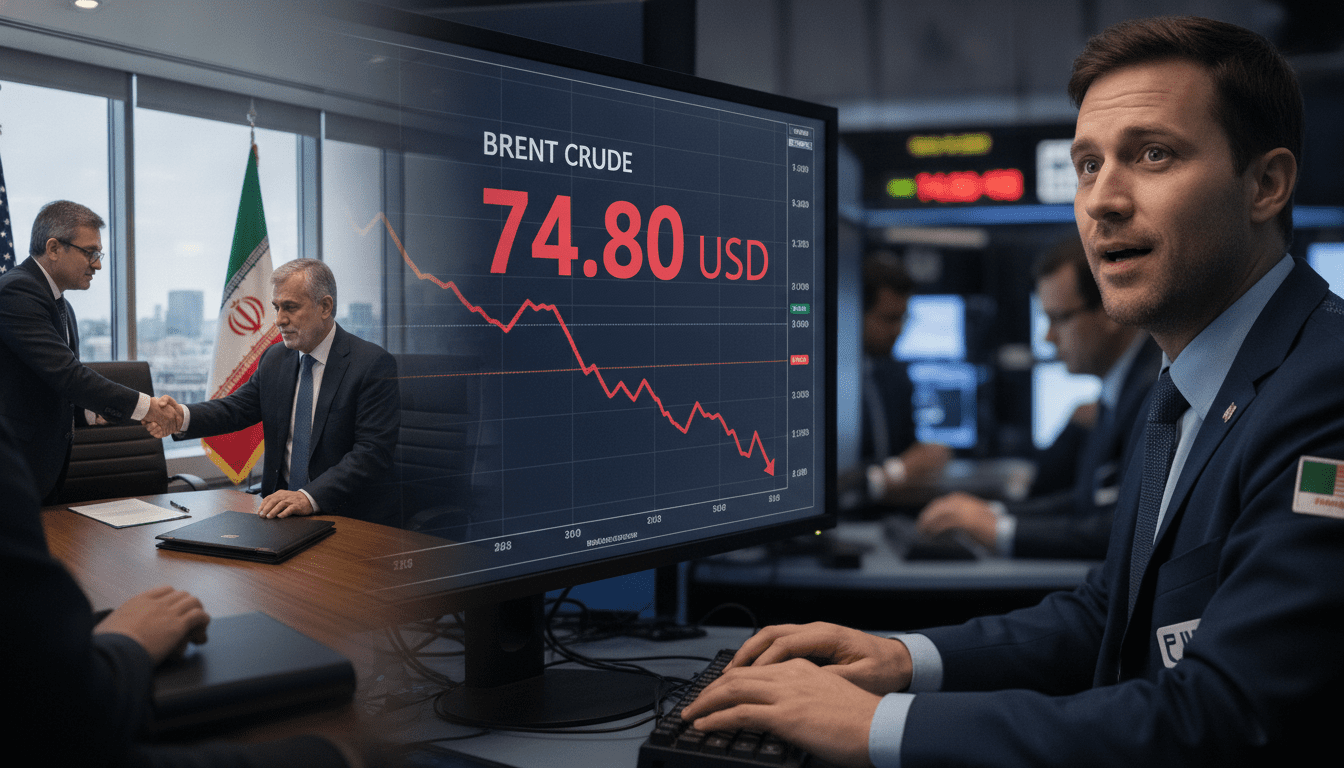
Brent crude falls below $75 as US–Iran talks ease geopolitical risk
Brent crude dipped under $75 a barrel on Tuesday, marking the first time the global benchmark has traded below that level since Feb. 27. The move — Brent was quoted at $74.80 per barrel at 12:34 GMT by Bloomberg — comes amid renewed market optimism driven by progress in negotiations between Washington and Tehran, Reuters reported.
Brent crude falls below $75 for the first time since Feb. 27
Brent’s slide to $74.80 represents a notable retreat from the risk-premium levels that had supported prices in the wake of heightened geopolitical tensions. Markets had previously priced in a premium amid the US–Israeli war on Iran, pushing Brent well above $75 through much of the intervening months.
Traders and investors took Tuesday’s levels as a signal that at least some of the geopolitical uncertainty is being reassessed. The drop to under $75 is the clearest market confirmation that diplomatic developments have had an immediate effect on oil valuations.
Markets react to progress in US–Iran negotiations
Reports of progress in talks between the United States and Iran prompted a reassessment of supply disruption risk, with investors reducing positions that had been hedging for a severe escalation. Commentators said the perceived easing of tensions removed a portion of the premium previously attached to crude.
The sense that direct confrontation might be avoided has loosened the tail risk that had underpinned oil prices since late February. While negotiations remain fragile, markets are pricing the reduced likelihood of near-term physical disruption into futures contracts.
Trading snapshot and source attribution
Bloomberg’s intraday quote of $74.80 at 12:34 GMT was cited by market participants as the benchmark level that confirmed the fall below $75. Reuters noted that the last time Brent traded under that threshold was Feb. 27, the day before the outbreak of the wider conflict.
Volume patterns during the session suggested profit-taking and short-covering rather than a sustained long-term sell-off. Traders said the combination of headline-driven flows and repositioning ahead of macroeconomic data influenced intraday volatility.
Analysts point to a waning geopolitical premium
Energy analysts said the most immediate driver of the move was a contraction of the geopolitical risk premium that had supported higher crude prices. The premium is highly sensitive to headlines, and any credible signs of de-escalation have historically triggered rapid retracement.
Several commodity strategists highlighted that sentiment shifts can be swift and that prices could rebound if talks falter or if new incidents raise concerns about supply. For now, however, the recalibration of risk appears to be the dominant influence on price discovery.
Supply, demand and other market fundamentals
Beyond geopolitics, traders noted other factors that tempered oil prices, including seasonal demand patterns in major consuming regions and ample crude inventories in several markets. Refinery maintenance schedules and shipping flows also contributed to the broader supply picture.
At the same time, demand-side uncertainties — ranging from economic growth signals to fuel consumption trends — remain relevant to medium-term price direction. Market participants cautioned that fundamentals and headline risk will continue to interact and drive price swings.
Wider implications for consumers, companies and exporters
A sustained period of lower Brent prices can alleviate cost pressures for refiners and consumers, potentially translating to softer retail fuel prices if the trend holds. Conversely, exporters and sovereign producers that rely on high oil revenues may face renewed fiscal and balance-of-payments pressure.
Financial markets often respond to oil moves with shifts in energy-sector equities and currencies of oil-dependent economies. Investors will be watching upcoming macro releases and diplomatic developments for clues about whether current prices reflect a durable change or a temporary repricing.
The retreat of Brent crude below $75 underscores how closely oil markets remain tied to geopolitical narratives and global demand expectations, and traders say the next movements will hinge on the stability of US–Iran discussions and incoming economic data.
