
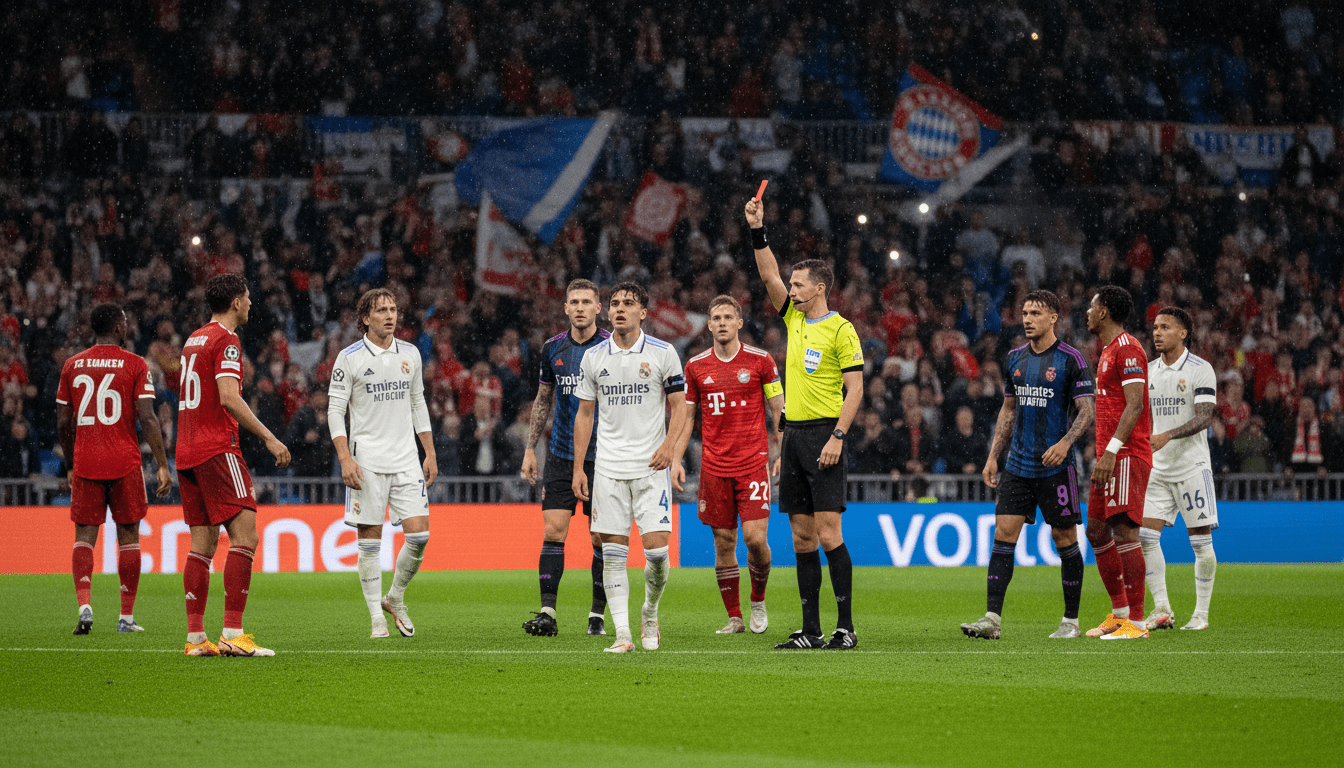
Camavinga red card hands Bayern dramatic 4-3 win in Munich
Late Eduardo Camavinga red card shifts momentum; Bayern rally to a 4-3 victory in a volatile Champions League quarterfinal, setting up a high-stakes semifinal with PSG.
The match in Munich turned on a late refereeing intervention when Eduardo Camavinga received a second yellow and then a red card for handling the ball after fouling Harry Kane, a moment that swung momentum and helped Bayern overturn the tie. The Camavinga red card came in the 86th minute and preceded a frantic finish in which Luis Díaz and Michael Olise scored decisive goals to secure a 4-3 victory at the Allianz Arena. The result capped a game of errors, individual brilliance and controversial decisions that will dominate post-match discussion.
Early miscues and quick responses
The contest began with an early error that set the tone for a chaotic evening; Manuel Neuer’s attempted pass misfired and fell to Arda Güler, who converted into an empty net. Bayern responded quickly with a set-piece routine that produced an Aleksandar Pavlović header to level the score, showing the home side’s resilience. The match oscillated between sharp attacking sequences and defensive lapses as both sides chased control.
Real Madrid struck again before halftime after a slick exchange involving Vinícius Júnior and Kylian Mbappé, restoring a lead that made the second half tense and tactical. Bayern answered through Harry Kane, whose timely finish brought the hosts back into contention and ensured the fixture remained finely poised. Each team alternated pressure and opportunities, leaving the outcome uncertain until the closing stages.
Turning point: Camavinga’s foul and subsequent sending-off
With the match entering its final minutes, Eduardo Camavinga fouled Kane — an action that initially drew only a yellow card. The decisive moment came when Camavinga then gathered the ball in his hand and took a few steps, prompting renewed protests from Bayern players and a reversal by the referee. After consultation or reconsideration, the official upgraded the sanction to a red card for the second booking and handball, reducing Real to ten men.
That intervention collapsed Madrid’s defensive structure and altered the immediate tactical balance of the game. Bayern capitalized by extending their attacking pressure, and in the numerical advantage they found the openings necessary to finish the match in dramatic fashion. The red card will be scrutinized for its timing, interpretation and impact on the tie.
Late goals reshape the narrative
In the 89th minute Luis Díaz produced a composed finish to make it 3-3, a strike he later described as possibly the most important of his career. The equaliser came in the aftermath of Real’s dismissal and reflected how quickly momentum can flip in elite knockout football. Bayern then pushed on in stoppage time and Michael Olise delivered a remarkable winner that completed the turnaround, sealing a 4-3 victory that stunned the stadium.
Those late strikes reframed the evening from a tale of defensive frailty to one of belief and clinical finishing under pressure. For Bayern, the comeback will be remembered as evidence of tactical adaptability and mental resilience. For Madrid, the defeat will prompt questions about discipline and game management in decisive moments.
Refereeing and debate to follow
The sequence that led to Camavinga’s red card has already provoked debate among players, coaches and pundits, with discussion focusing on whether the second yellow should have been issued and on the referee’s initial hesitance. Observers will analyze the prior booking for a tactical foul earlier in the match and whether the official’s later decisions were influenced by the match context or by the immediate reactions of Bayern players.
Beyond the single incident, the game raises broader questions about consistency in officiating and the role of player protests in influencing decisions. Governing bodies and referee panels may examine footage and timelines to clarify the reasoning behind the call and to guide future interpretations of similar situations.
Kompany’s perspective and squad character
Vincent Kompany, whose team produced the late comeback, framed the victory as emblematic of his squad’s mentality rather than a career-defining moment. He declined to amplify the hype surrounding the result, urging focus ahead of the next challenge and pointing to past achievements that shaped his managerial outlook. His measured response underscored a coaching philosophy grounded in collective effort rather than individual accolade.
Players echoed the coach’s sentiment while acknowledging the emotional intensity of the night; Joshua Kimmich and Manuel Neuer spoke of preparation and the need to guard against lapses ahead of the semifinal. The win reinforced a sense that Bayern, even when imperfect, can marshal belief and produce decisive moments in knockout competition.
Semifinal focus: Paris Saint-Germain looming
Bayern now turn their attention to a semifinal meeting with Paris Saint-Germain, a fixture that looms on the calendar with high expectations and dramatic potential. PSG’s blend of attacking talent and tactical cohesion will present a distinct challenge, and Bayern have signalled awareness of the quality they will face. Comments from Bayern players referenced PSG’s form and individual threats that will demand focused preparation.
The result in Munich gives Bayern momentum but also serves as a reminder of the fine margins in European competition. As both teams progress, attention will shift to strategy, squad fitness and how coaches adapt plans to counter elite opponents.
The match will be discussed for days as fans, analysts and officials unpack the Camavinga red card, the late goals and the broader tactical narratives that defined a memorable Champions League night.
