
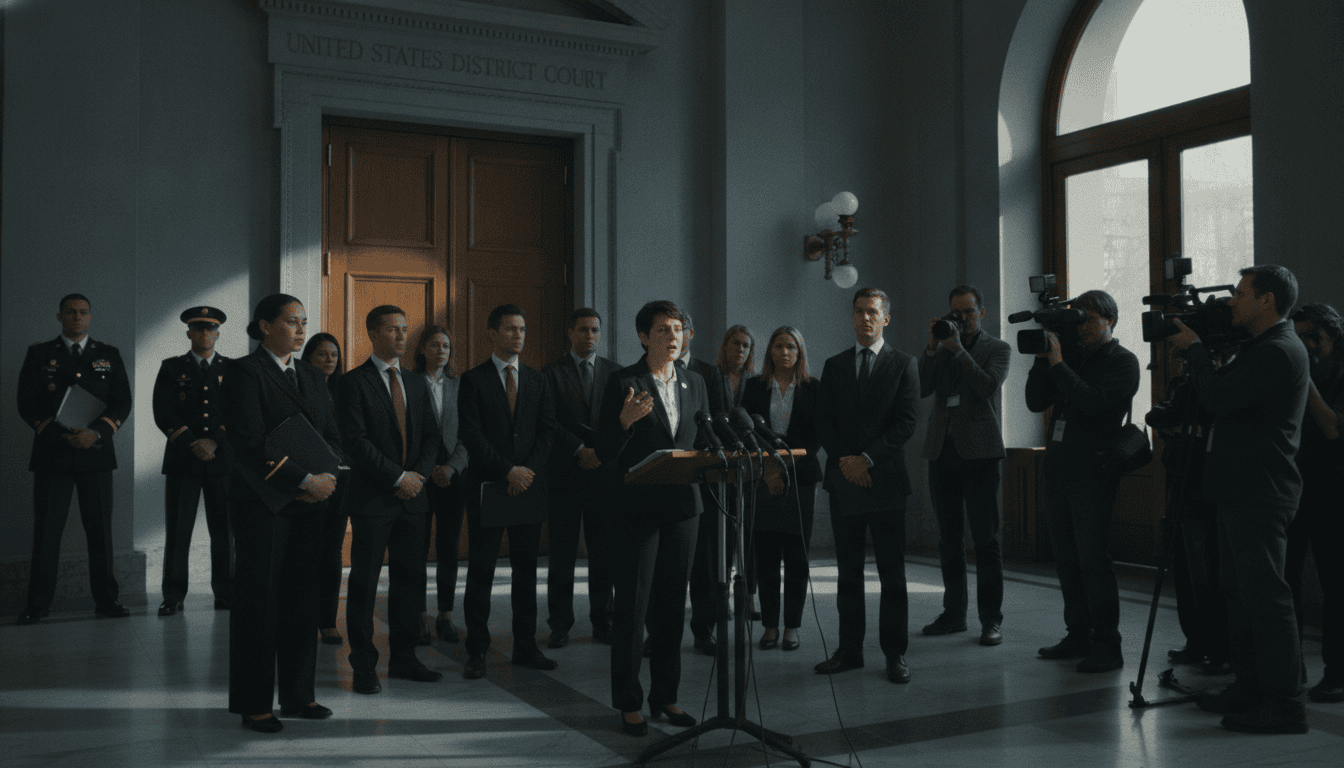
Judge: Government Hasn’t Shown Anthropic Is a Supply Chain Risk, Questions Pentagon Ban
Judge Rita Lin said the U.S. government has not presented sufficient evidence to prove Anthropic poses a supply chain risk, raising doubts about the Pentagon’s ban and weighing a permanent injunction.
At a federal hearing on July 30, 2026, U.S. District Judge Rita Lin said the government had failed to provide evidence that Anthropic could disable or otherwise tamper with delivered AI models, undermining its justification for declaring the company a supply chain risk and barring federal use. Anthropic is challenging the Department of Defense designation in one of two lawsuits filed earlier this year, and Lin must now decide whether to convert a temporary block into a permanent injunction. The judge also signaled concern about government action that could penalize a contractor for public criticism, a point that figured in the litigation.
Judge questions government’s evidence on model tampering
Judge Lin told the courtroom she found no demonstrable proof that Anthropic could “flip some kind of kill switch” or materially alter a model after delivery. The government had argued the potential for remote disabling or modification justified the supply chain designation. Lin rejected that chain of logic as unsupported by the record presented at Thursday’s hearing.
Her skepticism extended to the broader framing of risk, with the judge noting that speculative concerns about capabilities do not equate to the documented vulnerabilities normally required to justify a national security ban. That gap in proof is central to the court’s assessment of whether the Department of Defense acted within its authority in imposing the restriction.
Dispute traces back to stalled DoD contract talks
The underlying conflict arose from protracted negotiations between Anthropic and the Department of Defense over a potential procurement deal. Anthropic set explicit “red lines” on how its models could be used, saying it would not permit deployment for mass domestic surveillance or for automated targeting and firing decisions in lethal weapon systems. Those limitations stalled talks and prompted escalating friction between the company and the military.
The Pentagon responded that private providers cannot unilaterally constrain how the military uses technologies procured for national defense, and it defended its right to rely on vetted commercial tools. The legal fight has therefore merged technical questions about model control with policy disputes over contract terms and operational use.
Court flags potential retaliation for contractor speech
During the hearing, Judge Lin described the government’s reliance on Anthropic’s public criticism of the Department of Defense as “really troubling,” raising constitutional and procurement law concerns. The government had pointed to the company’s public statements as one rationale for the ban, a posture the judge warned could create a precedent where agencies retaliate against contractors for dissenting commentary.
Legal observers say such a precedent could chill speech by private vendors engaged with the government, with downstream effects on transparency and debate about the ethical use of advanced artificial intelligence. The court’s treatment of that argument will inform how agencies balance security evaluations with First Amendment and procurement protections.
National security claims face scrutiny from experts and court
The Department of Defense argued that Anthropic’s design choices and public positions made it an unacceptable risk to military operations. Officials suggested that a contractor might intentionally degrade performance, with consequences in high-stakes scenarios. Outside experts and the judge, however, criticized the evidentiary basis for those assertions as thin.
At Thursday’s hearing, Lin emphasized that national security concerns carry weight only when supported by demonstrable vulnerabilities or credible, specific threats. In the absence of such proof, the court signaled reluctance to defer entirely to agency judgment on matters that restrict market access and supplier participation.
Two parallel lawsuits and next legal steps
Anthropic filed two suits in March challenging the Department of Defense designation; this hearing concerns the case overseen by Judge Lin, while a separate action is pending in Washington, D.C. Lin had issued a temporary block on the ban in March and is now considering whether to make that relief permanent based on the current record. Both sides are expected to brief the court further, and a final ruling could hinge on whether the government supplements its evidence.
A permanent injunction would restore Anthropic’s eligibility to compete for certain federal contracts, while an adverse ruling would uphold the Pentagon’s authority to bar the company under its supply chain risk framework. The outcome will likely shape procurement practice and how defense agencies assess commercial AI vendors going forward.
Implications for AI procurement and military use
The dispute underscores a broader tension between operational imperatives and companies’ ethical guardrails for AI. If courts limit agency power to exclude suppliers without clear evidence, defense procurement processes may need to develop more precise technical standards and oversight mechanisms. Conversely, agencies seeking to protect sensitive systems may press for broader discretionary authority to manage supplier risk.
Both industry participants and policymakers will be watching how this case defines acceptable proof of supply chain risk and the extent to which contractors can publicly critique government plans without facing exclusion. The ruling could prompt revisions to vendor agreements, stronger audit and verification protocols, and renewed debate over the role of commercial firms in national defense technology stacks.
The court will issue further rulings after receiving additional filings; whatever the outcome, the case is likely to be cited in future disputes where national security designations intersect with contractual speech and technological assurances.
