
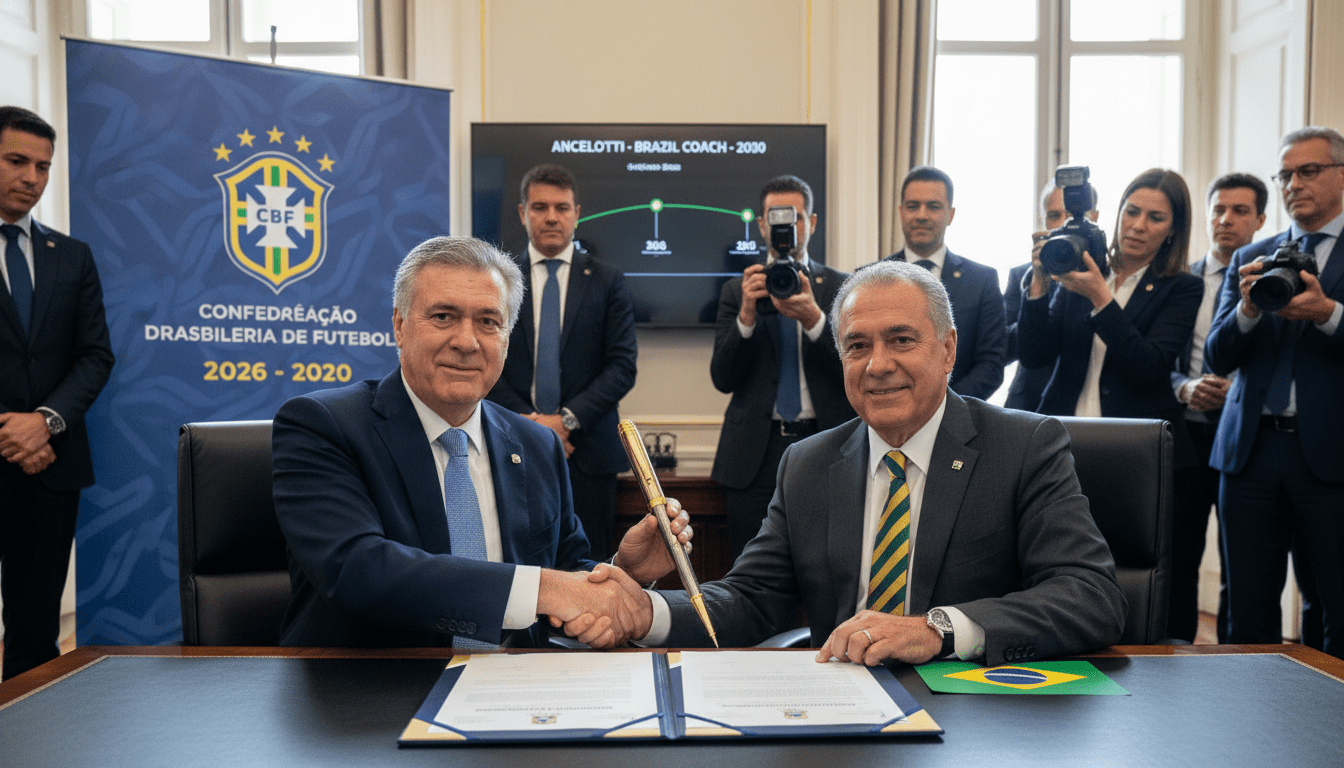
Carlo Ancelotti to Remain Brazil Coach Until 2030, CBF Confirms
Carlo Ancelotti will remain Brazil’s national team coach through 2030 after the Brazilian Football Confederation extended his contract on May 15, 2026, securing leadership for the Seleção ahead of the 2026 World Cup. The early renewal, announced less than a month before the tournament begins, signals a long-term planning approach by the CBF. The deal aims to provide continuity for Brazil’s coaching structure and strategic roadmap toward the next World Cup cycle.
CBF announces contract extension through 2030
The Brazilian Football Confederation (CBF) confirmed on May 15, 2026, that Carlo Ancelotti’s tenure as head coach has been extended to run through the year 2030. The federation framed the move as a measure to ensure planning stability across successive tournament cycles. By setting the timeline to coincide with the next World Cup cycle, the CBF has formalized a mandate for Ancelotti to oversee Brazil’s preparations and long-term squad development.
Timing of the decision and its immediate context
The extension was finalized in the run-up to the 2026 FIFA World Cup, creating certainty for the national team staff and players just before the tournament kickoff. Making a contractual commitment at this stage removes speculation about potential mid-tournament changes and allows technical staff to focus on match preparation. The timing underlines the federation’s intent to avoid short-termist decisions and to protect the coherence of the Seleção during a critical competitive window.
Continuity for squad selection and youth integration
With the contract secured through 2030, Brazil’s selection process can be mapped across multiple competitions, from continental tournaments to World Cup qualifiers and the 2030 World Cup itself. That continuity offers a clearer pathway for integrating younger players into the senior squad and for refining player roles over time. Ancelotti will be charged with balancing immediate tournament demands against the long-range goal of building a cohesive unit for future competitions.
Tactical profile and expectations under Ancelotti
Carlo Ancelotti’s appointment brings a reputation for tactical adaptability and experience managing elite players at club level, a profile the CBF appears to value for international competition. Observers expect a pragmatic approach that blends structured defensive organization with flexible attacking options tailored to opponent and personnel. The extension gives Ancelotti the latitude to implement systems and training processes that require time to mature, rather than demanding instant tactical revolution.
Club relations and player availability considerations
The long-term agreement raises questions about coordination between national team schedules and clubs that employ Brazil’s top players. Sustained cooperation with European and domestic clubs will be essential to manage workload and to secure the best possible availability of players for friendlies, qualifiers, and tournaments. The CBF and Ancelotti’s staff will likely prioritize communication with club managers and medical teams to reduce conflicts over minutes, rest and injury prevention across seasons.
Roadmap toward the 2030 World Cup cycle
Extending the coaching mandate to 2030 frames the 2026 World Cup as part of a broader preparatory arc rather than an endpoint in itself. The CBF can now outline a multi-year calendar that includes player scouting, tactical trials, and targeted friendlies aimed at testing formations and personnel. For Brazil, the decision positions the Seleção to pursue a coherent strategy designed to peak at major tournaments throughout the second half of the decade.
The CBF’s early commitment to Carlo Ancelotti delivers managerial certainty for the Seleção at a pivotal moment and sets the stage for sustained planning through the 2030 World Cup cycle. The federation and coaching staff will now face the task of translating that stability into on-field results while managing the complex dynamics between national ambitions and club commitments.
