
AfD in Mecklenburg-Vorpommern Unveils 100-Day Plan as Leaders Eye ‘Alleinregierung’
AfD in Mecklenburg-Vorpommern has released a preliminary 100-day government programme as party leaders Leif-Erik Holm and Enrico Schult position themselves ahead of the state election on 20 September. The plan, presented at a Schwerin press conference, sets out measures the party says it would implement immediately if it secures sole control of the state government. Despite leading recent polls, the party faces internal tensions and local election setbacks that cloud its path to an outright majority.
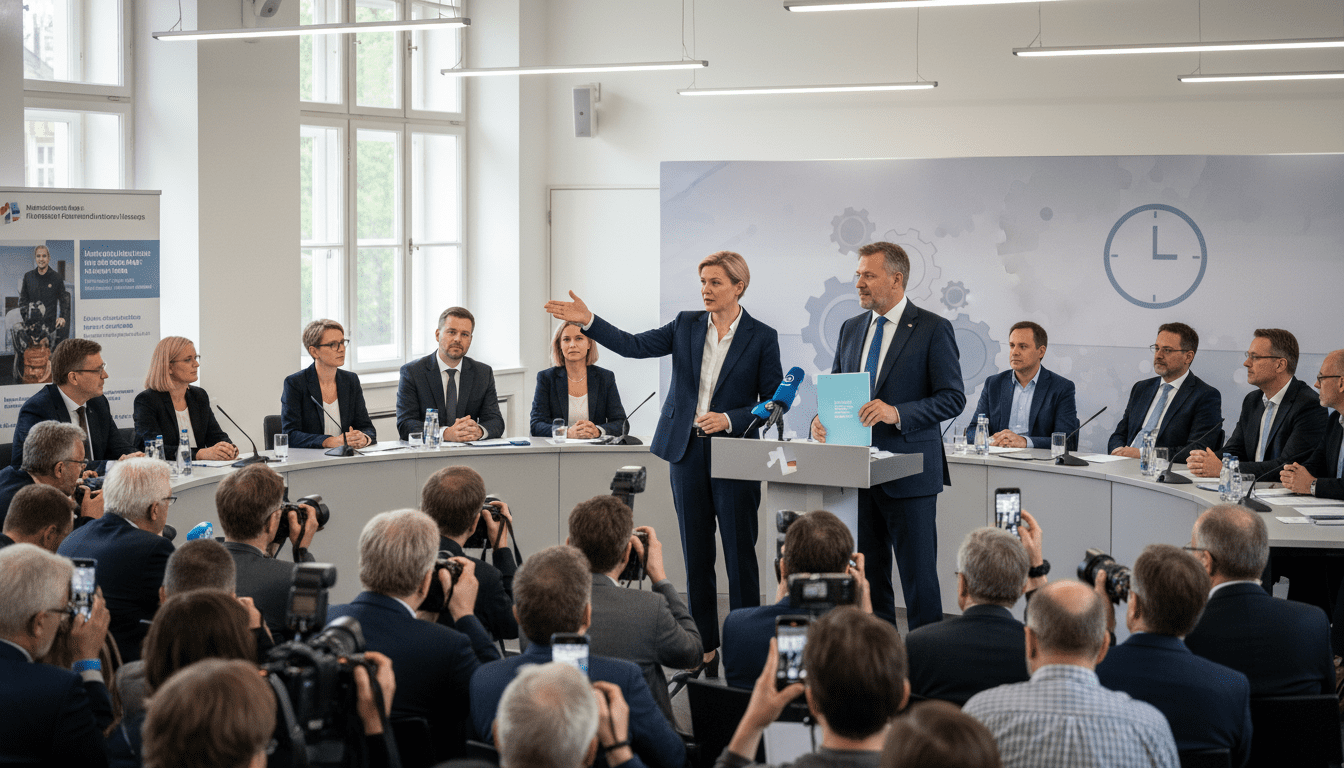
AfD’s 100-day programme presented in Schwerin
The party leadership laid out a list of administrative and policy changes framed as immediate priorities for a first 100 days in office. Officials described measures spanning administration, public safety, energy and media policy, while noting that the full programme will be finalised at a state party conference on 30 May. Many proposals were presented as intentions rather than detailed legislative plans, with party spokespeople repeatedly qualifying points pending legal review.
The presentation was businesslike but marked by caution, with terms such as "could" and "would" used frequently. Party chief Leif-Erik Holm and co-leader Enrico Schult stood side by side but offered alternating emphases, signaling both unity for the presentation and unresolved personal and strategic differences behind the scenes.
Local election results dent confidence
Recent mayoral contests in Schwerin, Anklam and Ueckermünde produced results that fell short of AfD expectations, prompting questions inside the party about momentum. In Schwerin the AfD candidate did not advance from the first round, and losses in traditionally strong towns offered a sobering reminder that local contests do not automatically translate into statewide success. Holm acknowledged disappointment at the outcome and stressed that municipal ballots are often decided on individual candidacies rather than party platforms.
The losses narrowed the space for confident assertions of inevitable victory and have prompted internal reassessment of campaign tactics. Party strategists now appear to be balancing headline-grabbing programmatic promises with a recognition that voter preferences across municipalities remain fragmented.
Leadership dynamics: Holm versus Schult
The public appearance in Schwerin underscored an uneasy power-sharing arrangement between Holm and Schult. Both present themselves as potential chief executive figures for the state while also navigating the party’s internal rules for candidate selection. Holm is contesting the direct candidacy for minister-president without the safety net of a secured top list position, a move that would hand the initiative to Schult should Holm fail to win a direct mandate.
Schult, who has positioned himself as a pragmatic, locally rooted politician, occupies the top spot on the partylist and would be the default frontrunner for state leadership in such a scenario. The arrangement reflects a compromise intended to contain rivalry but leaves open scenarios that could produce leadership change after the vote.
Policy priorities: energy, policing and administration
Energy policy is among the most conspicuous items in the draft agenda. Party officials signalled support for renewed flows of Russian gas via the Nord Stream pipelines and announced intentions to pursue a federal-level push to halt wind-power expansion in the state. These positions seek to appeal to voters in economically fragile regions where energy and industrial job security are prominent concerns.
On public safety, proposals include equipping police with tasers and creating separate statistical categories for what the party calls "migrant-related crime." Administrative measures outlined include halting gender-neutral language in official communications and restricting mobile-phone use in schools, along with a proposal to display the German flag on school grounds. Critics say many suggestions raise legal and constitutional questions that would require significant legislative work.
Media policy and public broadcasting overhaul
A high-profile element of the plan targets public broadcasting finance and governance. The party pledged to terminate what it described as the mandatory broadcasting contribution and to replace the current framework with a regional broadcaster funded under a new scheme. Party leaders acknowledged the costs involved and offered no concrete financing model, saying only that replacement arrangements could not be free.
Holm and Schult also criticised national media coverage as biased against their party and announced an intention to push for a parliamentary inquiry into pandemic policies, arguing the topic has received insufficient scrutiny. The media proposals are likely to attract scrutiny from legal experts and civil society groups over media independence and funding.
Electoral calculus and the road to 20 September
The AfD’s stated goal remains an exclusive governing mandate—an "Alleinregierung"—for the state government, but the electoral maths and political realities are uncertain. Poll leads can prove ephemeral, and the party’s ability to convert regional polling advantages into a legislative majority will depend on turnout patterns and the performance of mainstream competitors. Internal rivalries and public setbacks in local races complicate a straightforward path to single-party control.
Party organisers have scheduled the formal adoption of the programme for the 30 May state conference, which will serve as a test of cohesion and discipline ahead of the 20 September vote. Observers note that the vagueness of several proposals may be tactical, allowing the party to refine positions in response to legal advice and public reaction as the campaign progresses.
With the state campaign entering its next phase, the AfD in Mecklenburg-Vorpommern faces the dual task of consolidating its internal leadership arrangements and translating a headline-driven 100-day agenda into detailed, legally viable proposals that can persuade a broader electorate. The coming months will test whether its current polling advantage can withstand local setbacks and the scrutiny that will follow each proposed shift in policy.
