
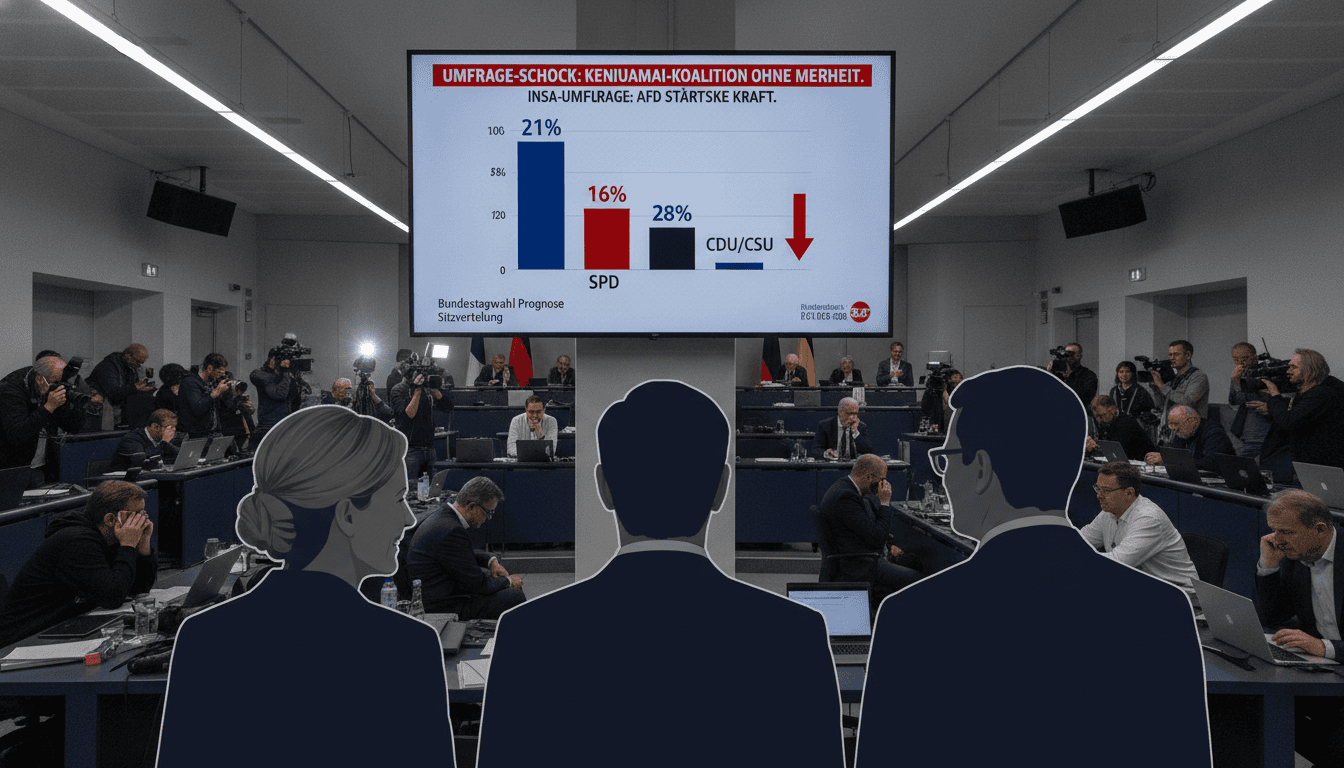
Forschungsgruppe Wahlen Poll: AfD Leads as Black‑Red Coalition Would Lose Bundestag Majority
New Forschungsgruppe Wahlen poll finds AfD in first place and shows the CDU–SPD black‑red coalition would lack a parliamentary majority if a federal election were held on Sunday.
Opening summary
If the federal election were held on Sunday, a fresh Forschungsgruppe Wahlen poll shows the Alternative for Germany (AfD) in the lead and the incumbent CDU–SPD black‑red coalition without a clear parliamentary majority. The survey also finds that the AfD’s national leader records the lowest approval figures among leading politicians. The result marks a notable shift in the electoral landscape and raises immediate questions about coalition arithmetic and government stability.
Poll snapshot — AfD leads while coalition lacks majority
The Forschungsgruppe Wahlen poll places the AfD ahead of other parties in voter intention, reversing the usual dynamics that have favored centrist groupings. Survey respondents indicated shifting preferences that, in combination, leave the traditional black‑red alliance short of the seats needed for a majority in the Bundestag. Polling institutes caution that preferences can change ahead of an actual election, but the snapshot underscores growing volatility in voter sentiment.
Leader ratings — AfD chair records weakest approval
Alongside party support levels, the survey assessed approval ratings for party leaders and top politicians. The AfD chair received the lowest score among the surveyed figures, even as the party’s vote intentions remained comparatively strong. Analysts note this divergence between party popularity and leader approval is unusual and could complicate coalition negotiations if the AfD’s position solidifies.
Parliamentary arithmetic — majority pathways become narrow
With the black‑red coalition failing to secure a majority in the poll, the Bundestag’s arithmetic becomes more complex. Traditional formations may need to consider broader cooperative arrangements or minority government options, while smaller parties could assume kingmaker roles. The absence of a clear majority increases the likelihood of protracted negotiations or new alliances that cross historic partisan boundaries.
Party responses — CDU, SPD and AfD react
Representatives from the CDU and SPD responded to early media reports by stressing the need to reconnect with voters and to address policy concerns that emerged during the survey period. The AfD framed the results as validation of its message, while acknowledging internal debates over leadership and strategy following the low approval rating of its chair. Political strategists say party responses in the coming weeks will be closely watched for signs of tactical shifts.
Regional and demographic patterns noted in results
The poll indicated variation in support across regions and demographic groups, with the AfD performing particularly strongly in certain areas and among specific voter cohorts. Urban‑rural divides and generational differences were evident, reflecting broader social and economic cleavages. These patterns suggest that campaign strategies focused on targeted issues may be decisive if the campaign season intensifies.
Implications for policy and parliamentary work
A fragmented Bundestag would complicate legislative planning and could affect the government’s ability to advance major policy initiatives. Lawmakers may need to pursue narrower, consensus‑based measures or rely on ad hoc alliances to pass legislation. The uncertainty signaled by the poll may also influence markets, public administration planning, and international partners monitoring Germany’s political trajectory.
Both immediate political tactics and longer‑term strategy will be shaped by how parties interpret the poll and adjust outreach, messaging and candidate selection. If the trends persist, they could prompt accelerated coalition scouting and more visible negotiation preparations across party lines.
The Forschungsgruppe Wahlen findings underline the fluidity of voter preferences and the challenges facing Germany’s established parties as they weigh next steps ahead of a potential national vote.
