
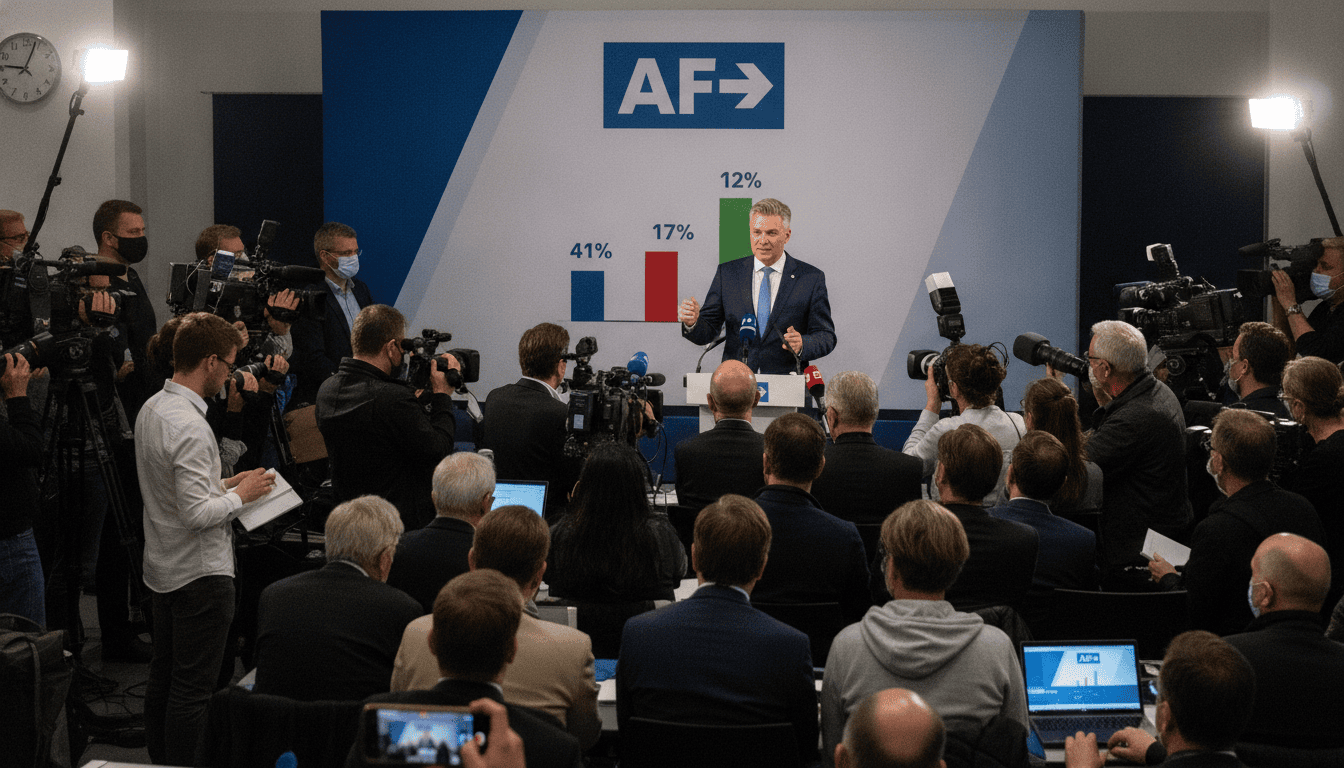
AfD Holds 41% Lead as Saxony-Anhalt State Election Nears; SPD and Greens Make Gains
AfD at 41% in an Infratest dimap poll ahead of the Saxony-Anhalt state election on September 6; SPD and Greens rise, significantly changing coalition arithmetic.
The AfD remains the clear front-runner in the run-up to the Saxony-Anhalt state election, polling at 41 percent in the latest Infratest dimap survey. The CDU trails well behind at 24 percent, leaving little prospect of a late reversal at the top of the race. Recent gains by the SPD and the Greens, however, are reshaping the composition of the Landtag and the likely coalition arithmetic after September 6.
AfD maintains commanding lead at 41% in poll
The new Infratest dimap figures show the AfD holding steady at 41 percent, a level the party has occupied for several months. That margin places the AfD well ahead of the CDU, which stands at 24 percent in the same survey. Polling analysts say such a gap is large enough that a single-party turnaround becomes increasingly unlikely as election day approaches.
SPD and Greens register modest recoveries
The SPD rose from five to seven percent in the latest poll, while the Greens improved from four to five percent, according to the Infratest dimap results cited in calculations published by ZEIT. Those gains, though small in absolute terms, could prove politically significant if they allow both parties to clear the electoral threshold needed to enter the Landtag. If both succeed, parliamentary arithmetic will become more complex and reduce the likelihood that the AfD could govern alone.
Coalition math becomes less certain for single-party majority
A comfortable single-party majority for the AfD now appears unlikely despite its lead, because smaller parties gaining representation changes seat distributions in the Landtag. Analysts point out that even with 41 percent of the vote, the AfD would not automatically secure the majority of seats necessary for unilateral governance if other parties consolidate their share. The improved prospects for SPD and Greens representation increase the options for opposition blocs and reduce the feasibility of a one-party administration in Magdeburg.
Poll details: Infratest dimap and ZEIT calculations
The headline numbers are drawn from an Infratest dimap survey summarized and interpreted using seat-projection calculations made available by ZEIT. The poll captures voter intention at a moment when party support has been relatively stable at the top, but shifting among smaller lists. While national trends influence some responses, regional issues and local campaigning in Saxony-Anhalt retain an outsized impact on voter choice, the survey’s authors note.
Party reactions and campaign implications
Party leaders are framing the numbers in line with their campaign narratives: the AfD emphasizes its lead as proof of momentum, the CDU warns against complacency, and smaller parties highlight incremental improvements as validation of their messages. For the SPD and the Greens, entry into the Landtag would be a tangible victory and provide a platform to influence policy debates in the state. Campaign strategists say the late-stage focus will likely turn to turnout, local mobilization, and whether smaller lists can convert rising percentages into actual seats.
Practical effects for governance in Magdeburg
If both the SPD and the Greens cross the threshold and take seats in the Landtag, the resulting parliamentary geometry will make single-party rule by the AfD difficult to achieve. That scenario would leave coalition-building and cross-party negotiations central to the formation of any state government after September 6. Observers expect renewed attention on potential partnerships and how centrist and left-leaning groups might coordinate their votes to influence legislation and administration in the coming legislative period.
The election remains more than a snapshot of current support; it is a test of whether incremental gains by smaller parties can translate into tangible influence inside the Landtag. Campaign dynamics, turnout patterns and regional issues in the weeks ahead will determine whether the modest recovery for SPD and Greens persists and how that ultimately shapes government options in Saxony-Anhalt.
