
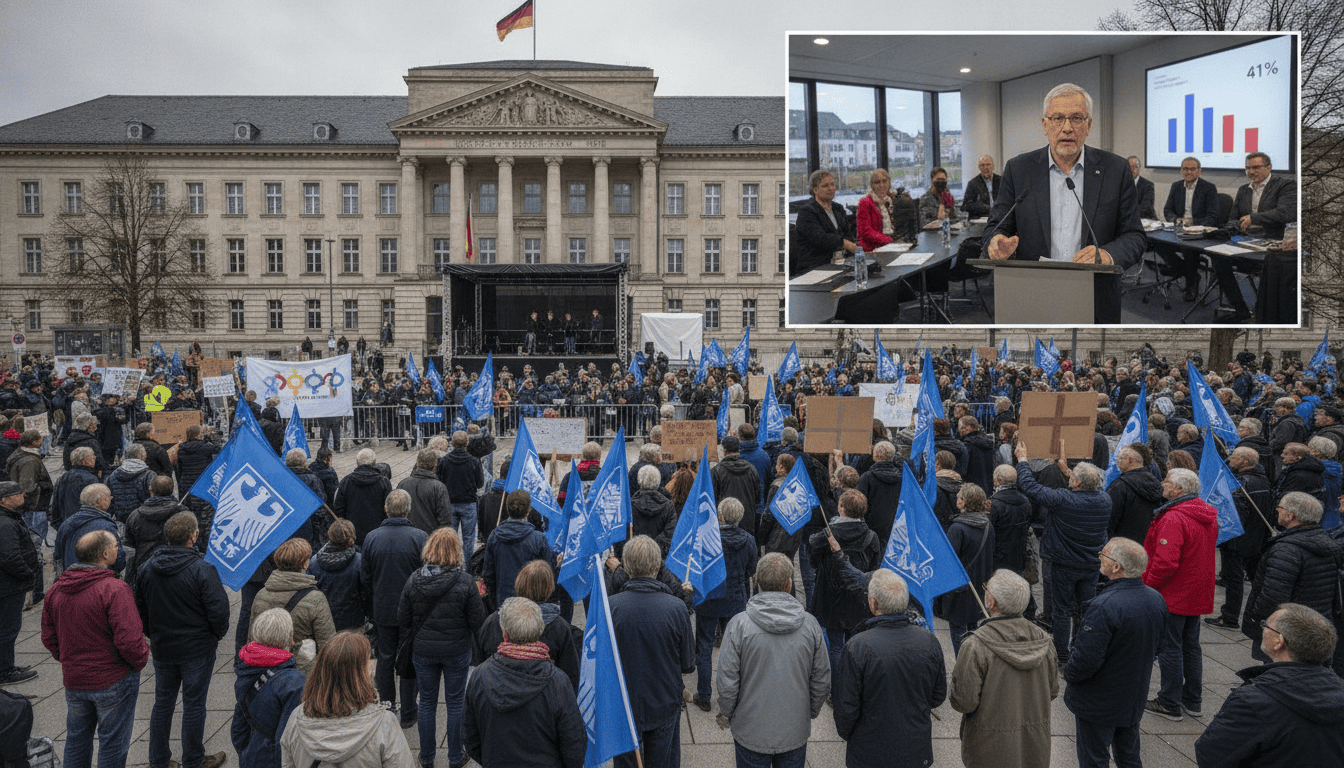
AfD in Sachsen-Anhalt Polls Leads at 41% Five Weeks Before State Election
AfD leads Sachsen-Anhalt polls at 41% five weeks before the state election, while Greens near 5% and experts warn of parallels with US politics and concerns.
The AfD in Sachsen-Anhalt is running well ahead in the latest Infratest dimap survey, polling at 41 percent just five weeks before the state election. The poll results place the party comfortably ahead of the CDU, Linke and SPD, while the Greens hover near the five-percent threshold needed to re-enter the Landtag. Political analysts say the numbers raise immediate questions about coalition arithmetic and the shape of campaigning in the coming weeks.
AfD Tops Infratest dimap Trend
The Infratest dimap release shows the AfD with a commanding lead at 41 percent in the current Sachsen-Anhalt trend. This figure reflects voting intentions measured by one of Germany’s established polling institutes and underscores the party’s consolidated support in the state. Parties that previously occupied the center and left are trailing well behind, increasing pressure on their campaigns to mobilize undecided voters.
Greens Close to Re-Entry Threshold
According to the same survey, the Greens sit just below or around the five-percent barrier that determines entry to the state parliament. If the Greens cross that threshold, their presence would alter potential coalition math and reduce the likelihood of an AfD single-party administration. Analysts caution that a small shift in Green support could substantially change the post-election options available to other parties.
Implications for Government Formation
At 41 percent, the AfD still falls short of an outright majority, but its lead gives it a strong bargaining position in any post-election negotiations. The composition of the remainder of the Landtag—whether smaller parties clear thresholds and how the CDU, SPD and Linke perform—will determine whether a broad coalition can exclude the AfD. Political strategists note that fragmented results among mainstream parties would complicate efforts to form a stable government without involving the AfD.
Experts Draw Parallels with US Political Shifts
Commentators and scholars are drawing comparisons between the current German dynamics and developments in the United States under former President Donald Trump. Reinhard Krumm, head of the Friedrich-Ebert-Stiftung’s Washington office, has warned that some US political trends have served as a laboratory for right-wing strategies abroad. He told listeners of a German news podcast that American examples show how political actors in government can rapidly reshape institutions and norms once in power.
Warnings on Policy Consequences and Institutional Change
Krumm and other observers point to concrete policy lessons from the US, including the impact of sweeping administrative cuts and reshuffles that left critical positions understaffed. They argue that promises to simplify or reduce bureaucracy can have unpredictable operational consequences when implemented without institutional safeguards. Experts also express concern about political efforts to redefine national identity and civic values, noting that such projects can erode pluralistic norms over time.
Campaign Events Intensify Scrutiny
The campaign in Saxony-Anhalt has seen heated encounters among leading candidates, including a recent televised duel in Magdeburg that drew significant attention. Observers say such debates and the AfD’s published program are shaping voter perceptions on competence and priorities in the final weeks before the vote. Mainstream parties are adapting their messages to respond both to the AfD’s policy proposals and to voter unease flagged in the polls.
Broadly, the poll places renewed emphasis on turnout dynamics and tactical voting as decisive factors in the weeks ahead. Parties below or near the threshold face intense pressure to consolidate support and to persuade undecided voters of the stakes in the election.
The coming five weeks will test whether the AfD’s lead represents a stable shift in voter alignment or a mobilization moment for opponents that narrows the gap before election day.
