
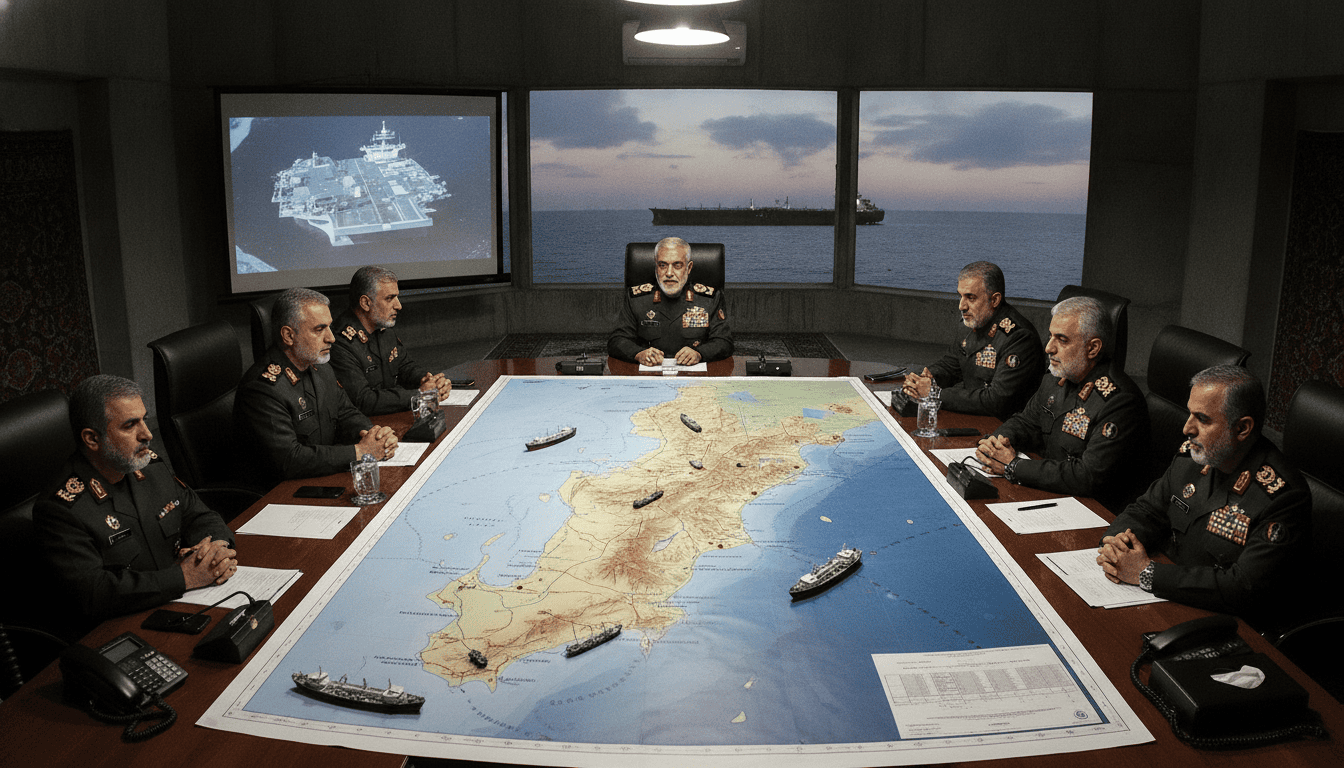
Iran’s shadow army tightens grip as Revolutionary Guards consolidate power
Iran’s shadow army tightens its grip as the Revolutionary Guards consolidate control, leveraging Hormuz, proxy networks and economic links amid US and Israeli strikes.
The Iranian regime shows little sign of retreat as air campaigns by the United States and Israel have failed to fracture its authority, according to analysts and sources close to Tehran. Iran’s shadow army — a web of militias, proxies and economic interests aligned with the Islamic Revolutionary Guard Corps (IRGC) — has in recent months solidified its role as the central instrument of Tehran’s regional strategy. Observers say the IRGC has used the conflict to deepen its political, military and commercial control inside Iran while maintaining influence across Lebanon, Iraq, Yemen and the Palestinian territories.
Revolutionary Guards consolidate domestic power
The Revolutionary Guards have moved decisively to tighten their hold on Iran’s state apparatus and economy, several analysts report.
Over years the IRGC expanded into banking, industry and religious foundations, and the current confrontation has accelerated that process, strengthening commanders who favor a hardline approach. Sources with contacts in Tehran say state institutions remain intact: civil servants continue to be paid and there have been no widely reported mass defections from the core bureaucracy.
Hormuz leverage becomes strategic centerpiece
Control of the Strait of Hormuz has emerged as one of Tehran’s most potent leverage points in the confrontation with the United States and its partners.
IRGC leaders and advisers have framed the strait as a strategic equalizer to conventional military inferiority, arguing that disruption of global oil shipments can inflict economic pain on adversaries. That calculation has encouraged Tehran to treat maritime chokepoints as tools for coercion, with officials portraying them as more consequential than a solely military arsenal.
Hizbullah weakened but politically tethered to Tehran
The Lebanese Hizbullah has been considerably degraded by Israeli strikes, yet remains a politically significant instrument for Iran.
Israeli operations after the 2024 escalation eliminated swathes of Hizbullah’s leadership and much of its long-range missile capacity, analysts say. Despite those losses, Tehran has publicly defended Hizbullah and sought to preserve the group as a regional asset, even as some Lebanese commanders express frustration at being drawn into operations that primarily serve Iranian strategic aims.
Huthi capabilities raise maritime and economic alarms
The Huthi movement in Yemen, trained and supplied over years with Iranian assistance, now plays an outsized role in Tehran’s maritime strategy.
Security experts note the group’s growing drone and missile capabilities and its ability to threaten the Bab al-Mandab and Red Sea shipping routes. Those capabilities have allowed the Huthis to mount blockades and attacks on commercial vessels, signaling a capacity to impose prolonged disruption on global trade and energy markets without direct attribution to Tehran.
Militias act more autonomously while ties to Tehran persist
While Iran founded and curated much of the regional patchwork of militias, many of those actors increasingly pursue local agendas that do not always align perfectly with Tehran’s objectives.
Observers compare the relationship to a messaging group where Iran sets broad parameters, but participants communicate independently and pursue national priorities. In Iraq, Lebanon and elsewhere, proxy leaders balance loyalty to Iran with domestic political calculations, sometimes resisting orders that would invite severe retaliation.
Iraq provides economic lifeline and political reach
Iraq remains a crucial component of Iran’s regional footprint, offering both political influence and economic channels that sustain Tehran’s networks.
Iran-aligned groups have embedded themselves within Iraqi institutions, controlling businesses and winning contracts that generate revenue and patronage. Those financial ties are described by analysts as central to Tehran’s capacity to underwrite proxies and maintain influence across the Shia crescent.
The unfolding dynamic leaves Tehran with a multifaceted instrument of power: a domestic security apparatus that has tightened its grip, and a regional constellation of proxies whose mixed autonomy and operational capabilities together create persistent friction with the United States, Israel and Gulf states. The IRGC’s emphasis on maritime chokepoints and long-range indirect fire, combined with economic linkages through neighboring states, gives Iran asymmetric means to exert pressure despite conventional weaknesses.
The coming months will test whether Tehran can sustain the cohesion of its shadow army while managing the competing interests of client groups and weathering continuing strikes on its infrastructure and partners. Observers caution that the network’s durability depends as much on local dynamics in Lebanon, Iraq and Yemen as on decisions made in Tehran, and that disruptions to shipping or finance could reshape strategic calculations across the region.
